

For most of the twentieth century Albania was sealed off from the world. Now the door is wide open, and what lies behind it is remarkable: a coast of pale beaches and bright blue water facing Corfu, Ottoman towns of stone and whitewash stacked up hillsides, Greek and Roman ruins half lost in woodland, and mountains in the north as wild as anywhere in Europe.
It is still a country finding its feet as a holiday destination, which is a large part of the charm. The welcome is warm, the food is fresh and generous, and the capital, Tirana, is one of the liveliest small cities in the Balkans. Go with a little patience for the roads and you will be richly rewarded.
Don't miss
The south coast and the Riviera
Where the Adriatic meets the Ionian and the water turns turquoise.
Ksamil
Beach

Photo: Pudelek (Marcin Szala), CC BY-SA 3.0 Albania's poster beach resort lies in the far south, a few miles from Saranda and within sight of Corfu. Small coves of pale sand and shingle face a scatter of tiny green islands across shallow water of a startling blue; you can swim or pedal out to the nearest. In July and August it is very busy indeed. Come in June or September for the same sea and more room.
Butrint
Landmark

Photo: Marcin Konsek, CC BY-SA 4.0 Just beyond Ksamil, on a wooded peninsula beside a lagoon, lie the ruins of a city that was Greek, then Roman, then Byzantine, then Venetian. A shady path leads past a theatre, a baptistery with a fine mosaic floor, a basilica and mighty walls, up to a castle with views over the water. Butrint is a UNESCO World Heritage Site and the most important ancient site in Albania.
Tip: Go early or late in the day: it is cooler, quieter and the light through the trees is lovely.
The Blue Eye
Nature

Photo: Pudelek (Marcin Szala), CC BY-SA 3.0 Inland from Saranda, in thick forest, a spring wells up from deep underground into a pool of intense, almost electric blue with a dark centre like the pupil of an eye. Its full depth has never been measured. A viewing platform hangs over it, and the icy river that flows away is impossibly clear. It is a popular stop on the road to Gjirokastër.
The Llogara Pass
Nature

Photo: Albinfo, CC BY-SA 4.0 The coast road south from Vlorë climbs through pine forest to a pass roughly a thousand metres above the sea, then tips over the edge. Below, the Albanian Riviera unrolls: mountainside, hairpin bends, white beaches and the Ionian stretching to Greece. It is one of the great coastal drives of the Mediterranean. Stop at the top for the view and a plate of roast lamb.
Dhërmi and the Riviera beaches
Beach

Photo: Sietske2, CC BY-SA 3.0 Below the Llogara Pass, a string of villages and beaches lines the Ionian shore. Dhërmi has a long white-pebble beach, a growing crop of beach clubs and an old village high on the hill. Further south, Himarë is a relaxed small town with a seafront promenade. The water along this coast is deep, clean and brilliantly clear. It suits beach lovers who also want mountain scenery.
The stone towns
Berat
Neighbourhood

Photo: Ivan Koev, CC BY-SA 4.0 Known as the city of a thousand windows, Berat climbs a steep hill above the River Osum in tiers of white Ottoman houses, their rows of dark windows all seeming to stare down at you. At the top is a castle that people still live inside, with Byzantine churches among the cottages. The old quarters on both banks are UNESCO-listed and wonderful at dusk.
Gjirokastër
Landmark

Photo: Pudelek, CC BY-SA 4.0 The city of stone is built entirely of grey rock, right down to the heavy slates on its roofs. Tall fortified tower houses line steep cobbled streets beneath a brooding hilltop castle, and the old bazaar at the centre sells rugs, carved stone and local cheese. Like Berat, it is a UNESCO World Heritage Site. Visit one of the restored Ottoman houses to see how grand families lived.
Krujë
Day trip

Photo: QaifarShqiptari, CC BY-SA 4.0 Perched on a mountainside north of Tirana, Krujë was the stronghold of Skanderbeg, the fifteenth-century hero who held off the Ottoman armies and is still Albania's national symbol. The castle holds a museum in his honour, and below it runs a restored bazaar street of wooden shops selling antiques, felt slippers and copperware. An easy half-day trip from the capital.
Tirana
A colourful, fast-changing capital that makes a good first or last stop.
Skanderbeg Square
Landmark

Photo: Pudelek, CC BY-SA 4.0 Tirana's vast central square is where everything meets. A statue of Skanderbeg on horseback stands at one side, with the delicate eighteenth-century Et'hem Bey Mosque and the clock tower behind it. Across the paving, the National History Museum is fronted by an enormous socialist-era mosaic. It is the best place to get your bearings and feel the city's mix of eras.
Bunk'Art
Museum
Albania's communist regime built concrete bunkers by the hundred thousand, and you still see them all over the country. The biggest, a huge underground shelter built for the leadership on the edge of Tirana, is now a museum of the dictatorship years. Its long, chilly corridors make the story hit home. A smaller sister site in the city centre focuses on the secret police.
Blloku
Nightlife
Under communism this leafy district was closed to ordinary Albanians and reserved for the party elite. Today it is the most fashionable part of Tirana, block after block of cafés, cocktail bars and restaurants that stay busy until late. Albanians take their coffee very seriously, so start with an espresso on a terrace and see where the evening goes.
Mount Dajti cable car
Activity
A long cable car ride lifts you from the outskirts of Tirana up the forested slopes of Mount Dajti, the mountain that fills the city's eastern skyline. At the top there are walking trails, restaurants and a view right across the capital to the sea on a clear day. It is a breath of cool air in summer and popular with local families at weekends.
The wild north
Theth and the Albanian Alps
Nature

Photo: Liridon, CC BY-SA 4.0 The mountains of the far north are sometimes called the Accursed Mountains, and they are spectacular: jagged limestone peaks above deep green valleys and stone-roofed farmhouses. The village of Theth is the best-known base, with a waterfall and a much-photographed little church. A classic day hike crosses a high pass between Theth and the neighbouring Valbona valley. This is for walkers and lovers of big scenery.
Tip: The hiking season runs from late spring to early autumn. Snow closes the high routes in winter.
The Lake Koman ferry
Activity

Photo: You may re-use this image under the terms of the license using the following ref, CC BY-SA 3.0 The usual way into the Valbona valley is by boat. A ferry travels the length of Lake Koman, a narrow, winding reservoir squeezed between towering rock walls. The journey is often compared to a trip through the Norwegian fjords, and it is one of the most memorable boat rides in the Balkans. Sit outside and watch the cliffs slide by.
Rozafa Castle, Shkodër
Landmark

Photo: You may re-use this image under the terms of the license using the following ref, CC BY 3.0 Shkodër is the main city of the north and the gateway to the mountains. Its castle, Rozafa, crowns a rocky hill where three rivers meet, with sweeping views over the city, the plains and Lake Shkodër, which Albania shares with Montenegro. A sombre legend clings to its walls. The town below has a pleasant pedestrian centre and a strong cycling habit.
Eat and drink
Byrek
Food
Albania's favourite snack is a flaky pie of paper-thin pastry filled with salty white cheese, spinach or minced meat, sold warm from small bakeries on every street. It is breakfast, lunch and late-night supper rolled into one. Pair it with a glass of dhallë, a cold, salted yoghurt drink, the way locals do.
Tavë kosi
Food
The closest thing Albania has to a national dish is lamb baked with rice under a thick, golden layer of yoghurt and egg, tangy and comforting. It comes from the central town of Elbasan and appears on traditional menus across the country. Follow it, if you dare, with a small glass of raki, the fiery spirit offered as a welcome everywhere.
Where to stay in Albania
Not sure which area suits you? Read our guide: Where to stay in Albania →

★★★★
Grand White City
Berat
Adults only · 42 rooms · Parking
From £74 a night, taxes incl.2 adults · checked 14 Nov, 03:07

★★★★
Hotel Argjiro
Gjirokaster
26 rooms · Parking
See prices and rooms →

★★★★★
Bougainville Bay Hotel
Sarandë
Beach 20 m · Spa · Family-friendly
From £62 a night, taxes incl.2 adults · checked 14 Nov, 08:22
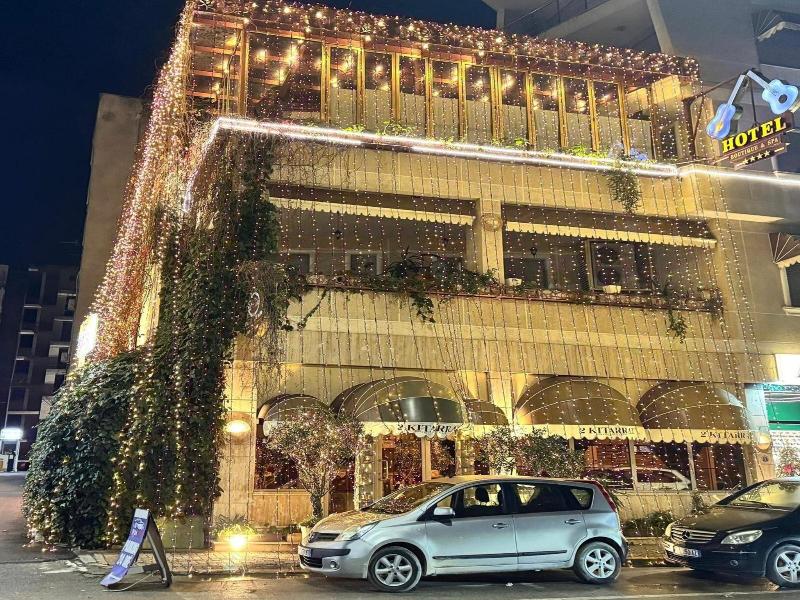
★★★★
2 Kitarrat
Durres
17 rooms · Parking
See prices and rooms →

★★★★
Albanian Star Hotel
Kavaje
Pool · Parking
See prices and rooms →

★★★★★
Sol Boutique Hotel
Vlora
Spa · 40 rooms · Parking
See prices and rooms →

★★★★
Aragosta Hotel
Durres
Beach 20 m · 39 rooms · Parking
From £68 a night, taxes incl.2 adults · checked 14 Nov, 02:37

★★★★★
Melia Durres Albania
Durres
Spa · Rooftop pool · Family-friendly
See prices and rooms →
Getting around
Albania has very few passenger trains, so travel is by road. Buses and shared minibuses, called furgons, link the towns informally. A hire car gives far more freedom, especially on the Riviera, though mountain roads are slow and driving styles can be bold. Many visitors to the south arrive by ferry from Corfu to Saranda.
When to go
The coast has long, hot, dry summers, and July and August are the busiest months. Late spring and early autumn are warm and much quieter, and are also the best time for the historic towns. The mountains of the north are for summer; winters there are snowy.
Questions about visiting Albania
- What is Albania best known for?
- The beaches of Ksamil and the Albanian Riviera, the UNESCO-listed towns of Berat and Gjirokastër, the ancient city of Butrint, the Albanian Alps and the thousands of concrete bunkers left from the communist era.
- Is Albania worth visiting?
- Yes. It has clear, warm seas, well-preserved Ottoman towns, dramatic mountains and a warm welcome, and it remains less crowded than its neighbours outside the peak summer weeks.
- How many days do you need in Albania?
- A week covers Tirana, Berat and the south coast around Saranda and Ksamil. With ten days to two weeks you can add Gjirokastër, the Riviera and the mountains of the north.
- Do you need a car in Albania?
- Not for a beach stay in Saranda or Ksamil, or for a city break in Tirana. For touring the Riviera and reaching smaller places a hire car is much the easiest option.
More guides
- Where to stay in Albania
- The best things to do in London
- The best things to do in Edinburgh
- The best things to do in Manchester
- The best things to do in York
- The best things to do in Amsterdam
- The best things to do in Birmingham
- The best things to do in Liverpool
- The best things to do in Bristol
- The best things to do in Barcelona
- The best things to do in Budapest
- The best things to do in Cambridge
- The best things to do in Dublin
- The best things to do in Krakow