
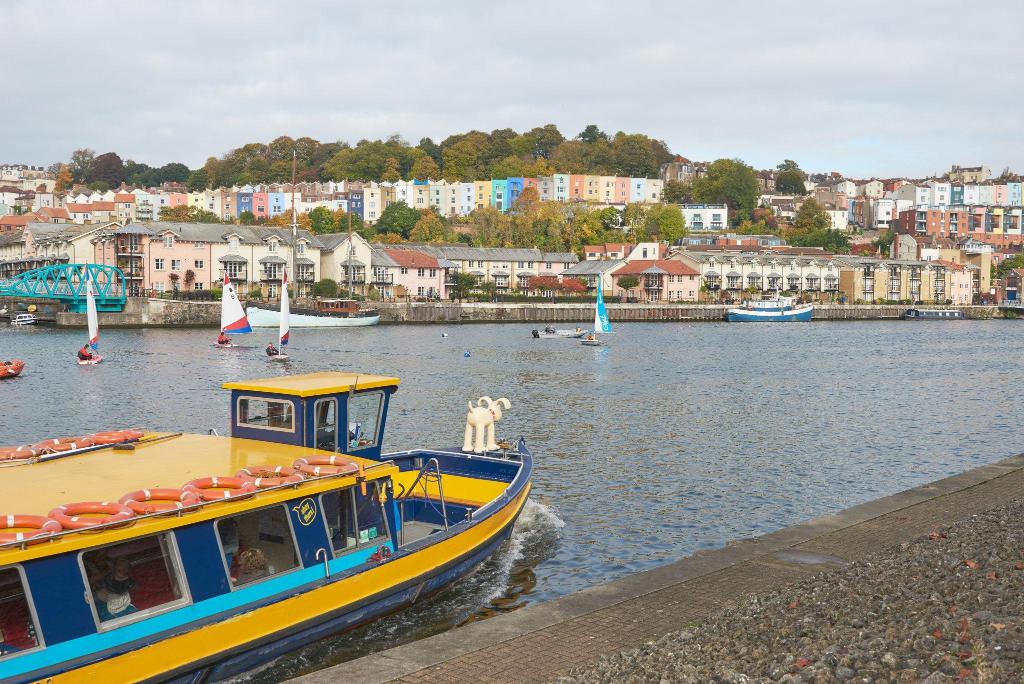
Bristol is a city of hills, water and strong opinions. For centuries its ships sailed from the heart of town to every corner of the Atlantic, and the old docks still curl through the centre, now busy with ferries, paddleboards and people eating outdoors. Above them, terraces of pastel-painted houses climb the slopes like a deck of cards.
It is also Britain's most independent-minded city: the home of Brunel's boldest engineering, Banksy's earliest walls, hot-air balloons and a music scene that changed the sound of the 1990s. Expect to walk a lot, mostly uphill, and to be rewarded with a view and a good coffee at the top.
Don't miss
The big sights
Brunel built the icons. The harbour ties them together.
Clifton Suspension Bridge
Landmark

Photo: mattbuck (category), CC BY-SA 3.0 Bristol's symbol hangs high across the Avon Gorge, strung between two stone towers. Isambard Kingdom Brunel designed it as a young man and never saw it finished: it opened in 1864, five years after his death. More than a century and a half later it still carries traffic. Walk across for the dizzying view down to the river, then climb to the grassy slope by the Observatory on the Clifton side for the classic photograph.
Tip: Come at dusk, when the bridge is lit up, and follow it with a drink in Clifton Village.
SS Great Britain
Museum

Photo: Nortix08, CC BY-SA 4.0 Another Brunel triumph. When she was launched in Bristol in 1843, this was the largest ship in the world and the first great ocean liner built of iron and driven by a propeller. After a long working life and decades abandoned in the Falkland Islands, she was towed home to the very dry dock where she was built. You can walk beneath the hull under a glass 'sea', then explore the decks, cabins and galley, restored with sounds and smells of a Victorian voyage.
The Harbourside
Neighbourhood
The old floating harbour is the city's living room. Converted warehouses hold museums, galleries, bars and restaurants, old cranes stand guard on the quay, and little yellow and blue ferries shuttle between the landing stages. A walk right round the water takes a couple of hours with stops. On a warm evening half of Bristol seems to be sitting on the cobbles with a cider, legs dangling over the edge.
Tip: Use the harbour ferries as a hop-on, hop-off way to reach SS Great Britain and the waterside pubs.
Cabot Tower
Landmark

Photo: Suicasmo, CC BY-SA 4.0 A slender red sandstone tower on top of Brandon Hill, built in the 1890s to mark 400 years since John Cabot sailed from Bristol to North America. A tight spiral staircase leads to two viewing balconies. From the top the whole city is laid out: the harbour, the coloured houses of Cliftonwood and the hills beyond. The park around it is a lovely place for a picnic.
Museums and street art
M Shed
Museum

Photo: Bob Jones, CC BY-SA 2.0 A 1950s transit shed on the quayside turned into the museum of Bristol and its people. It tells the city's story honestly, from trade, industry and its part in the transatlantic slave trade to protest, music and everyday life. Outside, the working exhibits are half the fun: electric cranes, steam locomotives and old boats that still run on certain days. The upstairs terrace has one of the best harbour views.
Bristol Museum and Art Gallery
Museum

Photo: Anthony O'Neil, CC BY-SA 2.0 A grand Edwardian building at the top of Park Street with a bit of everything: Egyptian mummies, dinosaurs, natural history, ceramics and a fine art collection upstairs. A replica of an early Bristol-built biplane hangs over the main hall. It was here, in 2009, that Banksy took over the building for a hugely popular exhibition. One of his sculptures, an angel with a paint pot upturned on her head, remains on display.
Banksy and Stokes Croft
Activity
Banksy grew up in Bristol, and several of his early works survive on the city's walls, including The Mild Mild West in Stokes Croft and the Well Hung Lover on the side of a building at the foot of Park Street. Stokes Croft is the best place to see how deep street art runs here: whole building-sides are painted, and the area's cafés, bars and independent shops share the same rebellious spirit. Guided walking tours explain who painted what.
Aerospace Bristol
Museum

Photo: Gareth James, CC BY-SA 2.0 Bristol has built aircraft for over a century, and this museum on the old Filton airfield tells the story with planes, helicopters, engines and rockets. The star has a hangar to itself: the last Concorde ever to fly, which was built here and came home for good in 2003. You can walk underneath her and step on board. A treat for anyone who ever looked up when one went over.
Neighbourhoods and food
Clifton Village
Neighbourhood

Photo: Anthony O'Neil, CC BY-SA 2.0 On the hill above the gorge, Clifton is Bristol at its most elegant: sweeping Georgian crescents in honey-coloured stone, garden squares and a village centre of delis, boutiques and pubs. Royal York Crescent, with its long raised pavement, is among the grandest terraces in the country. Browse the Victorian Clifton Arcade, then walk out onto the Downs, the great stretch of open grassland that locals treat as their back garden.
St Nicholas Market
Market

Photo: Colin Smith, CC BY-SA 2.0 In the heart of the Old City, around the 18th-century Corn Exchange, St Nick's is the oldest and best-loved market in Bristol. Stalls sell records, hats, jewellery and gifts, and the Glass Arcade is lined with food counters from around the world. It is the place for lunch on the go: pies, falafel, curries, Caribbean wraps. Outside, look for the bronze 'nails', the flat-topped pillars where merchants once settled their deals.
Wapping Wharf
Food

Photo: Neil Owen, CC BY-SA 2.0 Behind M Shed on the south side of the harbour, a stack of converted shipping containers called Cargo holds dozens of small independent restaurants, bars and shops. It has become one of the city's favourite places to eat. The choice is wide, from tacos and bao to fish, cheese and local cider, and the upper walkways catch the evening sun. Many of the kitchens are tiny, so popular ones fill up quickly.
Day trips
Bath
Day trip

Photo: Diego Delso, CC BY-SA 4.0 A short train ride from Temple Meads, Bath is one of the most beautiful cities in Britain and a World Heritage Site in its entirety. See the Roman Baths, where hot spring water still fills the great pool, then walk up to the Royal Crescent and the Circus, the grandest Georgian set pieces of all. If you want to take the waters yourself, the modern Thermae Bath Spa has a rooftop pool with views over the city.
Cheddar Gorge
Nature

Photo: Adrian Pingstone (Arpingstone), Public domain England's largest gorge cuts through the Mendip Hills south of Bristol, its limestone cliffs towering over a winding road. Beneath them are show caves full of stalactites, where the oldest complete human skeleton found in Britain, known as Cheddar Man, was discovered. Walk the clifftop path for the views, then try proper cheddar in the village that gave the cheese its name.
Wells
Day trip

Photo: Michael D Beckwith, CC0 England's smallest city is little more than a market square and a magnificent cathedral. The west front is covered with hundreds of medieval statues, and inside, the great scissor arches look astonishingly modern for something built in the 14th century. Next door are the moated Bishop's Palace and Vicars' Close, said to be the oldest purely residential street in Europe. It combines easily with Cheddar Gorge in a single day by car.
Where to stay in Bristol
Not sure which area suits you? Read our guide: Where to stay in Bristol →

★★★★
Leonardo Royal Hotel Bristol
Bristol
Pets allowed · Golf · Parking
From £121 a night, taxes incl.2 adults · checked 14 Nov, 22:52

★★★★
Brooks Guesthouse Bristol
Bristol
27 rooms
See prices and rooms →

★★★★★
Berwick Lodge
Bristol
See prices and rooms →

★★★★
Avon Gorge by Hotel du Vin
Bristol
78 rooms · Pets allowed · Parking
From £177 a night, taxes incl.2 adults · checked 14 Nov, 10:22

★★★★
Hilton Garden Inn Bristol City Centre
Bristol
Parking
From £141 a night, taxes incl.2 adults · checked 14 Nov, 22:52

★★★★
Aztec Hotel And Spa
Almondsbury
Spa · Pool · Parking
From £125 a night, taxes incl.2 adults · checked 14 Nov, 04:07

★★★★
Bath Arms Hotel
Cheddar
Adults only · 6 rooms
See prices and rooms →

★★★★
Bristol Harbour Hotel & Spa
Bristol
Spa · Pool · 42 rooms
From £175 a night, taxes incl.2 adults · checked 14 Nov, 10:22
Getting around
The centre and the Harbourside are best explored on foot, with ferries along the water. Clifton is a steep walk or a short bus ride uphill. Trains to Bath leave from Temple Meads all day. A car helps for Cheddar and Wells, but driving in the centre is slow and it has a clean air zone.
When to go
Late spring to early autumn is best, when the harbour comes alive outdoors. Summer is festival season, crowned by the Bristol International Balloon Fiesta in August, when hot-air balloons lift off over the city at dawn and dusk, weather permitting. The south-west is mild but often wet, so bring a jacket.
Questions about visiting Bristol
- What is Bristol best known for?
- The Clifton Suspension Bridge, Brunel's SS Great Britain, Banksy and street art, its historic harbour, hot-air balloons and a strong independent streak in its food, music and shops.
- Is Bristol worth visiting?
- Yes. It is one of the liveliest and most creative cities in Britain, with a walkable waterfront, great places to eat and the bonus of Bath a short train ride away.
- How many days do you need in Bristol?
- Two days covers the Harbourside, SS Great Britain, Clifton and the street art. Add a third for a day trip to Bath or Cheddar Gorge.
- What is there to do in Bristol with kids?
- SS Great Britain, M Shed and Aerospace Bristol with its Concorde are all excellent for families, and a ferry ride round the harbour is an easy win.
- Do you need a car in Bristol?
- Not for the city or for Bath, which is quick by train. A car is useful for Cheddar Gorge, Wells and the Mendip Hills.
More guides
- Where to stay in Bristol
- The best things to do in London
- The best things to do in Edinburgh
- The best things to do in Manchester
- The best things to do in York
- The best things to do in Amsterdam
- The best things to do in Birmingham
- The best things to do in Liverpool
- The best things to do in Barcelona
- The best things to do in Budapest
- The best things to do in Cambridge
- The best things to do in Dublin
- The best things to do in Krakow
- The best things to do in Oxford