
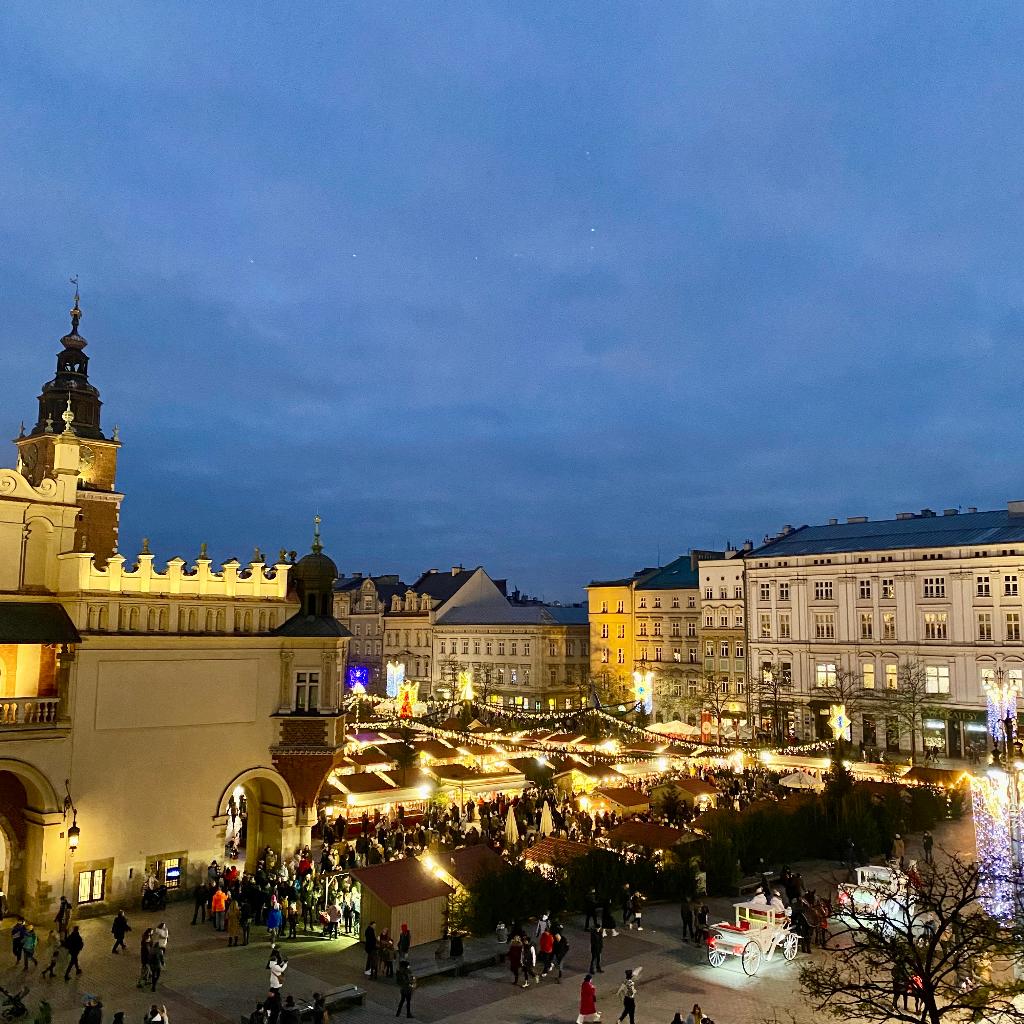
Poland's royal capital for centuries, Krakow escaped the destruction that flattened so many cities in the Second World War, and its old town is a gorgeous survivor: a vast medieval market square, Gothic church towers, a hilltop castle where kings were crowned and buried, and a ring of parkland where the walls once stood. Every hour, a trumpeter plays from the tower of St Mary's, just as one has for centuries.
It's also young, lively and inexpensive, with a university crowd filling the cellar bars and the cafés of Kazimierz, the old Jewish quarter. Three days lets you cover the Old Town, Wawel and Kazimierz; add a day each for the salt mine at Wieliczka and the Auschwitz-Birkenau memorial.
Don't miss
The Old Town
A UNESCO-listed medieval centre, small enough to stroll in an afternoon and rich enough to fill days.
The Main Market Square
Landmark

Photo: Jakub Hałun, CC BY-SA 4.0 Rynek Główny is one of the largest medieval town squares in Europe, and the beating heart of the city. In the middle stands the Cloth Hall (Sukiennice), a Renaissance trading hall whose arcades are lined with stalls selling amber, lace and wooden toys, with a gallery of 19th-century Polish art upstairs.
Around the edges, café terraces, horse-drawn carriages and street performers keep the square buzzing from morning until well after dark.
St Mary's Basilica
Landmark

Photo: Ввласенко, CC BY-SA 3.0 The brick Gothic basilica on the square has two mismatched towers and an interior of deep blue, star-spangled vaults. Its treasure is the huge carved wooden altarpiece by Veit Stoss, a masterpiece of the late Middle Ages.
On the hour, a trumpeter plays the hejnał from the taller tower, breaking off mid-note in memory, legend says, of a watchman struck by an arrow.
Rynek Underground
Museum
Beneath the Main Market Square, excavations uncovered medieval roads, stalls and foundations, now turned into an atmospheric underground museum that brings the old trading city back to life with projections and finds from the dig.
Tip: Entry is by timed ticket: book ahead in summer.
The Planty
Nature

Photo: Igor123121, CC BY-SA 4.0 A ring of shady parkland circles the Old Town where the medieval walls once stood. Walk it for a leafy loop of the centre, passing the surviving Florian Gate and the round brick Barbican, a rare medieval fortified outpost.
Wawel Hill
Wawel Castle and Cathedral
Landmark

Photo: Jakub Hałun, CC BY-SA 4.0 Above a bend of the Vistula, Wawel Hill was the seat of Polish kings. The Royal Castle wraps around an elegant Renaissance arcaded courtyard, and its state rooms are hung with Flemish tapestries. Next door, the cathedral saw centuries of coronations and royal funerals, and holds the golden-domed Sigismund Chapel and the great Sigismund Bell.
Tip: Castle exhibitions are ticketed separately with limited daily numbers: book online, especially in summer.
The Wawel Dragon
Activity

Photo: Diether, CC BY-SA 3.0 According to legend, a dragon once lived in a cave beneath Wawel Hill until a clever cobbler tricked it with a sheep stuffed with sulphur. Today a bronze dragon stands by the river at the foot of the hill and breathes real fire every few minutes, to the delight of children.
Kazimierz and Podgórze
History, memory and the city’s best bars.
Kazimierz
Neighbourhood

Photo: Igor123121, CC BY-SA 4.0 For centuries the centre of Jewish life in Krakow, Kazimierz holds historic synagogues, the old Remuh cemetery and the broad, cobbled Szeroka Street. Its population was murdered or scattered in the Holocaust, and the district fell into decay; today it's the city's most bohemian quarter, full of vintage cafés, galleries and candlelit bars.
Plac Nowy
Market

Photo: Zygmunt Put Zetpe0202, CC BY-SA 4.0 Kazimierz's lively square is centred on a round brick market hall, ringed with hatches selling zapiekanki: half a baguette toasted with mushrooms and melted cheese and loaded with toppings. It's Krakow's classic late-night snack, and the bars all around keep the square busy until the small hours.
Schindler's Factory
Museum

Photo: Adrian Grycuk, CC BY-SA 3.0 pl Across the river in Podgórze, Oskar Schindler's former enamel factory houses a powerful museum about Krakow under Nazi occupation, told through photographs, testimony and recreated streets. It's a sobering, essential visit, and pairs naturally with a walk through the nearby former ghetto.
Tip: Timed tickets often sell out: book online in advance.
Eat and drink
Pierogi
Food

Photo: Diego Delso, CC BY-SA 3.0 Poland's beloved dumplings come boiled or fried, stuffed with potato and curd cheese (ruskie), meat, sauerkraut and mushroom, or sweet fruit in summer, and served with fried onions or sour cream. For the real thing at local prices, try a bar mleczny, one of the old-school canteens known as milk bars.
Obwarzanek
Food

Photo: Chris Brown, CC BY 2.0 Krakow's signature snack is a chewy, braided bread ring, boiled before baking and sprinkled with poppy seeds, sesame or salt. It's sold from little carts on street corners all over the city, and makes the perfect walking breakfast.
Cellar bars
Nightlife
Beneath the Old Town's grand houses lies a warren of vaulted brick cellars, now home to bars, jazz clubs and dance floors. Order a Polish craft beer or try żubrówka, bison grass vodka, mixed with apple juice.
Day trips
Wieliczka Salt Mine
Day trip

Photo: Dennis G. Jarvis, CC BY-SA 2.0 Just outside the city, this UNESCO-listed mine was worked for centuries, and its miners carved an underground world out of rock salt: chambers, lakes, statues and the vast Chapel of St Kinga, where even the chandeliers are made of salt crystals.
Tip: Visits are by guided tour, with hundreds of steps down: wear comfortable shoes and book ahead.
Auschwitz-Birkenau
Day trip
West of Krakow, the former Nazi German concentration and extermination camp is now a memorial and museum. More than a million people were murdered here, most of them Jews. A visit is harrowing and unforgettable, and many people feel it is something they need to do.
Tip: Entry must be reserved in advance on the official memorial website; allow most of a day.
Zakopane and the Tatras
Day trip
A couple of hours south, Zakopane is Poland's mountain resort, with distinctive wooden villas and a cable car and funicular up into the Tatra Mountains. In summer it's all hiking and alpine meadows; in winter, skiing and snow.
Where to stay in Krakow
Not sure which area suits you? Read our guide: Where to stay in Krakow →

★★★★
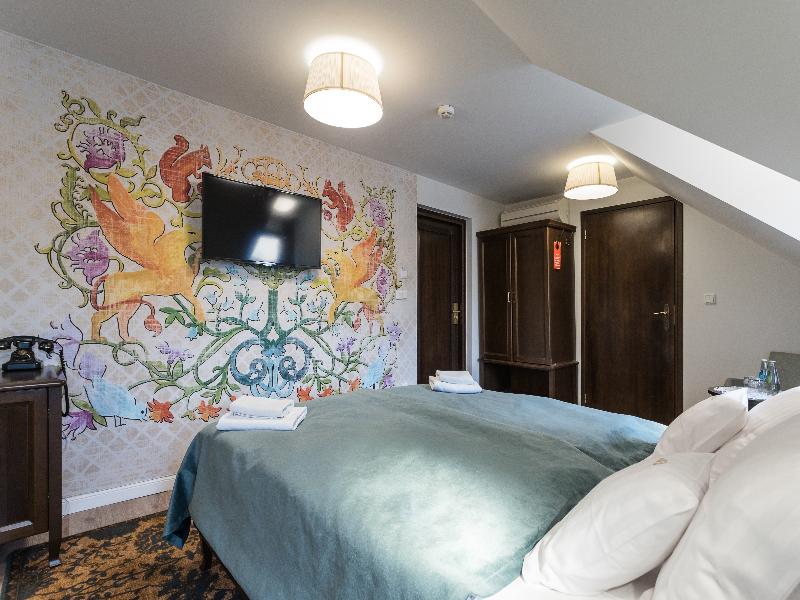
Hotel Indigo Krakow Old Town
Krakow
Adults only · All-inclusive option · 56 rooms
From £162 a night, taxes incl.2 adults · checked 1 Oct, 18:08
★★★★
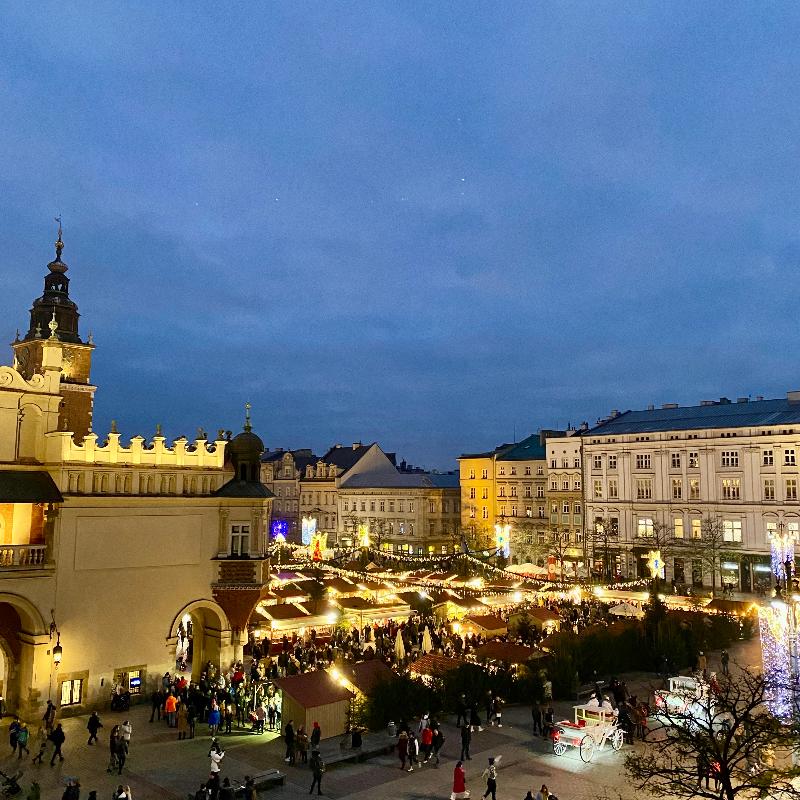
Hotel Ester
Krakow
Spa · 32 rooms · Parking
From £112 a night, taxes incl.2 adults · checked 1 Oct, 18:08
★★★★★
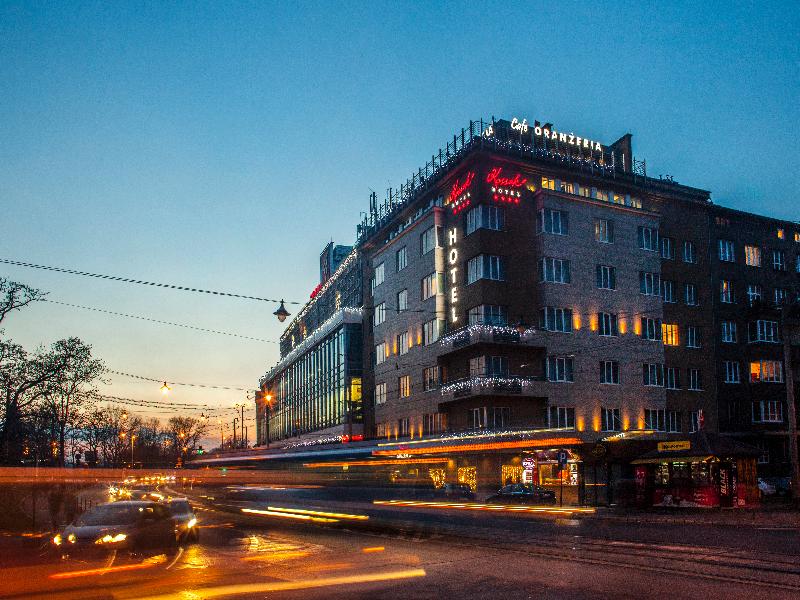
The Bonerowski Palace
Krakow
16 rooms · Parking
From £721 a night, taxes incl.2 adults · checked 1 Oct, 18:08
★★★★
Kossak
Krakow
Spa · Parking
From £261 a night, taxes incl.2 adults · checked 1 Oct, 18:08
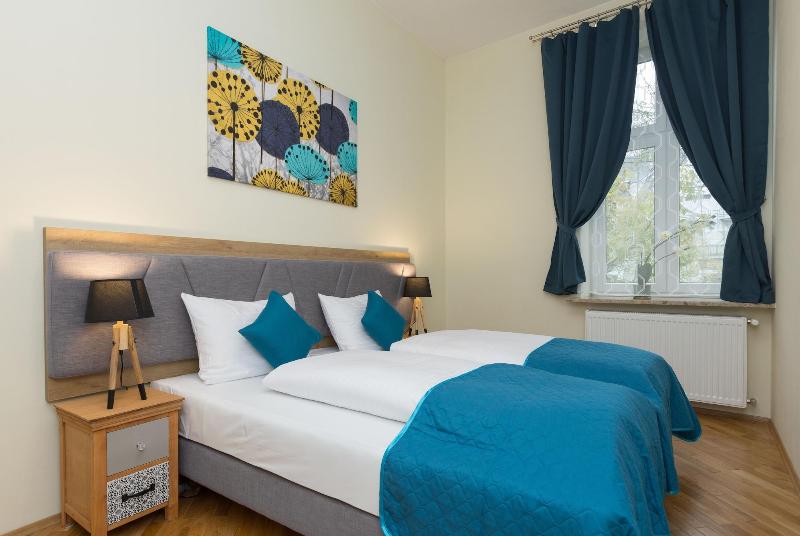
★★★★
1898 Parkside Boutique Residence
Krakow
20 rooms · Parking
From £108 a night, taxes incl.2 adults · checked 1 Oct, 18:08
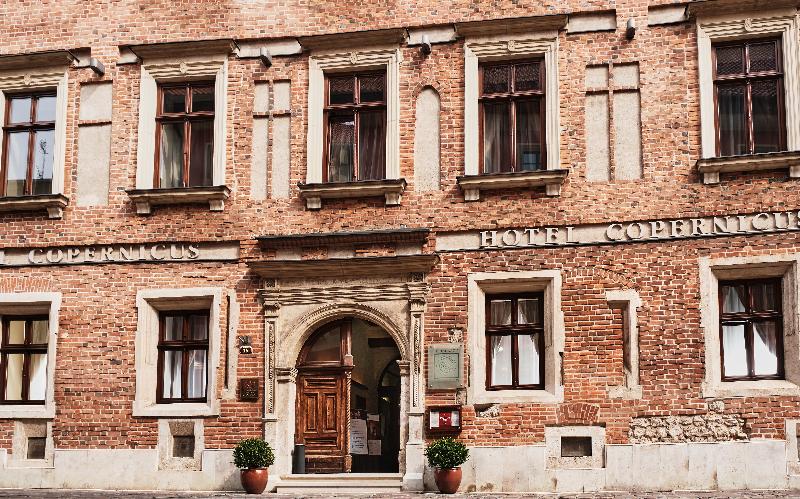
★★★★★
Copernicus
Krakow
Spa · Pool · Parking
See prices and rooms →
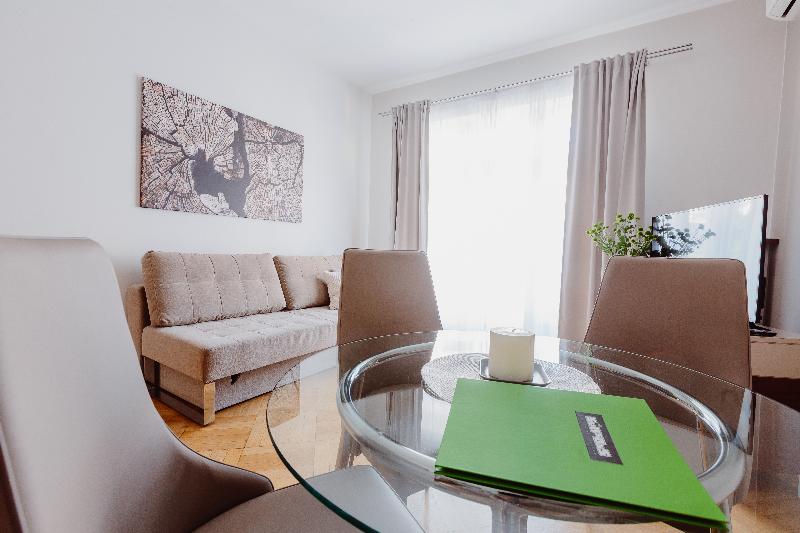
★★★★
4Seasons Apartments Cracow
Krakow
Pets allowed · Parking
See prices and rooms →
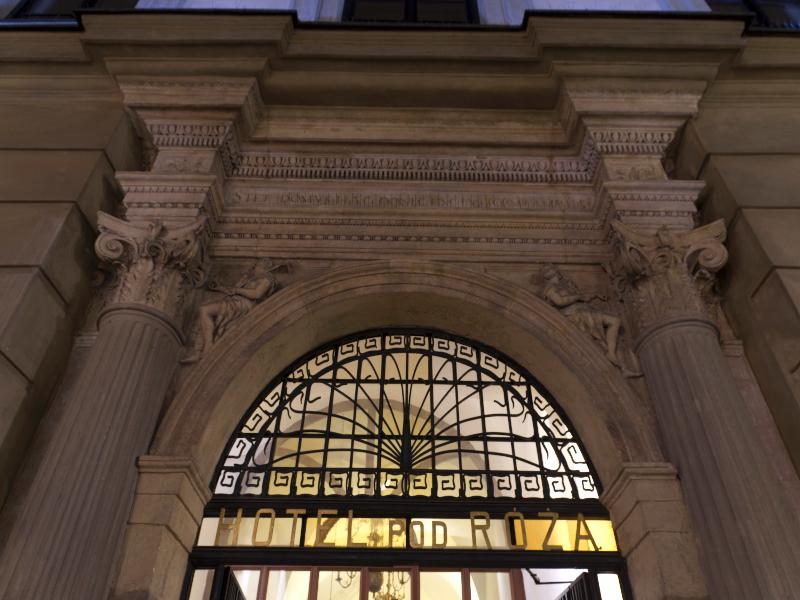
★★★★★
Pod Roza
Krakow
Spa · 56 rooms · Pets allowed
From £185 a night, taxes incl.2 adults · checked 1 Oct, 18:08
Getting around
The Old Town, Wawel and Kazimierz are all within easy walking distance of each other, and trams cover everything else. You won't need a car; Wieliczka and Auschwitz-Birkenau are easily reached by train, bus or organised tour.
When to go
Late spring and early autumn are ideal. Summer is warm and busy. Winter is cold, often below freezing, but the Christmas market on the Main Market Square and the cosy cellar bars make up for it.
Questions about visiting Krakow
- What is Krakow best known for?
- Its medieval Old Town and Main Market Square, Wawel Castle, St Mary’s Basilica, the old Jewish quarter of Kazimierz, and as a base for visiting the Wieliczka Salt Mine and Auschwitz-Birkenau.
- How many days do you need in Krakow?
- Three days covers the Old Town, Wawel and Kazimierz. Allow a day each for Wieliczka and Auschwitz-Birkenau, so four or five days in total is ideal.
- Is Krakow worth visiting?
- Yes. It has one of the best-preserved historic centres in Europe, a lively food and bar scene and good value, and it is a compact, walkable city.
- Do you need to book Auschwitz-Birkenau in advance?
- Yes. Entry must be reserved ahead on the official memorial website, and places, especially for guided tours, can fill up weeks in advance in summer.
More guides
- Where to stay in Krakow
- The best things to do in London
- The best things to do in Edinburgh
- The best things to do in Amsterdam
- The best things to do in Barcelona
- The best things to do in Budapest
- The best things to do in Dublin
- The best things to do in Prague
- The best things to do in Berlin
- The best things to do in Lisbon
- The best things to do in Milan
- The best things to do in Paris
- The best things to do in Rome
- The best things to do in Madrid