
Oxford has been teaching students for more than 800 years, and the university is not so much in the city as it is the city. Its colleges hide behind high stone walls and heavy oak doors, each one a little world of quadrangles, chapels and clipped lawns you are not allowed to walk on. Peer through a gateway and you will see why the place has launched so many novels.
Between the colleges run lanes of honey-coloured stone, bicycles by the thousand and pubs where half of English literature seems to have had a pint. It is compact, walkable and dense with things to see. Climb a tower, drift down a river, lose an afternoon in a museum, and leave time for the palace up the road.
Don't miss
The big sights
Domes, spires and quadrangles: the university at its grandest.
Radcliffe Camera
Landmark

Photo: Photograph by Mike Peel (www.mikepeel.net)., CC BY-SA 4.0 The building on every Oxford postcard: a great golden rotunda with a lead dome, standing alone in the middle of a cobbled square. It was built in the 18th century as a science library and is now a reading room of the Bodleian, so the inside is for readers only. No matter. The outside is the point. For the best view, climb the tower of the University Church of St Mary the Virgin on the south side of the square and look straight down on the dome.
Tip: Radcliffe Square is at its quietest and most golden early in the morning.
Bodleian Library
Landmark

Photo: Diliff, CC BY-SA 3.0 One of the oldest libraries in Europe, and entitled to a copy of every book published in Britain. Its medieval heart can be visited on guided tours, which take in the Divinity School, with an astonishingly intricate stone-vaulted ceiling, and Duke Humfrey's Library, all dark oak, painted beams and ancient leather-bound books. Both will be familiar to Harry Potter fans from the films. Just outside, the covered Bridge of Sighs arches prettily over New College Lane.
Tip: Tours have limited places, so book in advance if you want to see the old reading rooms.
Christ Church
Landmark

Photo: Andy Li, CC0 The grandest of the colleges, founded under Henry VIII, with the largest quadrangle in Oxford and a chapel that doubles as the city's cathedral. Its bell tower, Tom Tower, was designed by Christopher Wren. Most visitors come for the Great Hall, the long, portrait-lined dining room whose staircase appeared in the Harry Potter films. Lewis Carroll taught mathematics here, and Alice was the Dean's daughter. Behind the college, Christ Church Meadow runs down to the river.
Tip: The hall closes to visitors around student mealtimes, so late morning or mid-afternoon is safest.
Magdalen College
Landmark

Photo: Julian Herzog (Website), CC BY 4.0 Pronounced 'maudlin', and many people's favourite. Magdalen has a soaring bell tower beside the river, a serene medieval cloister and more open space than any other college, including a deer park where a herd grazes within sight of the High Street. A riverside path called Addison's Walk loops around a water meadow. Oscar Wilde studied here; C. S. Lewis taught here for nearly thirty years.
Museums and gardens
Ashmolean Museum
Museum

Photo: Julian Herzog (Website), CC BY 4.0 Britain's first public museum opened in 1683, and its collection of art and archaeology is among the best in the country. Behind the grand classical façade you will find Egyptian mummies, Greek sculpture, Anglo-Saxon treasure including the Alfred Jewel, and paintings from Uccello to Turner and Van Gogh. It is big enough to fill a day and well laid out for a quick visit. The rooftop restaurant is a pleasant surprise.
Museum of Natural History and Pitt Rivers
Museum

Photo: Diliff, CC BY-SA 3.0 Two museums in one, and a favourite with children. The first is a Victorian cathedral of science, with dinosaur skeletons under a soaring glass and iron roof and the remains of a dodo. Walk through a door at the back and you step into the Pitt Rivers Museum: a dimly lit hall crammed with glass cases of objects from every corner of the world, arranged by what they are for, not where they came from. Masks, boats, musical instruments and charms are packed in by the thousand.
Oxford Botanic Garden
Nature

Photo: JMski, CC0 Founded in 1621 for growing medicinal plants, this is the oldest botanic garden in Britain. It sits beside the River Cherwell opposite Magdalen College, with a formal walled garden, glasshouses of palms, water lilies and carnivorous plants, and borders that run down to the water. It is small, calm and a welcome change of pace after a morning of stone and crowds. Bring a book.
Rivers, meadows and neighbourhoods
Punting on the Cherwell
Activity

Photo: Ruth Sharville, CC BY-SA 2.0 The traditional Oxford afternoon. A punt is a long, flat-bottomed boat pushed along with a pole, and it is harder than the students make it look. Hire one by Magdalen Bridge and glide past college gardens and willow-hung banks. You will go in circles for the first ten minutes. Persist, or pay for a chauffeur and concentrate on the picnic. In Oxford, tradition says you stand at the sloping end of the boat.
Tip: Punts are hired in the warmer months and queues build on sunny weekends, so go early.
Port Meadow
Nature

Photo: AstacopsisGouldi, CC BY-SA 4.0 A huge, flat expanse of ancient common land beside the Thames on the north-west edge of the city, grazed by horses and cattle and said never to have been ploughed. It floods in winter and fills with buttercups in summer. Walk across it from Jericho and follow the river to one of the old pubs at Binsey or Wolvercote. It is the classic Oxford Sunday stroll.
Jericho
Neighbourhood
North of the centre, Jericho is a neighbourhood of small Victorian terraces built for workers at the university press and the canal. Today it is the city's most sociable quarter, with independent restaurants, cocktail bars, cafés and an arthouse cinema along Walton Street. Come here in the evening when you want to eat among locals instead of tour groups. The Oxford Canal towpath runs along its western edge.
Eat and drink
The Covered Market
Market

Photo: Jorge Royan, CC BY-SA 3.0 Trading since the 1770s, this warren of covered lanes between the High Street and Market Street holds butchers, greengrocers, cheese sellers and florists alongside cafés, bakeries and gift shops. It is a good place for a cheap lunch or a mid-morning stop. Follow your nose to the cookie stall, watch cakes being decorated in a shop window, and look out for traditional Oxford sausages.
The Turf Tavern
Nightlife

Photo: The Carlisle Kid, CC BY-SA 2.0 Half the fun is finding it. This low-beamed old pub sits hidden at the end of a narrow alley near the Bridge of Sighs, pressed up against a surviving stretch of the medieval city wall. Its courtyards are packed on summer evenings and warmed by braziers in winter. Generations of students, writers and future prime ministers have drunk here. Oxford has many historic pubs, but this is the one to seek out first.
Day trips
Blenheim Palace
Day trip

Photo: DeFacto, CC BY-SA 4.0 In the village of Woodstock, a short bus ride north of Oxford, stands one of the largest houses in England: a monumental baroque palace given to the first Duke of Marlborough for his victory at the Battle of Blenheim. Winston Churchill was born here in 1874. The state rooms are lavish, but the park, landscaped by Capability Brown with a lake and a grand bridge, is the real glory. It is a World Heritage Site and easily fills a day.
The Cotswolds
Day trip
West of Oxford the land rises into gentle limestone hills dotted with villages built of the same warm golden stone. Burford, with its steep high street running down to the River Windrush, is the nearest of the famous ones; Bourton-on-the-Water and Bibury lie further in. This is country for cream teas, pub lunches and short walks. A car gives you the most freedom, though organised tours leave from Oxford.
Where to stay in Oxford
Not sure which area suits you? Read our guide: Where to stay in Oxford →

★★★★
Malmaison Oxford
Oxford
Pets allowed · Parking
From £234 a night, taxes incl.2 adults · checked 14 Nov, 10:37

★★★★
The Old Parsonage Hotel
Oxford
35 rooms
From £269 a night, taxes incl.2 adults · checked 14 Nov, 10:37

★★★★★
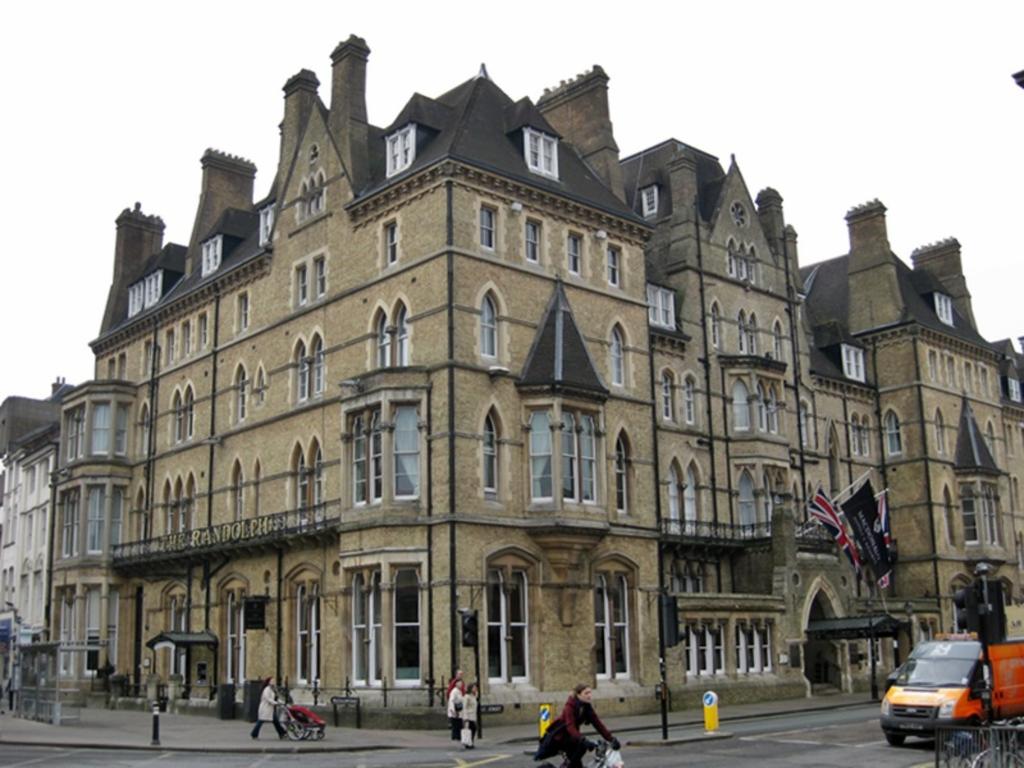
The Randolph Hotel Oxford, a Graduate Hotel
Oxford
All-inclusive option · Spa · Family-friendly
From £215 a night, taxes incl.2 adults · checked 14 Nov, 10:37

★★★★
The Head Of The River
Oxford
19 rooms
From £185 a night, taxes incl.2 adults · checked 14 Nov, 10:37

★★★★
Holiday Inn Oxford
Oxford
Parking
From £93 a night, taxes incl.2 adults · checked 14 Nov, 10:37

★★★★★
George Street Hotel
Oxford
41 rooms
From £158 a night, taxes incl.2 adults · checked 14 Nov, 10:37

★★★★
The Bay Tree Hotel
Burford
21 rooms · Pets allowed · Parking
From £252 a night, taxes incl.2 adults · checked 14 Nov, 10:37

★★★★★
Burford House
Burford
6 rooms
From £150 a night, taxes incl.2 adults · checked 14 Nov, 23:07
Getting around
Oxford is a walking city, and almost everything is within 20 minutes of Carfax, the central crossroads. Do not drive into the centre: streets are narrow, restrictions are tight and parking is scarce. Use the park-and-ride sites on the ring road. Buses run to Woodstock for Blenheim Palace.
Colleges set their own visiting times and can close without much notice for exams, events or term-time business, so check on the day.
When to go
Late spring and early summer are loveliest, with gardens in flower and punts on the river, though some colleges restrict visitors during exams. July and August are the busiest months. Autumn brings the students back and quieter streets, and winter is ideal for museums and firelit pubs.
Questions about visiting Oxford
- What is Oxford best known for?
- Its university, the oldest in the English-speaking world, and the beautiful college buildings that go with it, including the Radcliffe Camera, Christ Church and the Bodleian Library. It is also known for its literary and Harry Potter connections.
- Is Oxford worth visiting?
- Yes. Few cities pack so much architecture and history into such a small, walkable centre, and the museums are outstanding. It works as a day trip from London but rewards an overnight stay.
- How many days do you need in Oxford?
- Two days lets you see the main colleges, a museum or two and try punting. Add a third for Blenheim Palace or the Cotswolds.
- What is there to do in Oxford with kids?
- The Museum of Natural History and the Pitt Rivers are the best bets, followed by the Harry Potter locations at Christ Church and the Bodleian, a punt on the river and the grounds of Blenheim Palace.
- Do you need a car in Oxford?
- No, and it is better not to bring one into the centre. A car is only useful for exploring the Cotswold villages.
More guides
- Where to stay in Oxford
- The best things to do in London
- The best things to do in Edinburgh
- The best things to do in Manchester
- The best things to do in York
- The best things to do in Amsterdam
- The best things to do in Birmingham
- The best things to do in Liverpool
- The best things to do in Bristol
- The best things to do in Barcelona
- The best things to do in Budapest
- The best things to do in Cambridge
- The best things to do in Dublin
- The best things to do in Krakow