
Cambridge is a market town that happens to contain one of the world's great universities. Newton worked out gravity here, Darwin collected beetles, and Crick and Watson unravelled DNA before strolling to the pub to announce it. The colleges they belonged to line a slow green river, their lawns running down to the water behind high walls and ancient gatehouses.
It is smaller and gentler than Oxford, with more sky and more bicycles. The centre takes an hour to cross and a weekend to enjoy properly. Glide past the colleges in a punt, hear a choir sing under the most beautiful ceiling in England, then walk across the meadows for tea in an orchard.
Don't miss
The big sights
The famous colleges sit side by side along the river, a few minutes apart.
King's College Chapel
Landmark

Photo: Sumit Surai, CC BY-SA 4.0 The emblem of Cambridge and one of the finest Gothic buildings in Europe. Begun by Henry VI and finished under Henry VIII, the chapel is roofed with the largest fan vault in the world, a canopy of stone that seems to float above walls made almost entirely of 16th-century stained glass. Behind the altar hangs Rubens's Adoration of the Magi. The choir is famous worldwide for its Christmas Eve service of carols, but you can hear it sing evensong during term.
Tip: Attending a choral service lets you experience the chapel as it was meant to be used. Arrive early to queue.
The Backs
Nature

Photo: David Howard, CC BY-SA 2.0 The stretch of lawns, gardens and meadows where the colleges back onto the River Cam. From the far bank you get the view that defines the city: King's College Chapel rising above the grass, with cows sometimes grazing in the foreground. Walk along Queen's Road and cut through whichever college gates are open. In early spring the banks are carpeted with crocuses and daffodils.
Trinity College
Landmark

Photo: Cmglee, CC BY-SA 3.0 The largest and wealthiest of the Cambridge colleges, founded by Henry VIII, whose statue stands over the Great Gate holding a chair leg in place of a sceptre, thanks to a student prank long ago. Beyond lies Great Court, a vast quadrangle with a fountain at its centre. Isaac Newton studied and taught here; an apple tree outside the gate is said to descend from his famous one. The Wren Library, by the river, holds his notebooks and A. A. Milne's Winnie-the-Pooh manuscripts.
St John's College and the Bridge of Sighs
Landmark

Photo: Diliff, CC BY-SA 3.0 Next door to Trinity, St John's spreads across both banks of the river through a sequence of ever-grander courts. The two halves are joined by the Bridge of Sighs, a covered Victorian Gothic bridge named after the one in Venice and one of the most photographed sights in the city. You see it best from the water, or from the older Kitchen Bridge beside it. The college's Victorian chapel tower is a landmark for miles around.
On the river
Punting on the Cam
Activity

Photo: Peter Trimming, CC BY-SA 2.0 The best way to see the colleges is from a punt, sliding under a succession of bridges along the Backs: the wooden Mathematical Bridge at Queens', Clare Bridge, the Bridge of Sighs. Hire your own and steer with the pole, or sit back on a chauffeured tour and listen to the stories, some of them true. It takes under an hour and it is unmissable, even if the river resembles a dodgem track on a sunny Saturday.
Tip: Go early or late in the day for a calmer river. In Cambridge, the punter stands on the flat deck at the back.
Grantchester
Day trip
Follow the footpath upstream across the meadows and in under an hour you reach the village of Grantchester, all thatch, church tower and riverside pubs. The poet Rupert Brooke lived here and immortalised it in verse. The tradition is tea and scones in a deckchair under the apple trees at the Orchard Tea Garden, where Brooke, Virginia Woolf and their friends once did the same. On a hot day, some people punt all the way.
Museums and gardens
Fitzwilliam Museum
Museum

Photo: Kim Fyson, CC BY-SA 2.0 The university's art museum is a temple of marble and mosaic on Trumpington Street, and the collection lives up to the entrance hall. There are Egyptian coffins, Greek vases and medieval manuscripts downstairs, and upstairs paintings by Titian, Rembrandt, Monet and the English masters. It is one of the best museums in the country outside London, and rarely crowded. Give it at least a couple of hours.
Kettle's Yard
Museum

Photo: Marathon, CC BY-SA 2.0 A row of cottages knocked together by a former Tate curator, Jim Ede, and filled with his collection of 20th-century art. Paintings and sculptures by artists such as Ben Nicholson, Barbara Hepworth and Henri Gaudier-Brzeska sit among pebbles, plants and well-worn furniture. Everything is exactly where he placed it, and you are welcome to sit in the chairs. It is an intimate, calming place, quite unlike a conventional gallery.
Tip: Entry to the house is by timed ticket, which is worth reserving ahead.
Cambridge University Botanic Garden
Nature

Photo: GualdimG, CC BY-SA 4.0 Forty acres of gardens between the station and the centre, laid out in the 1840s by John Henslow, the professor who taught Charles Darwin. There are majestic old trees, a lake, a rock garden, a scented garden and a long range of glasshouses that take you from alpine peaks to steamy tropics. It is beautiful in every season and has plenty of room for children to run about. A good way to start or end a day if you arrive by train.
Eat and drink
The Eagle
Nightlife
The most famous pub in Cambridge, on Bene't Street. In 1953 Francis Crick and James Watson, regulars from the nearby Cavendish Laboratory, came in at lunchtime and announced that they had discovered the structure of DNA. Go through to the back bar and look up: the ceiling is covered with the names and squadron numbers of British and American airmen, burned on with candles and lighters during the Second World War.
Fitzbillies
Food

Photo: bryan..., CC BY-SA 2.0 A Cambridge bakery that has been feeding students since 1920. It is known for one thing above all: the Chelsea bun, a spiral of soft dough packed with currants and drenched in a dark, outrageously sticky syrup. The original shop, with its Art Nouveau frontage, is on Trumpington Street near the Fitzwilliam Museum. Buy one to eat in, and a box to take home.
Cambridge Market
Market

Photo: Anthony Parkes, CC BY-SA 2.0 Traders have set up in the square in front of Great St Mary's church since the Middle Ages. The stalls sell fruit, bread, cheese, flowers, second-hand books and bicycles, plus street food from around the world. It is handy for a picnic to take down to the river. While you are there, climb the church tower for a rooftop view over King's College and the market below.
Day trips
Ely
Day trip

Photo: Dmitry Tonkonog and Ksenia Fedosova, CC BY-SA 3.0 A short train ride north across the flat, wide-skied Fens brings you to the tiny city of Ely and its enormous cathedral. Known as the Ship of the Fens, it can be seen for miles, rising from what was once an island in the marshes. Inside, the Octagon, a medieval lantern tower of timber and glass above the crossing, is one of the wonders of English architecture. Oliver Cromwell's house is nearby, and the riverside is pleasant for lunch.
IWM Duxford
Museum

Photo: Paul Hudson, CC BY 2.0 South of Cambridge, a historic airfield that played a leading part in the Battle of Britain is now one of the great aviation museums of Europe. Its hangars hold Spitfires, a Lancaster, a Concorde you can walk through and a striking hall of American aircraft. The site is large, so wear comfortable shoes. On air show days, historic planes take to the sky above the runway.
Where to stay in Cambridge
Not sure which area suits you? Read our guide: Where to stay in Cambridge →

★★★★
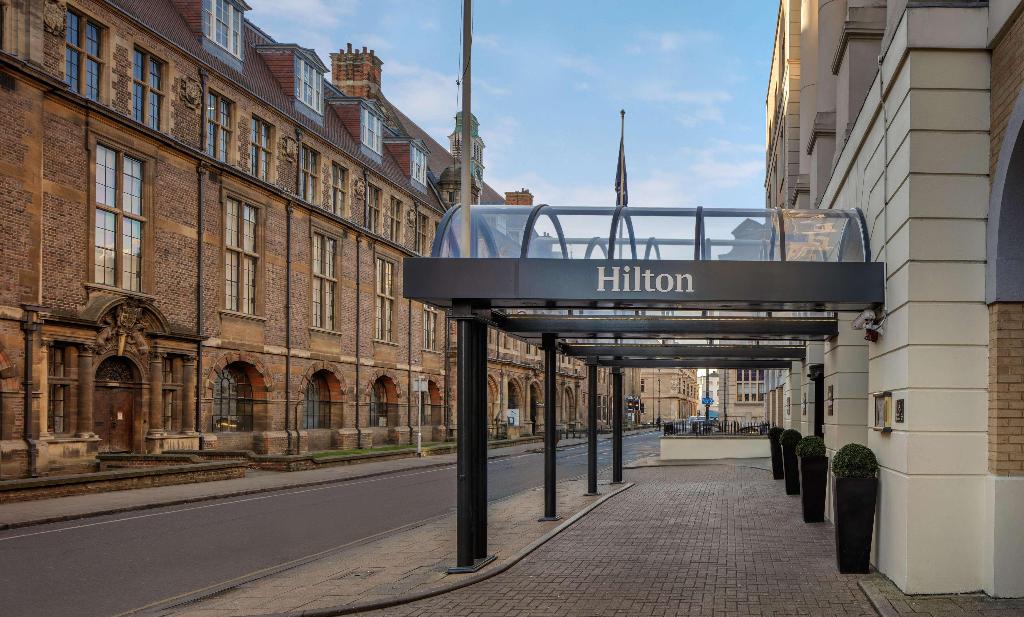
Hilton Cambridge City Centre
Cambridge
Parking
From £195 a night, taxes incl.2 adults · checked 14 Nov, 10:37

★★★★
University Arms Hotel
Cambridge
Pets allowed · Parking
From £299 a night, taxes incl.2 adults · checked 14 Nov, 04:22

★★★★
Clayton Hotel Cambridge
Cambridge
From £167 a night, taxes incl.2 adults · checked 14 Nov, 10:37

★★★★
Hyatt Centric Cambridge
Cambridge
Pets allowed · Parking
From £92 a night, taxes incl.2 adults · checked 14 Nov, 10:37

★★★★
Quy Mill Hotel & Spa, Cambridge
Cambridge
Pool · 51 rooms · Parking
From £116 a night, taxes incl.2 adults · checked 14 Nov, 10:37

★★★★
Cambridge Bar Hill Hotel BW Signature Collection
Cambridge
Pool · Pets allowed · Parking
From £77 a night, taxes incl.2 adults · checked 14 Nov, 10:37

★★★★
Du Vin Bistro Cambridge
Cambridge
41 rooms · Pets allowed
From £243 a night, taxes incl.2 adults · checked 14 Nov, 04:22

★★★★
Graduate by Hilton Cambridge
Cambridge
Pets allowed · Parking
From £182 a night, taxes incl.2 adults · checked 14 Nov, 10:37
Getting around
Walk or cycle. The centre is flat, compact and largely closed to cars, and the station is about 20 minutes on foot from the colleges or a short bus ride. If you drive, leave the car at a park-and-ride site. Trains reach Ely quickly; Duxford is easiest by car.
Colleges close to visitors during exams in late spring and for private events, and each sets its own rules, so check before you go.
When to go
Spring is glorious, with flowers along the Backs, though many colleges limit access during the exam period. Summer is peak season for punting and for crowds. Autumn is quieter and golden, and at Christmas the choirs are in full voice. East Anglia is one of the driest parts of Britain, but the wind across the Fens can be sharp.
Questions about visiting Cambridge
- What is Cambridge best known for?
- Its university, founded in the 13th century, and the colleges along the River Cam. King's College Chapel, punting along the Backs and a long list of famous scientists, from Newton to Hawking, are what most people think of.
- Is Cambridge worth visiting?
- Yes. It is one of the most beautiful small cities in England, easy to reach from London and simple to explore on foot. A day shows you the highlights; a night or two lets you enjoy it once the day-trippers leave.
- How many days do you need in Cambridge?
- One full day covers the main colleges and a punt. Two days adds the Fitzwilliam Museum, the Botanic Garden and the walk to Grantchester, and a third allows for Ely or Duxford.
- What is there to do in Cambridge with kids?
- A chauffeured punt, the Botanic Garden and the aircraft at IWM Duxford are all good with children. The university also has several small museums in the centre, including ones devoted to zoology and to polar exploration.
- Do you need a car in Cambridge?
- No. The centre is best on foot or by bike, and driving in is awkward. A car helps only for Duxford and the surrounding villages.
More guides
- Where to stay in Cambridge
- The best things to do in London
- The best things to do in Edinburgh
- The best things to do in Manchester
- The best things to do in York
- The best things to do in Amsterdam
- The best things to do in Birmingham
- The best things to do in Liverpool
- The best things to do in Bristol
- The best things to do in Barcelona
- The best things to do in Budapest
- The best things to do in Dublin
- The best things to do in Krakow
- The best things to do in Oxford