
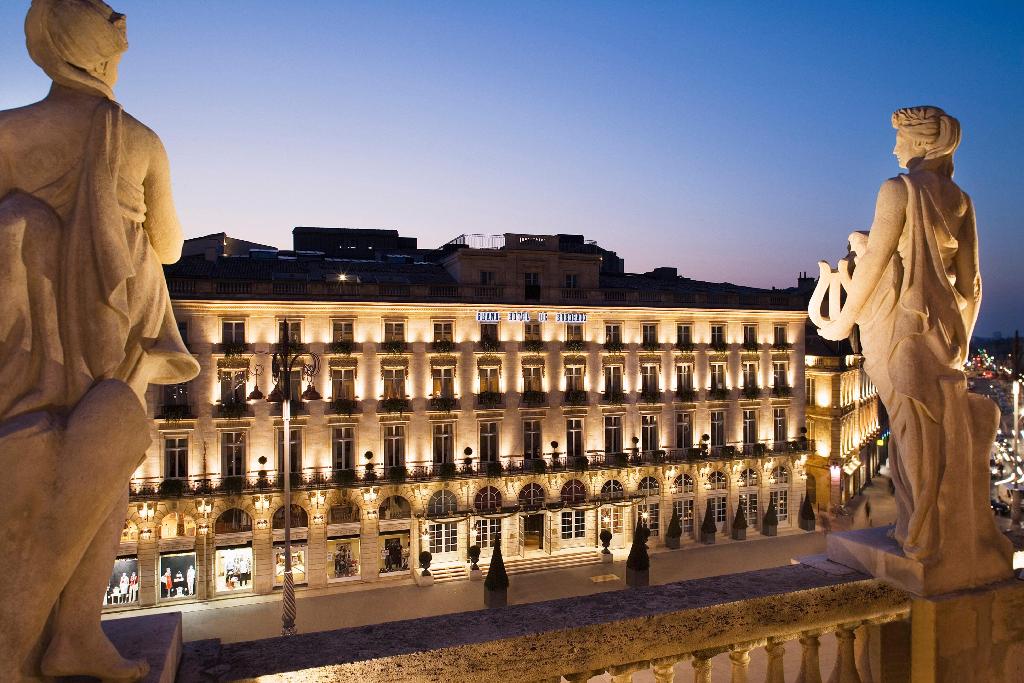
Bordeaux spent much of the 20th century hiding its good looks under a layer of soot. Then the city scrubbed its limestone, cleared the warehouses off the riverfront, laid tram lines down the middle of its boulevards and emerged as one of the most handsome cities in France: a great golden crescent of 18th-century facades along the Garonne, much of it a UNESCO World Heritage Site.
The wine, of course, is why most people come, and the vineyards start almost at the city limits. But give the city itself a couple of days first. It is flat, walkable, full of good places to eat, and at its best in the early evening when the stone turns the colour of honey.
Don't miss
The big sights
Place de la Bourse and the Miroir d'eau
Landmark

Photo: Javier Perez Montes, CC BY-SA 4.0 The image of Bordeaux: a sweeping 18th-century square, open to the river, designed to show visiting ships what kind of city they were arriving at. Across the road lies the Miroir d'eau, a vast sheet of granite covered by a film of water that reflects the facades, then vanishes in a cloud of mist.
It is an artwork, a paddling pool and a meeting place all at once. Children run through it barefoot, and photographers wait for the stillness between the fog cycles.
Tip: Come at dusk, when the buildings are lit and the reflection is at its sharpest.
La Cité du Vin
Museum

Photo: FrDr, CC BY-SA 4.0 North of the centre on the riverbank, a swirling gold and glass building, said to evoke wine turning in a glass, holds a museum devoted to wine across the world and through history. It is hands-on and high-tech: you sniff, listen and watch your way round, with no need for prior knowledge.
The visit ends on the top floor, with a glass of wine and a panorama of the city and the river. It suits beginners as much as buffs.
Cathédrale Saint-André and the Tour Pey-Berland
Landmark

Photo: Zairon, CC BY-SA 4.0 Bordeaux's Gothic cathedral, where Eleanor of Aquitaine married the future king of France, stands on a wide square beside the city hall. Its bell tower was built separately, a short distance away, so that the vibrations of the bells would not damage the church.
Climb the tower's narrow spiral stair for a rooftop view over the whole city. The steps are many and steep, and the reward is considerable.
Grosse Cloche
Landmark

Photo: Alexey Komarov, CC BY-SA 4.0 One of the oldest belfries in France straddles a narrow street in the old town: a medieval gateway with twin conical towers and a great bell hung between them. It was once part of the town hall and its dungeon. It takes a minute to admire and is on the way to almost everything.
Grand Théâtre
Landmark

Photo: Marc Ryckaert (MJJR), CC BY-SA 3.0 Fronting the Place de la Comédie, the city's opera house is an 18th-century temple with a portico of twelve Corinthian columns, each topped by a statue of a muse or goddess. Its grand staircase is said to have inspired the one at the Paris Opéra. Go to a performance if you can, or take a guided tour.
Neighbourhoods and the river
Saint-Pierre and Rue Sainte-Catherine
Neighbourhood
Behind the Place de la Bourse, the Saint-Pierre quarter is the medieval core: narrow lanes, small squares crowded with restaurant tables, and the Place du Parlement at its heart. It is where you will end up for dinner. Cutting through it is Rue Sainte-Catherine, one of the longest pedestrian shopping streets in Europe, running dead straight for well over a kilometre.
Chartrons
Neighbourhood
North of the centre, this was the district of the wine merchants, whose stone warehouses lined the river. Today it has a village feel, with antique dealers along Rue Notre-Dame, wine bars, independent shops and a Sunday market on the quay where people eat oysters with a glass of white before lunch.
Darwin
Neighbourhood
Across the river on the right bank, a former military barracks has been turned into a sprawling alternative hub: a skate park, street art on every wall, an organic food hall, co-working spaces and a big, cheerful canteen. It shows a younger, scruffier Bordeaux and is good with teenagers.
Pont de Pierre
Landmark

Photo: Marc Ryckaert (MJJR), CC BY-SA 3.0 Ordered by Napoleon, this long brick and stone bridge was the first to cross the Garonne at Bordeaux. Its seventeen arches are often said to match the letters in Napoléon Bonaparte. Walk across at sunset for the classic view back to the quays and the spire of Saint-Michel.
Art and museums
Bassins des Lumières
Museum

Photo: Rc1959, CC BY-SA 4.0 Inside a colossal concrete submarine base built during the Second World War, digital art shows are projected onto the walls and reflected in the dark water of the pens. Paintings by famous artists drift, dissolve and re-form across surfaces the size of football pitches, set to music. Atmospheric, unusual and a hit with all ages.
Musée d'Aquitaine
Museum
The city's history museum tells the story of Bordeaux and its region from prehistory to the present, with Roman mosaics, medieval sculpture and a frank, well-presented section on the city's role in the Atlantic slave trade and the wealth it brought. It is the best place to understand what you have been looking at.
Eat and drink
Canelés
Food

Photo: Rhododendrites, CC BY-SA 4.0 Bordeaux's own pastry is small, fluted and almost black on the outside, with a caramelised crust that gives way to a soft, custardy centre scented with rum and vanilla. They are baked in copper moulds and sold all over the city. The right number to buy is more than you think.
Marché des Capucins
Market

Photo: Benreis, CC BY-SA 4.0 The city's main covered market is known as the belly of Bordeaux. Stalls are heaped with cheese, charcuterie, fruit and seafood, and the thing to do is pull up a stool at one of the counters for a plate of oysters from the Arcachon basin and a glass of cold white wine. Mornings only, and best at the weekend.
Wine bars
Food
You do not have to leave the city to taste the region. Wine bars across the centre pour Bordeaux by the glass, from everyday reds to grand names, alongside boards of cheese and ham. Order by appellation, such as Médoc, Saint-Émilion, Pessac-Léognan or sweet Sauternes, and let the staff steer you.
Day trips
Vineyards in every direction, and the Atlantic to the west.
Saint-Émilion
Day trip

Photo: Nataloche, CC BY-SA 4.0 East of Bordeaux, a medieval village of pale stone sits on a hillside surrounded by some of the most prized vineyards in the world. Steep cobbled lanes lead to a remarkable church carved out of the solid rock, with a bell tower above. The village and its vineyards are a UNESCO World Heritage Site. Wine merchants and châteaux offer tastings at every turn. It is reachable by train, which solves the question of who drives.
Tip: The lanes are steep and slippery. Wear flat shoes with grip.
The Médoc
Day trip

Photo: David Perez, CC BY 3.0 North of the city, a flat peninsula between the Gironde estuary and the Atlantic is lined with famous wine villages: Margaux, Saint-Julien, Pauillac, Saint-Estèphe. The road through them passes one grand château after another, set among neat rows of vines. Many estates welcome visitors by appointment. Book ahead, or join a guided tour from Bordeaux and enjoy the tasting.
Dune du Pilat
Day trip

Photo: Pline, CC BY-SA 3.0 On the coast south-west of Bordeaux stands the tallest sand dune in Europe, a mountain of pale sand more than 100 metres high. On one side is the Atlantic and the sandbanks at the mouth of the Arcachon basin; on the other, an unbroken pine forest. Climb it barefoot, catch your breath at the top and run back down. Children will want to do it twice.
Arcachon and the oyster villages
Day trip
The seaside town of Arcachon sits on a wide tidal bay famous for its oysters. Stroll the beachfront, admire the fanciful 19th-century villas of the Ville d'Hiver, then take a boat across to Cap Ferret or seek out one of the oyster-farmers' cabins around the basin for a dozen straight from the water.
Where to stay in Bordeaux
Not sure which area suits you? Read our guide: Where to stay in Bordeaux →

★★★★
Mercure Bordeaux Gare Atlantic
Bordeaux
72 rooms · Pets allowed · Parking
From £93 a night, taxes incl.2 adults · checked 14 Nov, 14:53

★★★★
Aparthotel Adagio Bordeaux Gambetta
Bordeaux
Spa · Parking
From £77 a night, taxes incl.2 adults · checked 14 Nov, 14:53

★★★★★
Intercontinental Bordeaux - Le Grand Hotel
Bordeaux
Spa · Pool · Pets allowed
From £225 a night, taxes incl.2 adults · checked 14 Nov, 14:53

★★★★
Best Western Premier Bordeaux Bayonne Etche Ona
Bordeaux
61 rooms · Parking
From £125 a night, taxes incl.2 adults · checked 14 Nov, 14:53

★★★★
Best Western Premier Hotel des Vignes et des Anges
Pauillac
Pool · 44 rooms · Family-friendly
From £101 a night, taxes incl.2 adults · checked 14 Nov, 14:53

★★★★★
Hôtel des Quinconces
Bordeaux
9 rooms · Parking
See prices and rooms →

★★★★
Cabot Bordeaux MGallery Collection
Le Pian Médoc
Spa · Pool · 79 rooms
From £91 a night, taxes incl.2 adults · checked 14 Nov, 14:53

★★★★★
Mondrian Bordeaux Les Carmes
Bordeaux
Spa · Pool · Pets allowed
From £135 a night, taxes incl.2 adults · checked 14 Nov, 14:53
Getting around
The centre is flat and compact, made for walking and cycling, and a modern tram network covers the rest, including the Cité du Vin. Trains run to Saint-Émilion and Arcachon. For the Médoc and château visits, a car or an organised wine tour is the practical choice.
When to go
Late spring to early autumn is the best time, with warm weather and long evenings on the terraces. The grape harvest in early autumn adds colour and bustle to the vineyards. Winters are mild but can be grey and wet.
Questions about visiting Bordeaux
- What is Bordeaux best known for?
- Wine, above all, from surrounding regions such as the Médoc and Saint-Émilion. The city itself is known for its elegant 18th-century architecture, the Place de la Bourse and its water mirror, and the Cité du Vin.
- How many days do you need in Bordeaux?
- Two days for the city, plus one or two more for day trips to Saint-Émilion, the Médoc or the Dune du Pilat and Arcachon.
- Is Bordeaux worth visiting if you do not drink wine?
- Yes. The architecture, the riverfront, the food markets, the museums and the Atlantic coast at Arcachon are all reasons to come.
- Do you need a car in Bordeaux?
- Not in the city, where trams and your own feet do the job. Saint-Émilion and Arcachon are on the railway. A car or a guided tour is useful for visiting châteaux in the Médoc.
More guides
- Where to stay in Bordeaux
- The best things to do in London
- The best things to do in Edinburgh
- The best things to do in Manchester
- The best things to do in York
- The best things to do in Amsterdam
- The best things to do in Birmingham
- The best things to do in Liverpool
- The best things to do in Bristol
- The best things to do in Barcelona
- The best things to do in Budapest
- The best things to do in Cambridge
- The best things to do in Dublin
- The best things to do in Krakow