
Busan is Korea with its top button undone. The country's second city and biggest port sprawls along the south-east coast, squeezed between green mountains and the sea, and it has the swagger of a place that knows it is more fun than the capital. There are beaches in the middle of town, temples on the cliffs, hillside villages painted every colour going and a fish market that smells exactly as a great fish market should.
It is also a city of neighbourhoods strung a long way apart, so plan by area: the old port and markets around Nampo-dong in the south, the beaches of Gwangalli and Haeundae in the east, the temples on the edges. The subway ties them together, and the seafood is superb everywhere.
Don't miss
Beaches and the coast
Busan is one of the few big cities where the beach is the main event.
Haeundae Beach
Beach

Photo: A Fun Couple, CC BY 2.0 Korea's most famous beach is a broad sweep of sand backed by a wall of gleaming towers. In high summer it is packed with parasols and half the country seems to be here; out of season it becomes a fine place for a breezy walk, with street performers on the promenade and seafood tents doing a steady trade.
At the western end, the wooded headland of Dongbaekseom has an easy coastal path with views back along the beach and across to the Gwangan Bridge.
Gwangalli Beach
Beach

Photo: Masterhatch, CC BY-SA 4.0 Where Haeundae is for sunbathing, Gwangalli is for evenings. This crescent of sand looks straight out at the Gwangan Bridge, which lights up after dark, and the road behind is lined with cafés, bars and raw-fish restaurants with terraces facing the view. Bring a takeaway beer and sit on the sand like the locals.
Tip: Arrive just before sunset and stay for the bridge lights.
Haeundae Blueline Park
Activity

Photo: VN.NguyenDucDuy, CC BY-SA 4.0 A disused coastal railway between Haeundae and Songjeong has been turned into a seaside walking trail with two rides running along it: a slow beach train and little pastel-coloured sky capsules that trundle above the track. The views of the rocky shore are lovely, and the old fishing harbour of Cheongsapo makes a good stop along the way.
Tip: The sky capsules are popular, so reserve ahead in busy periods.
Taejongdae
Nature

Photo: Christophe95, CC BY-SA 4.0 At the southern tip of Yeongdo island, pine forest ends abruptly in cliffs that drop sheer into the sea. A road loops through the park to a lighthouse and an observation deck, with rocky ledges below where the waves crash in. A little road train does the circuit if you would rather not walk. On a clear day you can see Japan's Tsushima island.
Songdo Beach
Beach
Busan's oldest bathing beach, west of the port, has reinvented itself with a cable car that swings out across the bay, some cabins with glass floors, and a curving skywalk built over the water. It is smaller and more local than Haeundae, and a good pairing with the markets of nearby Nampo-dong.
Temples and villages
Gamcheon Culture Village
Neighbourhood

Photo: Basile Morin, CC BY-SA 4.0 A steep hillside of small houses stacked like building blocks and painted in pinks, blues, yellows and greens. Gamcheon began as a settlement for refugees during the Korean War and was revived by artists, who filled its stairways and alleys with murals, sculptures and tiny galleries. The view from the top, across the rooftops to the harbour, is the classic Busan photograph.
Tip: Wear comfortable shoes, and remember people live here: keep your voice down and stay out of doorways.
Haedong Yonggungsa
Landmark

Photo: Christian Bolz, CC BY-SA 4.0 Most Korean temples hide in the mountains. This one sits on the rocks right above the sea, on the coast north-east of Haeundae. You descend a long flight of stone steps, cross a bridge and find prayer halls, a golden Buddha and a pagoda with waves breaking just below. It is especially beautiful at sunrise and around Buddha's Birthday, when it is hung with lanterns.
Beomeosa Temple
Landmark

Photo: Basile Morin, CC BY-SA 4.0 Busan's great mountain temple, on the slopes of Geumjeongsan at the northern edge of the city, has been a place of worship for well over a thousand years. Its painted gates and halls are set among forest, with hiking trails climbing on to the old fortress walls above. It is a calm counterweight to the city and easy to reach by subway and bus.
Huinnyeoul Culture Village
Neighbourhood
A row of whitewashed houses clinging to a cliff on Yeongdo island, with a narrow lane along the top and a coastal path at the bottom. It is quieter than Gamcheon, full of small cafés and bookshops with enormous sea views, and the ships waiting at anchor offshore give it a distinct atmosphere.
Markets and food
A port city eats what the boats bring in.
Jagalchi Fish Market
Market

Photo: Bernard Gagnon, CC0 Korea's largest seafood market spreads along the waterfront at Nampo-dong, part modern market hall and part open-air lanes where women in rubber boots preside over tubs of octopus, sea squirts, crabs and fish you will not recognise. Choose something downstairs and have it prepared and served to you in the restaurants on the floor above.
Tip: Go in the morning for the most action.
Gukje Market and BIFF Square
Market

Photo: Christophe95, CC BY-SA 4.0 Across the road from Jagalchi lies a warren of covered alleys selling everything from kitchenware to vintage clothes. Gukje Market grew out of the wartime refugee trade; next door, Bupyeong Kkangtong Market is the place for street food. BIFF Square, named for the city's film festival, is where to queue for ssiat hotteok, a sweet fried pancake stuffed with seeds.
Dwaeji gukbap
Food

Photo: chomjong, CC BY 2.0 Busan's comfort food is pork and rice soup: a milky, long-simmered pork-bone broth with slices of meat and rice, which you season at the table with salted shrimp, chives and chilli paste. It is cheap, filling and eaten at all hours. Milmyeon, cold wheat noodles in an icy broth, is the city's other signature and perfect in summer.
Seomyeon
Nightlife
The commercial centre of Busan, where the main subway lines cross, is a dense grid of shops, cafés, barbecue restaurants and bars that stays busy long into the night. There are no sights as such. Come in the evening to eat, wander the neon-lit side streets and see where the city's students and office workers let off steam.
Views and culture
Busan Tower and Yongdusan Park
Landmark

Photo: Mobius6, CC BY-SA 4.0 A hilltop park in the middle of the old downtown, reached by escalator from the shopping street of Gwangbok-ro. The tower at its centre gives a wide view over the port, the bridges and the hills that divide the city, and is a good way to get your bearings on a first day.
Shinsegae Centum City and Spa Land
Activity
A department store so large it holds a world record, with an ice rink and a cinema among the shops. Its most enjoyable corner is Spa Land, a smart, modern take on the Korean jjimjilbang, with hot spring baths and a whole series of themed sauna rooms. It is an easy, very Korean way to spend a rainy afternoon.
Gyeongju
Day trip

Photo: Basile Morin, CC BY-SA 4.0 The ancient capital of the Silla kingdom is about an hour north of Busan and makes a rewarding day out. Grassy royal burial mounds rise in the middle of town, and on the hills outside are Bulguksa Temple and the Seokguram Grotto, with its serene stone Buddha, both on the UNESCO World Heritage list.
Where to stay in Busan
Not sure which area suits you? Read our guide: Where to stay in Busan →

★★★★
Avani Central Busan
Busan
Parking
See prices and rooms →

★★★★
Ananti At Busan Cove
Busan
Spa · Pool · Parking
See prices and rooms →

★★★★★
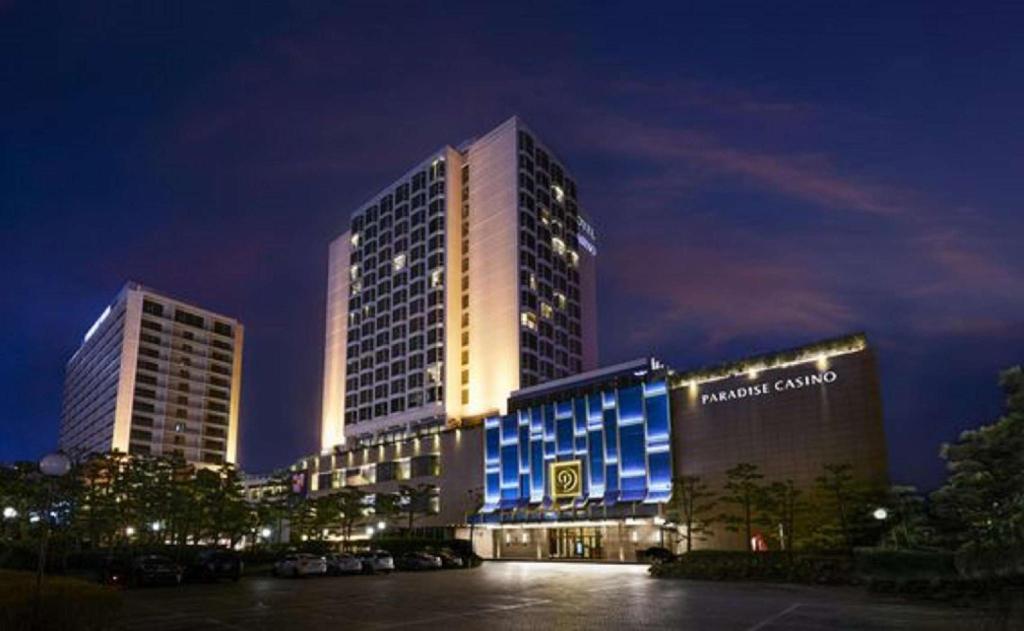
Paradise Hotel Busan
Busan
Beach 400 m · Spa · Pool
See prices and rooms →

★★★★
Commodore Hotel Busan
Busan
Pool · Parking
See prices and rooms →

★★★★
Grab the Ocean SONGDO
Busan
Parking
See prices and rooms →

★★★★★
Park Hyatt Busan
Haeundae Beach
Spa · Pool · Parking
See prices and rooms →

★★★★
Haeundae Centum
Busan
Parking
See prices and rooms →

★★★★★
Hotel Aqua Palace
Busan
Spa · Pool · Parking
See prices and rooms →
Getting around
The subway is clean, cheap and signed in English, and it links Busan Station, Nampo-dong, Seomyeon, Gwangalli and Haeundae. Buses fill the gaps to Gamcheon, Taejongdae and the temples, and taxis are good value. The city is long and thin, so crossing it takes time: allow close to an hour between Nampo-dong and Haeundae.
When to go
Spring and autumn are the most comfortable seasons, with mild days and clear skies; cherry blossom arrives around late March and early April. Summer is hot, humid and very busy on the beaches, with a rainy spell usually in early summer. The Busan International Film Festival takes over the city each autumn.
Questions about visiting Busan
- What is Busan best known for?
- Beaches, seafood and its port. Haeundae is Korea's most famous beach, Jagalchi is the country's biggest fish market, and the city hosts Asia's leading film festival every autumn.
- How many days do you need in Busan?
- Three days covers the beaches, Gamcheon, the markets and a temple or two without rushing. Add a fourth for a day trip to Gyeongju.
- Is Busan worth visiting?
- Yes. It is more relaxed than Seoul, with a coastline, great food and enough sights for a long weekend, and the high-speed train from the capital takes under three hours.
- What is there to do in Busan with kids?
- Ride the sky capsules at Haeundae Blueline Park, take the Songdo cable car across the bay, play on Haeundae Beach and explore the painted alleys of Gamcheon Culture Village.
- Do you need a car in Busan?
- No. The subway, buses and inexpensive taxis reach everything, and driving in the hilly, busy city is more trouble than it is worth.
More guides
- Where to stay in Busan
- The best things to do in London
- The best things to do in Edinburgh
- The best things to do in Manchester
- The best things to do in York
- The best things to do in Amsterdam
- The best things to do in Birmingham
- The best things to do in Liverpool
- The best things to do in Bristol
- The best things to do in Barcelona
- The best things to do in Budapest
- The best things to do in Cambridge
- The best things to do in Dublin
- The best things to do in Krakow