
You walk out of Cologne's main station and the cathedral is simply there, two black Gothic spires filling the sky, so close you have to tip your head right back. It is one of the great arrivals in European travel. It also sets the tone, because Cologne is a city that puts its best things where you can get at them.
This is not Germany's prettiest city: the war saw to that. It is, though, among its friendliest. Two thousand years of history, from Roman walls to Romanesque churches, sit alongside outstanding art museums, a riverfront made for strolling and a beer culture with rules all of its own. People here like to talk, laugh and stay for one more.
Don't miss
The big sights
The cathedral, the river and the old town are all a few minutes' walk from each other.
Cologne Cathedral
Landmark

Photo: Jörg Braukmann, CC BY-SA 4.0 The Dom is the largest Gothic church in northern Europe and a UNESCO World Heritage Site. Building began in 1248 and was not finished until 1880, and its twin spires have defined the city's skyline ever since. Inside, the nave soars, light pours through medieval and modern stained glass, and behind the high altar gleams the golden Shrine of the Three Kings.
You can climb more than five hundred steps up the south tower for a view over the Rhine. Your legs will remember it the next day.
Tip: There is no lift up the tower, and the spiral stair is narrow. Go early to avoid meeting too many people coming down.
Hohenzollern Bridge
Landmark

Photo: Thomas Wolf (Der Wolf im Wald), CC BY-SA 3.0 The railway bridge that carries trains across the Rhine into the main station has a footpath along one side, and its fence is covered, end to end, in love locks. Tens of thousands of padlocks, engraved with names and dates, have been clipped on by couples, who then throw the key into the river.
Cross to the far bank for the classic view of Cologne: the bridge's three iron arches leading the eye straight to the cathedral.
Tip: Walk over at dusk and look back from the Deutz side as the cathedral lights come on.
The Old Town and Great St Martin
Neighbourhood

Photo: Leandro Neumann Ciuffo, CC BY 2.0 Cologne's Altstadt, rebuilt after the war, runs along the Rhine in a tangle of lanes and squares. The prettiest corner is the Fischmarkt, where a row of narrow, pastel-painted houses stands beneath the massive tower of Great St Martin, one of the city's twelve Romanesque churches.
The squares of Alter Markt and Heumarkt are lined with brewhouses and restaurants, and the riverside promenade fills with walkers on any fine day.
Museums
Museum Ludwig
Museum

Photo: Jorge Franganillo, CC BY 4.0 Right beside the cathedral, Museum Ludwig is one of Europe's leading museums of modern art. It is famous for its Pop Art, with major works by Andy Warhol and Roy Lichtenstein, and holds one of the largest Picasso collections anywhere, together with German Expressionism and the Russian avant-garde. The building is bright and easy to get around. Art lovers should set aside a few hours.
Wallraf-Richartz Museum
Museum
For older art, head to the Wallraf-Richartz, a short walk from the cathedral beside the old Town Hall. Its collection runs from luminous medieval altarpieces of the Cologne school through Rubens and Rembrandt to a strong group of Impressionist and Post-Impressionist paintings. It is calmer than Museum Ludwig and makes a perfect contrast to it.
Chocolate Museum
Museum

Photo: Dietmar Rabich, CC BY-SA 4.0 On a spit of land in the Rhine, built like a glass ship, the Chocolate Museum follows cocoa from the tropical plant to the finished bar. There is a small working production line, a hothouse of cocoa trees and, the moment everyone waits for, a tall chocolate fountain where wafers are dipped and handed out. Children adore it. Adults pretend they came for the history.
Tip: It gets busy at weekends and in school holidays, so aim for a weekday morning if you can.
The Fragrance Museum at Farina House
Museum

Photo: Fred Romero from Paris, France, CC BY 2.0 Eau de Cologne means water from Cologne, and it was first made here in the early eighteenth century by the Italian-born perfumer Johann Maria Farina. The house where he worked, opposite the Town Hall, is now a small museum of perfume, visited on guided tours that end with a sniff of the original scent. A light, charming hour, and a good source of presents.
Neighbourhoods and the river
The Belgian Quarter
Neighbourhood
West of the centre, in streets named after Belgian cities, is Cologne's most stylish district. Handsome old apartment buildings house independent fashion shops, galleries, cafés and bars, and on warm evenings a young crowd gathers on Brüsseler Platz, around the church in the middle of the square. Come here to shop in the afternoon and to drink in the evening.
Rheinauhafen
Neighbourhood

Photo: Rolf Heinrich, Köln, CC BY 3.0 The old harbour south of the centre has been rebuilt as a sleek waterfront quarter. Its landmarks are the three Kranhäuser, or crane houses, glass towers shaped like the dockside cranes that once worked here, cantilevered out over the water. A promenade runs the length of it, past converted warehouses, to the Chocolate Museum. It is a fine riverside walk on a sunny afternoon.
The Rhine promenade in Deutz
Activity

Photo: Raimond Spekking, CC BY-SA 4.0 The best views of Cologne are from the other side. On the right bank in Deutz, a broad flight of steps called the Rheinboulevard runs down to the water, where locals sit with a drink and watch the sun set behind the cathedral and the old town. Just behind, the viewing platform on top of the KölnTriangle tower gives the same panorama from high above.
Eat, drink and celebrate
Cologne's traditions, most of which involve a small glass of beer.
Kölsch and the brewhouses
Food
Kölsch is Cologne's own beer: pale, crisp and served in slim little glasses that hold barely a few mouthfuls. In the traditional brewhouses, blue-aproned waiters called Köbes carry them round on circular trays and replace your empty glass without being asked, marking a tally on your beer mat.
The food is hearty Rhineland cooking. Order a Halve Hahn and you will get not half a chicken but a rye roll with a slab of cheese, a favourite local joke.
Tip: The beer keeps coming until you put your beer mat on top of your glass. That is the signal to stop.
Cologne Carnival
Activity
Carnival is known here as the fifth season, and Cologne celebrates it harder than anywhere in Germany. It opens officially on 11 November, but the real madness comes in the days before Lent, when the whole city puts on fancy dress and takes to the streets and bars. The climax is the Rose Monday parade, with floats, marching bands and showers of sweets.
Tip: Wear a costume, however simple, and learn the local cheer: Kölle Alaaf.
The Christmas markets
Market

Photo: CGP Grey, CC BY 2.0 From late November, Cologne turns into one of Germany's great Christmas cities. Several markets are spread around the centre, each with its own character: one under a canopy of lights at the foot of the cathedral, another filling the old town squares with wooden huts and an ice rink. Expect mulled wine in collectable mugs, roasted almonds, potato pancakes and a great many people.
Day trips
Palaces, a former capital and a castle on a crag, all a short train ride away.
Brühl Palaces
Day trip

Photo: Martin Falbisoner, CC BY-SA 4.0 In the small town of Brühl, between Cologne and Bonn, stand two eighteenth-century palaces built for the prince-archbishops of Cologne. Augustusburg is a masterpiece of Rococo, with a breathtaking ceremonial staircase, and an avenue through the park leads to the little hunting lodge of Falkenlust. Together with their formal gardens they are a UNESCO World Heritage Site. The palace is just across from the station.
Phantasialand
Activity
Also in Brühl, Phantasialand is one of Germany's best-known theme parks, with elaborately themed areas and a strong line-up of roller coasters and water rides, alongside gentler attractions for small children. It is the big family day out from Cologne, and thrill-seekers rate its coasters highly. Allow a full day, and expect queues in school holidays.
Bonn
Day trip

Photo: Asif Masimov, CC BY-SA 3.0 A short train ride up the Rhine, Bonn was the capital of West Germany for forty years and is the birthplace of Ludwig van Beethoven. The house where the composer was born is now a museum, the old town is pleasant and unhurried, and a row of major museums along the river covers German history and modern art. In spring, its cherry blossom streets are a sight.
Drachenfels
Day trip

Photo: Dietmar Rabich, CC BY-SA 4.0 South of Bonn, the Drachenfels, or Dragon's Rock, rises steeply from the bank of the Rhine at Königswinter, crowned by a ruined medieval castle. A historic rack railway climbs the hill, passing the turreted nineteenth-century Schloss Drachenburg on the way. From the top, the view sweeps along the river valley. This is the Rhine of legend, and an easy outing with children.
Where to stay in Cologne
Not sure which area suits you? Read our guide: Where to stay in Cologne →

★★★★
Lindner Cologne City Plaza, part of JdV by Hyatt
Koln
Pets allowed · Parking
From £121 a night, taxes incl.2 adults · checked 14 Nov, 01:52

★★★★
&REPEAT Köln Airport
Cologne
Parking
From £125 a night, taxes incl.2 adults · checked 14 Nov, 01:52

★★★★★
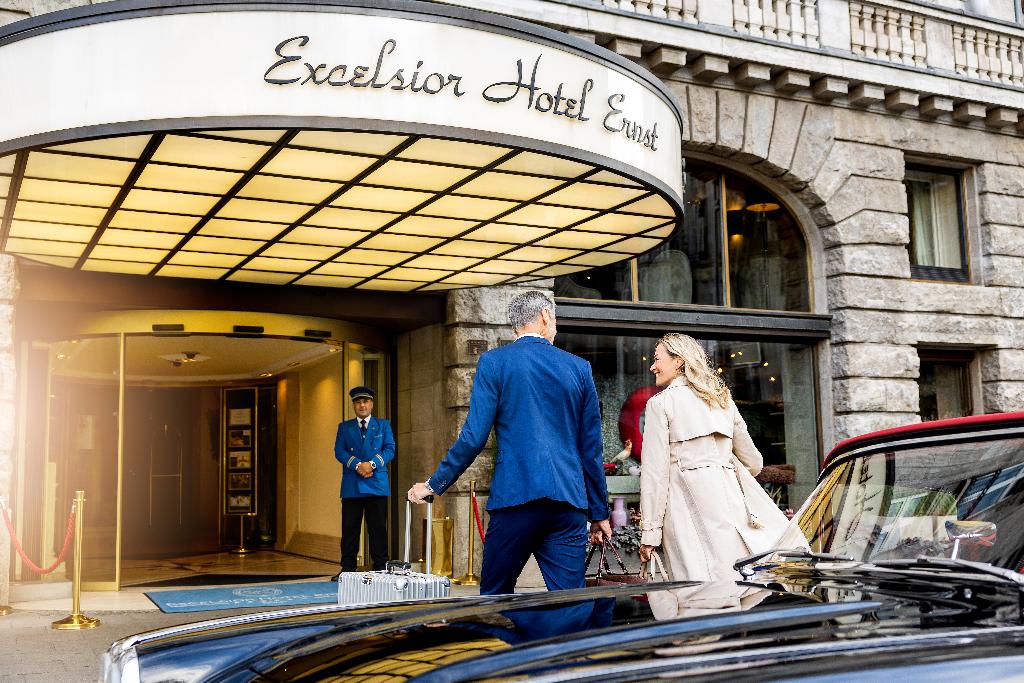
Excelsior Hotel Ernst am Dom
Cologne
Pets allowed · Parking
From £303 a night, taxes incl.2 adults · checked 14 Nov, 01:52

★★★★
25hours Hotel The Circle
Koeln
Parking
From £133 a night, taxes incl.2 adults · checked 14 Nov, 01:52

★★★★
Adina Apartment Hotel Cologne
Cologne
Pool · Parking
From £175 a night, taxes incl.2 adults · checked 14 Nov, 01:52

★★★★★
Dorint Hotel Am Heumarkt Köln
Cologne
Pets allowed · Parking
From £113 a night, taxes incl.2 adults · checked 14 Nov, 01:52

★★★★
Am Augustinerplatz
Köln
Spa · 53 rooms · Parking
From £114 a night, taxes incl.2 adults · checked 14 Nov, 01:52

★★★★★
Hotel Wasserturm Cologne, Curio Collection
Colonia
Spa · Parking
From £170 a night, taxes incl.2 adults · checked 14 Nov, 01:52
Getting around
The cathedral, the museums, the old town and the river are all within walking distance of the main station. Trams and the underground cover the rest of the city, and frequent regional trains run to Brühl and Bonn. You do not need a car, and parking in the centre is a nuisance.
When to go
Cologne is a year-round city break. Summers are warm and the riverside comes alive. Late November and December bring the Christmas markets, and the days before Lent bring Carnival: both are huge fun and very busy, so book early. Winters are cool and often grey.
Questions about visiting Cologne
- What is Cologne best known for?
- Its vast Gothic cathedral, Carnival, Kölsch beer, eau de Cologne, Christmas markets and a lively, easy-going character, all on the banks of the Rhine.
- How many days do you need in Cologne?
- Two days cover the cathedral, the old town, a museum or two and an evening in a brewhouse. Add a third for a day trip to Brühl, Bonn or the Drachenfels.
- What is there to do in Cologne with kids?
- The Chocolate Museum is the favourite, along with climbing the cathedral tower and walking across the love-lock bridge. Phantasialand in nearby Brühl is a full day of rides, and the rack railway up the Drachenfels is fun for all ages.
- Is Cologne worth visiting?
- Yes. The cathedral is one of the great sights of Germany, the art museums are first-rate, and the brewhouse culture and friendly locals make it one of the country's most enjoyable cities for a weekend.
- Do you need a car in Cologne?
- No. The centre is compact and walkable, and trains reach Brühl, Bonn and Königswinter easily.
More guides
- Where to stay in Cologne
- The best things to do in London
- The best things to do in Edinburgh
- The best things to do in Manchester
- The best things to do in York
- The best things to do in Amsterdam
- The best things to do in Birmingham
- The best things to do in Liverpool
- The best things to do in Bristol
- The best things to do in Barcelona
- The best things to do in Budapest
- The best things to do in Cambridge
- The best things to do in Dublin
- The best things to do in Krakow