
Dusseldorf has a reputation as Germany's well-dressed rich relation, all fashion houses, advertising agencies and trade fairs. That is true as far as it goes. But it misses the other half of the city, which is to be found a few streets away in the Old Town, standing shoulder to shoulder in a brewery tavern with a small glass of dark beer in its hand.
That mix is the fun of it. This is a place where you can window-shop along one of Europe's smartest boulevards, look at Paul Klee and Andy Warhol, admire a set of wonky buildings by Frank Gehry, eat first-rate ramen and still be at the bar by six. The Rhine, wide and busy, runs through the middle and ties it all together.
Don't miss
The big sights
The Altstadt
Neighbourhood

Photo: Marek Gehrmann, CC BY-SA 3.0 Dusseldorf's Old Town packs several hundred bars, pubs and restaurants into a small grid of cobbled lanes, which is how it earned its nickname: the longest bar in the world. It is busy from late afternoon and heaving at weekends, with drinkers spilling into the streets.
By day it is a pleasant place to wander, with the old town hall and its equestrian statue on the market square, the Burgplatz with its lone castle tower by the river, and the oddly twisted spire of St Lambertus.
The Rhine promenade
Activity

Photo: Dietmar Rabich, CC BY-SA 4.0 In the 1990s the city buried its riverside road in a tunnel and gave the bank back to people. The result is a broad, tree-lined promenade running from the Old Town to the harbour, with cafés on the lower level, steps for sitting on and barges sliding past.
On a sunny evening half of Dusseldorf seems to be here, strolling, skating or watching the sun set over the river. It is the single best free thing to do in the city.
Tip: Boat trips along the Rhine leave from the landing stages by the Burgplatz.
The Königsallee
Neighbourhood

Photo: Stöhrfall (talk) 18:38, 8 August 2010 (UTC), Public domain Known to everyone simply as the Kö, this is one of the most elegant shopping streets in Germany. A long, straight canal runs down the middle, shaded by chestnut and plane trees and crossed by ornamental bridges. One side is lined with banks; the other with every luxury label you can name.
Even if you have no intention of buying anything, it is a lovely walk, and a fine place to sit with a coffee and watch the well-heeled go by.
The MedienHafen
Neighbourhood

Photo: Dietmar Rabich, CC BY-SA 4.0 Dusseldorf's old river harbour has been reinvented as a district of media firms, design studios and restaurants, with an open-air gallery of modern architecture along the quays. The stars are three buildings by Frank Gehry: leaning, curving towers, one white, one brick and one clad in mirror-bright metal.
Old warehouses and cranes survive among the new blocks. Come in the late afternoon to look around, then stay for dinner or a drink by the water.
The Rhine Tower
Landmark

Photo: Dietmar Rabich, CC BY-SA 4.0 The tall concrete needle between the Old Town and the harbour is the Rheinturm, the city's telecommunications tower and the tallest thing in Dusseldorf by a wide margin. A fast lift whisks you to a viewing deck with slanting windows that you can lean out over.
On a clear day the view runs along the Rhine as far as the spires of Cologne Cathedral. The lights running up the shaft at night are a giant clock, though it takes a while to learn to read it.
Art and gardens
The city's art academy trained Joseph Beuys and Gerhard Richter, and its museums are among the best in Germany.
K20 and K21
Museum

Photo: Ralf Houven, CC BY 3.0 The art collection of the state of North Rhine-Westphalia is split between two buildings. K20, behind a curving wall of polished black granite on the edge of the Old Town, covers the twentieth century and is first-class: Picasso, Matisse, Kandinsky, Pollock and Warhol, and an outstanding group of works by Paul Klee, who taught in Dusseldorf.
K21, in a grand former parliament building beside a lake to the south, takes up the story with contemporary art and installations.
The Kunstpalast
Museum

Photo: Paul Hermans, CC BY-SA 3.0 At the northern end of the Rhine promenade, in a monumental brick complex of the 1920s, the Kunstpalast is the city's broadest museum. Its collection ranges from old masters, including Rubens, through nineteenth-century painters of the Dusseldorf school to modern art, design and one of Europe's great collections of glass.
It is a good choice if you want one museum that covers a bit of everything. The courtyard and its fountain are worth a pause too.
The Hofgarten
Nature
Stretching from the Old Town to the Kö and beyond, the Hofgarten is Germany's oldest public park, laid out in the eighteenth century. It is a place of winding paths, old trees, ponds with swans and small bridges, with a pink hunting lodge, Schloss Jägerhof, at one end.
It is the natural short cut between the city's main sights, and a pleasant spot for a picnic or a rest between museums.
Eat and drink
Altbier in a brewery tavern
Food

Photo: © 1971markus, CC BY-SA 4.0 Dusseldorf's own beer is Altbier: copper-brown, top-fermented, crisp and slightly bitter. The way to drink it is in one of the handful of traditional brewery taverns in the Old Town, where it is brewed on the premises and poured straight from wooden barrels into small, straight glasses.
The blue-aproned waiters, known as Köbes, will bring you a fresh one the moment yours is empty and mark your beer mat each time. Put the mat on top of the glass when you have had enough.
Tip: Do not order a Kölsch. That is the beer of Cologne, the great local rival, and you will be teased for it.
Little Tokyo
Food
Dusseldorf is home to one of the largest Japanese communities in Europe, the legacy of the many Japanese companies that set up here after the war. Its centre is the area around Immermannstrasse, between the main station and the Kö.
Here you will find ramen bars with queues out of the door, sushi counters, izakayas, Japanese bakeries, bookshops and supermarkets. It is the best place in Germany for Japanese food, and a welcome change after a few days of pork and potatoes.
Carlsplatz Market
Market

Photo: Pixelcrew, CC BY-SA 3.0 On the southern edge of the Old Town, a permanent market of covered stalls sells the best produce in the city: fruit and vegetables, bread, cheese, fish, flowers and spices. It is just as popular for eating as for shopping.
At lunchtime, office workers crowd around the stands for soup, fried fish, potato pancakes, oysters and a glass of wine. Join them. It is a quick way to try Rhineland specialities without sitting down to a full meal.
Out of the centre
Kaiserswerth
Neighbourhood

Photo: Tuxyso, CC BY-SA 4.0 One of the oldest parts of Dusseldorf lies on the Rhine to the north, and feels like a village of its own. Its centre is a cobbled market square of baroque brick houses under lime trees.
On the riverbank stand the massive ruins of an imperial palace enlarged by Emperor Frederick Barbarossa in the twelfth century. Beside them is a beer garden looking over the water. It makes a perfect sunny afternoon, reached by tram or, in season, by boat from the Old Town.
Schloss Benrath
Landmark

Photo: A.Savin, CC BY-SA 3.0 In the southern suburbs, beside a long reflecting pond, stands a pink rococo pleasure palace built in the eighteenth century for the Elector Palatine. It looks modest from the front, a trick of the design: there are dozens of rooms hidden inside.
Behind it is a large park of formal gardens, canals and woodland running down to the Rhine. Guided tours show the interior, but the gardens alone justify the tram ride. It is especially lovely in spring.
Day trips
Cologne
Day trip

Photo: Rolf Heinrich, Köln, CC BY 3.0 Dusseldorf's bigger neighbour and sworn rival is less than half an hour away by fast train. You step out of the station straight into the shadow of its Gothic cathedral, one of the largest in the world and a UNESCO World Heritage Site, with twin spires you can climb.
Add a Roman museum, a clutch of Romanesque churches, a chocolate museum on the river and a rival beer to compare. Just keep your opinion on which is better to yourself until you are home.
The Neanderthal Museum
Day trip
In 1856, quarry workers in a wooded valley just east of Dusseldorf dug up some unusual bones. They turned out to belong to an unknown kind of early human, who took the name of the place: the Neander valley, or Neanderthal.
A modern museum near the spot tells the story of human evolution with lifelike reconstructions and plenty to touch and try. A trail leads to the discovery site itself. It is an excellent outing for families, reached by local train.
Where to stay in Dusseldorf
Not sure which area suits you? Read our guide: Where to stay in Dusseldorf →

★★★★
Clayton Hotel Düsseldorf
Dusseldorf
Spa · Pool · Parking
From £90 a night, taxes incl.2 adults · checked 14 Nov, 18:07

★★★★
MUZE Hotel Dusseldorf - Handwritten Collection
Düsseldorf
60 rooms · Pets allowed
From £79 a night, taxes incl.2 adults · checked 14 Nov, 18:07

★★★★★
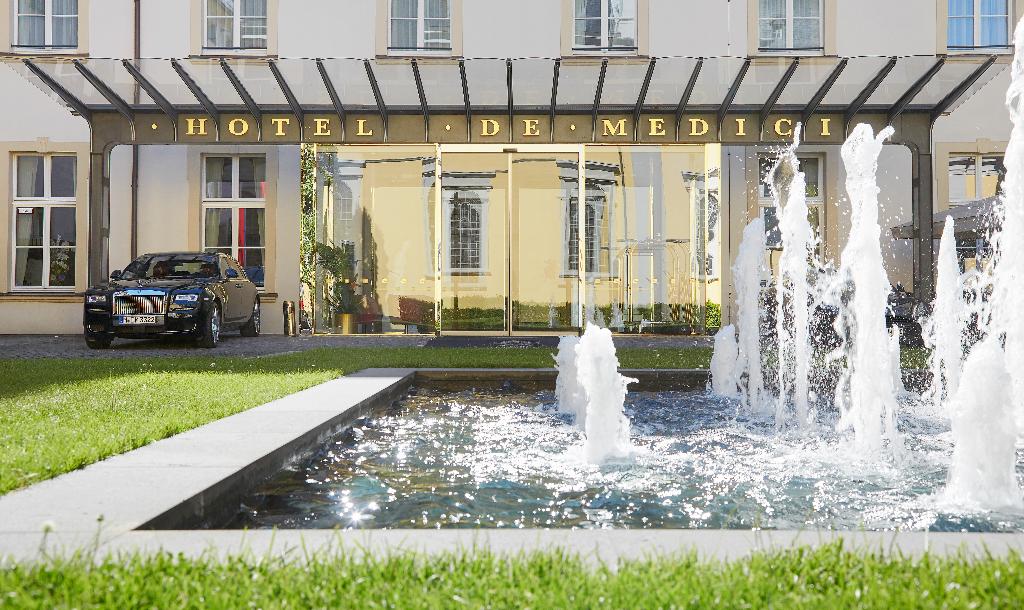
Living Hotel De Medici
Dusseldorf
Parking
From £173 a night, taxes incl.2 adults · checked 14 Nov, 18:07

★★★★
25hours Hotel Duesseldorf Das Tour
Duesseldorf
Parking
From £85 a night, taxes incl.2 adults · checked 14 Nov, 18:07

★★★★
Auszeit Hotel Dusseldorf
Dusseldorf
48 rooms · Parking
See prices and rooms →

★★★★★
Breidenbacher Hof
Dusseldorf
Spa · Pool · Pets allowed
From £414 a night, taxes incl.2 adults · checked 14 Nov, 12:17

★★★★
b'mine Duesseldorf, WorldHotels Crafted
Düsseldorf
Parking
From £90 a night, taxes incl.2 adults · checked 14 Nov, 18:07

★★★★★
Hyatt Regency Dusseldorf
Dusseldorf
Spa · Parking
From £183 a night, taxes incl.2 adults · checked 14 Nov, 12:15
Getting around
The Old Town, the Kö, the Hofgarten and the riverfront are all within walking distance of one another, and the MedienHafen is a pleasant stroll along the promenade. Trams and the U-Bahn reach Kaiserswerth and Benrath, and the airport is a short train ride from the centre.
When to go
Late spring to early autumn is best for the riverside and beer gardens. The city lets its hair down for carnival in late winter and for a huge funfair on the Rhine in July, and has a spread of Christmas markets in December. Hotels fill up during big trade fairs.
Questions about visiting Dusseldorf
- What is Dusseldorf best known for?
- Fashion and shopping on the Königsallee, the bars of the Altstadt and its Altbier, modern architecture in the MedienHafen, a strong art scene and one of the largest Japanese communities in Europe.
- Is Dusseldorf worth visiting?
- Yes. It is a relaxed and stylish city for a weekend, with excellent museums, a lively Old Town, good food and the Rhine on its doorstep. Cologne is close enough to add as a day trip.
- How many days do you need in Dusseldorf?
- Two days covers the Old Town, the riverfront, the Kö, the MedienHafen and a museum. A third gives you time for Kaiserswerth, Schloss Benrath or a trip to Cologne.
- What is there to do in Dusseldorf with kids?
- Go up the Rhine Tower, take a boat trip on the river, run about in the Hofgarten or the park at Schloss Benrath, and spend a day at the Neanderthal Museum.
- Do you need a car in Dusseldorf?
- No. The centre is walkable, and trams, the U-Bahn and local trains cover the suburbs, the airport and neighbouring cities.
More guides
- Where to stay in Dusseldorf
- The best things to do in London
- The best things to do in Edinburgh
- The best things to do in Manchester
- The best things to do in York
- The best things to do in Amsterdam
- The best things to do in Birmingham
- The best things to do in Liverpool
- The best things to do in Bristol
- The best things to do in Barcelona
- The best things to do in Budapest
- The best things to do in Cambridge
- The best things to do in Dublin
- The best things to do in Krakow