
Geneva sits at the tip of the largest lake in the Alps, with a plume of water shooting into the sky and Mont Blanc floating on the horizon. It is a small city with an outsized job: home of the United Nations in Europe, the Red Cross, and more watchmakers and private bankers than seems strictly necessary.
Behind the diplomatic polish there is plenty to enjoy. A hilltop old town of grey stone and quiet squares. A lakeside bathing pier where locals swim in summer and eat fondue in winter. A village-like quarter built by an Italian king. And within an hour or so, some of the finest mountain and lake scenery in Europe.
Don't miss
The big sights
The lake, the old town on its hill and the city's most photographed clock.
Jet d'Eau
Landmark

Photo: Markus Bernet, CC BY-SA 2.5 Geneva's emblem is a single jet of water fired some 140 metres straight up from the lake. It began life in the nineteenth century as a pressure release valve for a hydraulic plant, and the city liked it so much it made it permanent. You can see it from almost anywhere along the shore.
A stone jetty leads right out to its base. Whether you stay dry depends entirely on the wind.
Tip: Walk out along the jetty on a sunny day to see rainbows in the spray, and keep your camera somewhere waterproof.
St Pierre Cathedral and the Old Town
Landmark

Photo: Torbjorn Toby Jorgensen, CC BY-SA 2.0 The Vieille Ville climbs a hill on the left bank, a tight knot of cobbled streets, grey stone townhouses, antique shops and fountains. At the top stands St Pierre Cathedral, where John Calvin preached and made Geneva the capital of the Reformation. Climb its towers for a wide view of the city, the lake and the mountains.
Below it, the Place du Bourg-de-Four is the oldest square in the city and the best spot for a coffee on a terrace.
The Flower Clock and Jardin Anglais
Landmark

Photo: Cayambe, CC BY-SA 3.0 At the edge of the lakeside English Garden, a working clock several metres across is planted with thousands of flowers, replanted through the seasons. It is a nod to the city's watchmaking tradition, and everyone stops for a photograph. The garden behind it is a pleasant strip of lawns, old trees and a bandstand along the waterfront, with the Jet d'Eau in view.
The Reformation Wall
Landmark

Photo: Guilhem Vellut from Annecy, France, CC BY 2.0 In the Parc des Bastions, under the walls of the old town, a long stone monument honours the leaders of the Protestant Reformation. Four stern giants, Calvin among them, stand at its centre. The park itself is a favourite with students from the university next door, who play on the giant chessboards by the gate. It suits a quiet half hour between sights.
International Geneva and museums
Palais des Nations
Landmark

Photo: Yann Forget, CC BY-SA 3.0 The European headquarters of the United Nations occupies a vast 1930s palace in a park above the lake, originally built for the League of Nations. Guided tours take visitors through the assembly halls and council chambers where world affairs are thrashed out.
Outside the gates, on the Place des Nations, stands the Broken Chair, a giant wooden chair with one shattered leg, a memorial to the victims of landmines.
Tip: Tours must be booked in advance and you will need your passport to get in.
International Red Cross and Red Crescent Museum
Museum
The Red Cross was founded in Geneva, and its museum, just across the road from the United Nations, is one of the most thought-provoking in Switzerland. Through personal testimony, archive material and inventive displays, it explores humanitarian work in three themes: defending human dignity, restoring family links and reducing natural risks. It is serious and affecting, and best for adults and older children.
CERN
Museum

Photo: Photograph by Mike Peel (www.mikepeel.net)., CC BY-SA 4.0 On the outskirts of Geneva, straddling the French border, CERN is the laboratory where physicists smash particles together in the Large Hadron Collider, a ring of tunnel deep underground. Its visitor centre, the Science Gateway, has hands-on exhibitions that explain the science with real flair. You need no background in physics, and curious children love it. A tram runs there from the main station.
Patek Philippe Museum
Museum
Geneva has been making watches for five centuries, and this museum shows the craft at its most extravagant. Several floors of cases hold antique pocket watches, enamelled miniatures, musical automata and the creations of one of the city's most prestigious houses. It is a place to peer closely and marvel at what patient hands can do. Watch enthusiasts will be here for hours.
The lake and neighbourhoods
Bains des Pâquis
Activity

Photo: Alexey M., CC BY-SA 4.0 A public bathing pier that sticks out into the lake from the right bank, and Geneva's most democratic institution. In summer, everyone from bankers to students comes to swim, sunbathe on the concrete and eat lunch at the canteen. In winter it turns into a sauna and hammam, and the same canteen serves a much-loved fondue.
The view takes in the Jet d'Eau, the old town and the mountains behind.
Lake Geneva cruises
Activity

Photo: Terragio67, CC BY-SA 4.0 Boats criss-cross the lake from the quays in the centre, from short harbour tours to longer cruises past villas, vineyards and villages, some on elegant old paddle steamers. Closer in, little yellow water taxis called mouettes shuttle between the two banks and count as public transport. Any of them gives you the best view of the city: from the water, with the Alps behind.
Carouge
Neighbourhood

Photo: HJPD, CC BY 3.0 A short tram ride south of the centre, Carouge was laid out in the eighteenth century by the kings of Sardinia, and it still looks more Italian than Swiss: low pastel houses, shuttered windows, hidden courtyard gardens and leafy squares. Today it is full of craft workshops, independent boutiques, cafés and bars. Come for a lazy afternoon and stay for dinner.
Eat and drink
Fondue
Food

Photo: Brücke-Osteuropa, CC0 Melted cheese is a serious matter in this part of Switzerland. A classic fondue blends Gruyère and Vacherin with white wine in a shared pot, kept bubbling at the table, into which you dip cubes of bread on long forks. It is winter food at heart, though you will find it all year. Lake fish, especially fillets of perch with chips, is the other local favourite.
Tip: Scrape up the crust of toasted cheese left at the bottom of the pot. The Swiss consider it the best bit.
Day trips
Mountains and lakeside towns, several of them just over the border in France.
Mont Salève
Day trip
The long limestone ridge that looms behind Geneva is actually in France, a few minutes from the edge of the city. A cable car swings up the cliff face to the top, where there are walking trails, paragliders launching into space and a panorama over the whole city, the lake and the Jura on one side and Mont Blanc on the other.
Tip: It is across the border, so carry your passport.
Chamonix and Mont Blanc
Day trip

Photo: Christian David, CC BY-SA 4.0 The French mountain town of Chamonix lies at the foot of Mont Blanc, the highest peak in the Alps. From the town, a cable car climbs to the Aiguille du Midi, a needle of rock high among the glaciers with staggering views of the summit, and a rack railway runs up to the Mer de Glace glacier.
It is the most dramatic day out from Geneva, in summer or winter. Coaches and tours make the journey from the city.
Tip: Take warm clothes even in August: it is cold at the top of the cable car. Bring your passport too.
Montreux and Château de Chillon
Day trip

Photo: Christian David, CC BY-SA 4.0 At the far eastern end of the lake, Montreux is a genteel resort with a flower-lined promenade, palm trees and a famous jazz festival each summer. A short walk or boat ride along the shore stands the Château de Chillon, a medieval castle on a rock in the lake, with towers, dungeons and courtyards. It is among the most visited historic monuments in Switzerland.
Annecy
Day trip
Over the border in France, Annecy is a storybook old town threaded with canals and flower-decked bridges, set on a lake of startlingly clear, turquoise water with mountains all round. There is a medieval prison on an island in the middle of a canal, a hilltop castle and a lakeside park for picnics. In summer, people swim and hire pedalos.
Where to stay in Geneva
Not sure which area suits you? Read our guide: Where to stay in Geneva →

★★★★
Warwick Geneva
Geneva
Parking
From £240 a night, taxes incl.2 adults · checked 14 Nov, 07:52

★★★★
Maison du Lac Boutique Hôtel
Nyon
30 rooms · Parking
From £228 a night, taxes incl.2 adults · checked 14 Nov, 07:52

★★★★★
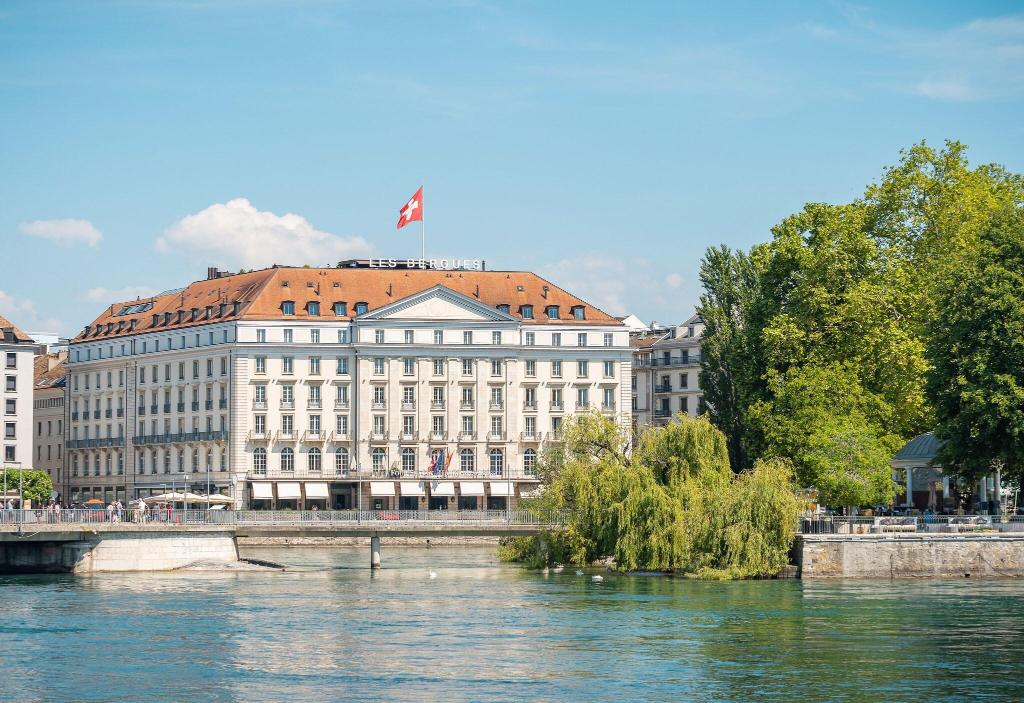
Four Seasons Hotel des Bergues Geneva
Geneva
Spa · Pool · Pets allowed
From £1,575 a night, taxes incl.2 adults · checked 14 Nov, 07:52

★★★★
Adina Apartment Hotel Geneva
Geneva
Spa · Parking
From £174 a night, taxes incl.2 adults · checked 14 Nov, 07:52

★★★★
Appart'City Collection Geneve Aeroport Vernier
Vernier
Pets allowed · Parking
From £107 a night, taxes incl.2 adults · checked 14 Nov, 07:52

★★★★★
Hotel Les Armures
Geneva
Pets allowed · Parking
From £494 a night, taxes incl.2 adults · checked 14 Nov, 07:52

★★★★
Auberge Port-Gitana
Geneva Airport
Adults only · 17 rooms · Pets allowed
From £224 a night, taxes incl.2 adults · checked 14 Nov, 07:52

★★★★★
InterContinental Geneva
Geneve
Spa · Pool · Pets allowed
From £390 a night, taxes incl.2 adults · checked 14 Nov, 07:52
Getting around
Geneva is compact, and the lakefront and old town are easily walked. Trams and buses are frequent, the airport is a few minutes from the main station by train, and the yellow mouette boats cross the harbour. Many day trips cross into France, so keep your passport with you. A car is only useful for touring the wider region.
When to go
Summer is warm and made for the lake, with swimming, boat trips and outdoor festivals. Winter is cold, sometimes grey in the city, but the ski resorts of the Alps are close. Spring and autumn are mild and quieter. Mont Blanc is clearest on crisp, bright days.
Questions about visiting Geneva
- What is Geneva best known for?
- The Jet d'Eau fountain on Lake Geneva, the United Nations and the Red Cross, luxury watches, chocolate, its role in the Reformation and views of Mont Blanc and the Alps.
- How many days do you need in Geneva?
- The city itself can be seen in one or two days. Allow three or four if you want to add day trips to Chamonix, Montreux and Château de Chillon, or Annecy.
- What is there to do in Geneva with kids?
- A boat trip on the lake, swimming at the Bains des Pâquis in summer, the hands-on exhibitions at CERN and the cable car up Mont Salève all work well. Older children enjoy a day in Chamonix.
- Is Geneva worth visiting?
- Yes, especially as a base. The city is elegant and beautifully set, and the lake, mountains and nearby French towns give it far more variety than its buttoned-up reputation suggests.
- Do you need a car in Geneva?
- No. Public transport in the city is excellent, trains run along the lake to Montreux, and coaches and tours cover Chamonix and Annecy.
More guides
- Where to stay in Geneva
- The best things to do in London
- The best things to do in Edinburgh
- The best things to do in Manchester
- The best things to do in York
- The best things to do in Amsterdam
- The best things to do in Birmingham
- The best things to do in Liverpool
- The best things to do in Bristol
- The best things to do in Barcelona
- The best things to do in Budapest
- The best things to do in Cambridge
- The best things to do in Dublin
- The best things to do in Krakow