
Goa is India with its shoes off. The country's smallest state is a strip of palm-backed coast on the Arabian Sea, and for 450 years it was Portuguese, which is why you will find whitewashed baroque churches among the paddy fields, pork and vinegar in the curries and a siesta in the afternoon. The hippies arrived in the 1960s and, in spirit at least, never entirely left.
The beaches are the reason to come, and there is one for every temperament, from the party sands of the north to the empty crescents of the far south. But go inland too. The old capital, the spice farms and a waterfall that tumbles out of the Western Ghats are all within an easy day's drive.
Don't miss
Beaches
Lively in the north, quieter in the south, and long enough that you can always find a patch to yourself.
Palolem Beach
Beach

Photo: iMahesh, CC BY-SA 4.0 A near-perfect crescent of sand in the far south, hemmed in by wooded headlands and lined with coconut palms that lean out over colourful beach huts. The bay is sheltered and good for swimming, kayaks can be hired on the sand, and boatmen offer trips to look for dolphins. It is busy by southern standards but still very easy-going.
Agonda Beach
Beach
A few miles north of Palolem and a notch quieter, Agonda is a long, wide, open sweep of sand with a church at its centre and not much else. Cows wander past, hammocks swing outside the huts and evenings are early. Come here to read, swim and do very little.
Calangute and Baga
Beach

Photo: Slyronit, CC BY-SA 4.0 The busiest stretch of sand in Goa, and the place to come if you like company. Beach shacks serve cold beer and fried fish from breakfast onwards, watersports operators line the shore and the lanes behind are crammed with shops and restaurants. Baga, at the northern end where a creek meets the sea, has the liveliest bars and clubs.
Anjuna and Vagator
Beach

Photo: Nikhilb239, CC BY 3.0 The old heartland of Goa's hippie and trance scene. Anjuna is a rocky, palm-lined shore of beach bars and yoga studios; Vagator, just to the north, has small coves beneath dramatic red laterite cliffs. Both are at their best at sunset, when half the coast seems to gather with a drink to watch the sun go down.
Arambol and Mandrem
Beach

Photo: iMahesh, CC BY-SA 4.0 The far north is where the laid-back, bohemian Goa of legend survives. Arambol has drum circles at sunset, a freshwater lake behind a neighbouring cove and a long-stay crowd of travellers and musicians. Mandrem and Ashwem, a little to the south, are quieter and more polished, with boutique huts and wide, uncrowded sands.
Churches, forts and old streets
Basilica of Bom Jesus
Landmark

Photo: iMahesh, CC BY-SA 4.0 Old Goa was once a city to rival Lisbon. Today its great churches stand in quiet lawns beside the Mandovi River, a UNESCO World Heritage Site. The Basilica of Bom Jesus, built of dark red laterite stone, is the most revered: it holds the tomb and remains of St Francis Xavier in an ornate silver casket.
Tip: Cover shoulders and knees. Come early, before the heat and the tour buses.
Se Cathedral
Landmark

Photo: iMahesh, CC BY-SA 4.0 Across the road from the basilica, the white Se Cathedral is one of the largest churches in Asia. It took most of a century to build and has a lopsided look, having lost one of its two bell towers long ago. Inside are a vast, cool nave and a gilded altarpiece. The Church of St Francis of Assisi next door has an archaeological museum.
Fontainhas
Neighbourhood

Photo: iMahesh, CC BY-SA 4.0 The old Latin Quarter of Panaji, the state capital, is a few narrow streets of Portuguese-era houses painted ochre, blue and deep red, with tiled roofs, wrought-iron balconies and oyster-shell windows. There are small galleries, bakeries and cafés to duck into. Climb to the white church of Our Lady of the Immaculate Conception, at the top of its zigzag staircase, to finish.
Fort Aguada
Landmark

Photo: 0kumr, CC0 A 17th-century Portuguese fort on the headland south of Candolim, built to guard the mouth of the Mandovi against the Dutch. Its thick laterite walls enclose a huge freshwater cistern that once supplied passing ships, and an old lighthouse stands on top. The views along the coast and across the river are the main event.
Chapora Fort
Landmark

Photo: Nikhilb239, CC BY 3.0 Not much remains of this hilltop fort above Vagator beyond its red stone ramparts, but nobody comes for the architecture. They come for the view, over the Chapora River on one side and the beaches on the other, and for the sunset. A short, steep scramble gets you up there.
Tip: Wear proper shoes; the path is loose underfoot.
Inland
Dudhsagar Falls
Nature

Photo: soumyajit pramanick, CC BY-SA 2.0 On the border with Karnataka, deep in the forests of the Western Ghats, the Mandovi River drops more than 300 metres in four tiers of white water. The name means 'sea of milk'. A railway line crosses the face of the falls on a stone viaduct. Jeeps take visitors through the wildlife sanctuary to a pool at the bottom.
Tip: The falls are fullest just after the monsoon. Jeep access generally closes during the rains themselves.
Spice plantations of Ponda
Activity
The hills around Ponda are planted with pepper, cardamom, nutmeg, vanilla, cashew and betel palms, and several family-run farms offer guided walks through the shade to see how it all grows. Tours usually end with a Goan lunch served on a banana leaf. The area's Hindu temples, including Shri Mangeshi, are close by.
Markets and food
Anjuna Flea Market
Market

Photo: Vyacheslav Argenberg, CC BY 4.0 Started by hippies selling their belongings to fund the journey onwards, the Wednesday market at Anjuna has grown into a sprawling bazaar under the palms. Traders from all over India sell jewellery, textiles, spices, hammocks and souvenirs, and there is live music and food among the stalls. Bargaining is expected.
Tip: It runs in the dry season only. In the evening, look for the Saturday night market at Arpora.
Goan fish curry
Food

Photo: Fredericknoronha, CC BY-SA 4.0 Ask a Goan what they miss when they are away and the answer is fish curry rice: the day's catch in a tangy, orange coconut gravy sharpened with kokum, served with a mound of rice. The Portuguese left their mark on the rest of the menu, from fiery pork vindaloo to the chouriço sausage and the layered coconut dessert bebinca.
Beach shacks and feni
Food
The seasonal shack, a bamboo-and-palm-thatch restaurant put up on the sand each autumn, is a Goan institution. Sit with your feet in the sand and order grilled kingfish, butter-garlic prawns and a cold beer. Feni, the local spirit distilled from cashew fruit or coconut sap, is pungent stuff: try it in a cocktail first.
Where to stay in Goa
Not sure which area suits you? Read our guide: Where to stay in Goa →

★★★★
3102bce – A Vedic Resort
Goa
Spa · Rooftop pool · 36 rooms
See prices and rooms →

★★★★
Aguada Anchorage - The Villa Resort, Candolim
Goa
Beach 1 km · Pool · 45 rooms
See prices and rooms →
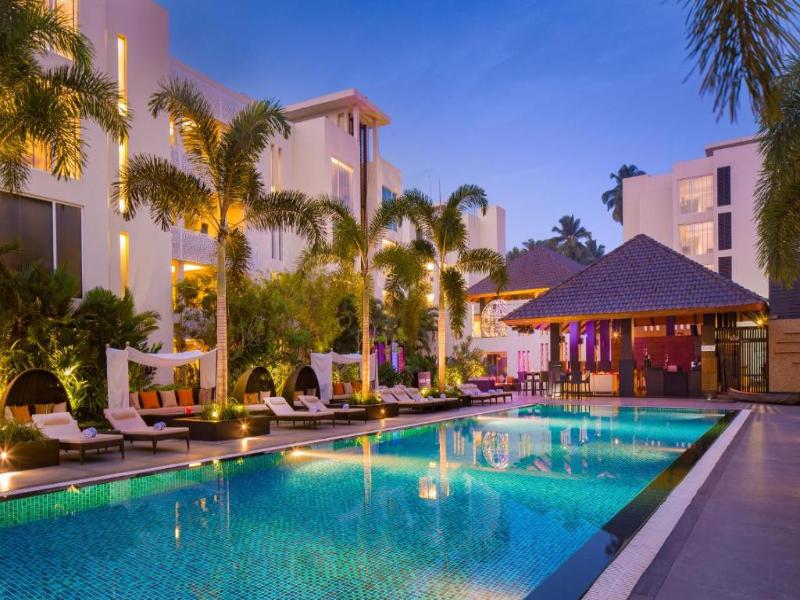
★★★★★
Hard Rock Hotel Goa
North Goa
Beach 1 km · Pool · Parking
See prices and rooms →

★★★★
Andores Resort And Spa
Calangute
Spa · Pool · 25 rooms
See prices and rooms →

★★★★
Beleza By The Beach
Goa
Spa · Pool · Parking
See prices and rooms →

★★★★★
O Hotel Goa Candolim beach
North Goa
Beach 100 m · Spa · Pool
See prices and rooms →

★★★★
De Mandarin Beach Resort Suites & Villas Goa
North Goa
Pool · Parking
See prices and rooms →

★★★★★
W Goa
Vagator, Bardez
Spa · Pool · Family-friendly
See prices and rooms →
Getting around
Goa is small, but its roads are slow and winding. Taxis are the simplest way to travel between areas, and hiring a car with a driver for a day's sightseeing is common. Many visitors rent scooters; ride carefully, wear a helmet and carry your licence. Local buses are cheap and link the main towns.
When to go
The season runs from November to March, with dry, sunny days and calm seas; Christmas and New Year are the busiest weeks. April and May are hot and humid. The monsoon, from June to September, brings heavy rain and rough seas, and most beach shacks and huts close, though the countryside is at its greenest.
Questions about visiting Goa
- What is Goa best known for?
- Beaches, Portuguese colonial heritage and a relaxed way of life. The churches of Old Goa are a UNESCO World Heritage Site, and the state is known across India for its seafood and its nightlife.
- Is North Goa or South Goa better for things to do?
- North Goa has more going on: markets, forts, bars and busy beaches. South Goa is quieter and more scenic, with beaches such as Palolem and Agonda. Old Goa and Panaji sit between the two.
- How many days do you need in Goa?
- A week is ideal: enough for several beach days, a day in Old Goa and Panaji and a trip inland to Dudhsagar or a spice farm. Five days works if you stick to one end of the state.
- What is there to do in Goa with kids?
- Calm southern beaches such as Palolem suit families, with kayaking and boat trips. Add a jeep ride to Dudhsagar Falls, a spice plantation tour and a walk around Fort Aguada.
- Do you need a car in Goa?
- Not a self-drive one. Taxis and cars with drivers are easy to arrange, and scooters are widely rented by confident riders.
More guides
- Where to stay in Goa
- The best things to do in London
- The best things to do in Edinburgh
- The best things to do in Manchester
- The best things to do in York
- The best things to do in Amsterdam
- The best things to do in Birmingham
- The best things to do in Liverpool
- The best things to do in Bristol
- The best things to do in Barcelona
- The best things to do in Budapest
- The best things to do in Cambridge
- The best things to do in Dublin
- The best things to do in Krakow