
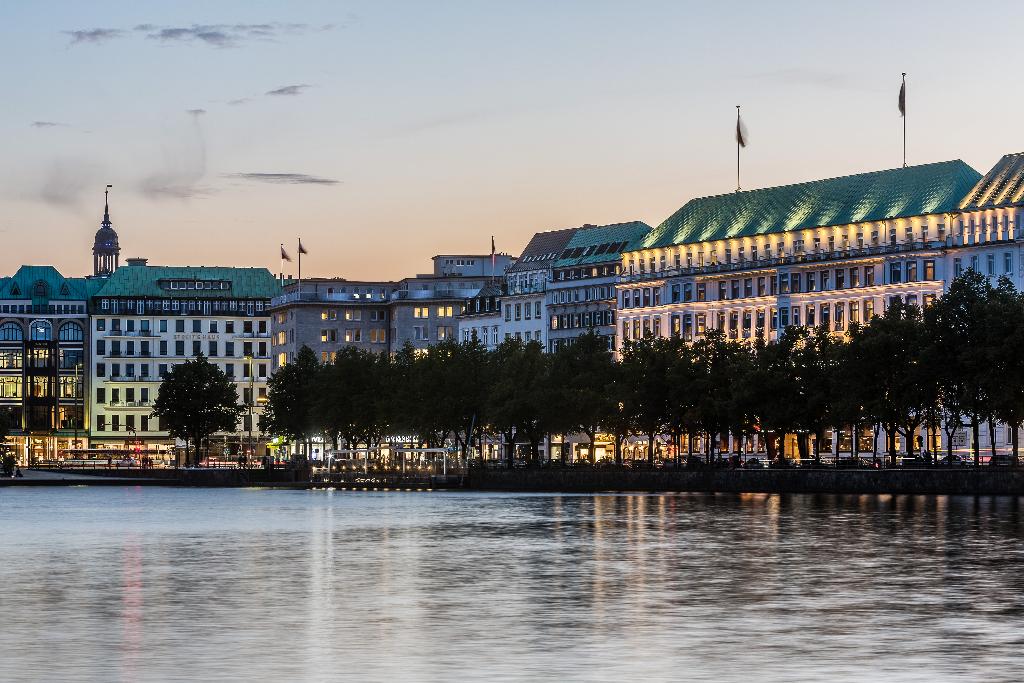
Hamburg does not flatter you the way Munich does. It is a working port with salt on its lips: cranes on the skyline, gulls over the ferry piers, brick warehouses standing in their own reflections. Give it a day, though, and it gets under your skin. The concert hall looks like a wave frozen in glass, the lakes in the middle of town are full of sailing boats, and the night ends, if you let it, with a fish roll at dawn.
The city is built around water, and the best way to see it is to keep close to it. Walk the harbour front, take a ferry instead of a tour boat, cross the river through a tunnel that is more than a century old, then head inland for galleries, parks and neighbourhoods where the coffee is taken very seriously.
Don't miss
The big sights
The landmarks that tell you, at once, that this is a port city.
Elbphilharmonie
Landmark

Photo: Dietmar Rabich, CC BY-SA 4.0 Hamburg's concert hall is a glass crown set on top of an old brick cocoa warehouse, right at the tip of HafenCity. Designed by Herzog & de Meuron and opened in 2017, it became the symbol of the city almost overnight. You don't need a concert ticket to enjoy it: a long, curving escalator carries visitors up to the Plaza, a public viewing platform that runs right round the building.
From up there the whole harbour is laid out below you, ships, cranes, church spires and all. If you can get a seat for a concert, take it. The main hall wraps the audience around the orchestra like a vineyard on a hillside.
Tip: Concerts sell out a long way ahead, so look at the programme as soon as you know your dates.
Speicherstadt
Neighbourhood

Photo: Thomas Wolf, www.foto-tw.de, CC BY-SA 3.0 A whole district of tall red-brick warehouses, built on timber piles and threaded with narrow canals. Coffee, tea, spices and carpets were stored here for generations, and the Speicherstadt is now a UNESCO World Heritage site together with the neighbouring Kontorhaus district and its ship-shaped Chilehaus.
It is at its best at dusk, when the bridges and gables are lit and the water turns black and gold. Photographers gather on the Poggenmühlen bridge for the view of the little moated Wasserschloss.
Miniatur Wunderland
Museum

Photo: Steven Lek, CC BY-SA 4.0 The largest model railway in the world, spread over several floors of a Speicherstadt warehouse, and far better than that sounds. Tiny trains run through the Alps, Scandinavia, Italy and America; a miniature airport sends planes down a runway; and every few minutes the lights dim and night falls over thousands of little windows.
Children love it, but so does everyone else. The real fun is in the detail, where the model-makers have hidden hundreds of small jokes and dramas among the figures.
Tip: It is hugely popular. Reserve a time slot in advance, especially in school holidays and on wet days.
St Michael's Church
Landmark

Photo: Dietmar Rabich, CC BY-SA 4.0 The Michel, as locals call it, is Hamburg's best-loved church: a big baroque building with a copper-topped tower that sailors used to look for as they came up the Elbe. The interior is light, white and gold, and the viewing platform on the tower gives one of the finest panoramas of the port and the city.
Hamburg Rathaus
Landmark

Photo: Dietmar Rabich, CC BY-SA 4.0 The town hall is a late 19th-century palace of sandstone, statues and a tall clock tower, built to show what a rich trading city could afford. It still houses the city's parliament and senate. Step through to the inner courtyard and its fountain, then wander the white Alster arcades across the canal for coffee with a view of the swans.
On and around the water
Landungsbrücken and the harbour
Activity

Photo: Dietmar Rabich, CC BY-SA 4.0 The St Pauli piers are the port's front door: a long floating landing stage where ferries, tour boats and the odd tall ship come and go. This is the place to get out on the Elbe, past the container terminals and dry docks, with the Elbphilharmonie sliding by on the way back.
Harbour tours leave from here all day, but the public ferries are part of the city's transport network and do a very similar job. Stand on the top deck, hold on to your hat.
Tip: Ferry 62 towards Finkenwerder is the classic route. An ordinary public transport ticket covers it.
Old Elbe Tunnel
Landmark

Photo: Thomas Wolf, www.foto-tw.de, CC BY-SA 3.0 Opened in 1911, this tiled tunnel runs under the river from the Landungsbrücken to the south bank. Huge lifts, built for carts and later cars, lower you down the shaft, and you walk or cycle beneath the Elbe past ceramic reliefs of fish and crabs. The reward at the far end is the best view there is of the Hamburg waterfront.
The Alster lakes
Nature
Two lakes in the middle of the city, made by damming a small river centuries ago. The Inner Alster is the smart one, edged by the Jungfernstieg promenade and a tall fountain. The Outer Alster is where Hamburg plays: joggers and dog-walkers on the path round the shore, sailing boats and rowers on the water, café terraces on the jetties.
Alster steamers cruise the lakes and the leafy canals beyond them, which is a gentle way to see the grand villas from their best side.
Planten un Blomen
Nature

Photo: Dirtsc, CC BY-SA 4.0 A long green park on the line of the old city walls, with a Japanese garden, a rose garden, tropical glasshouses and plenty of lawn to lie on. In the warmer months there are water-and-light shows with music on the park lake after dark. Families should know about the big playgrounds, too.
Museums and galleries
Hamburger Kunsthalle
Museum
One of Germany's great art museums, between the main station and the Alster. The collection runs from medieval altarpieces to contemporary work, but most visitors head straight for the German Romantics and Caspar David Friedrich's Wanderer above the Sea of Fog, a painting you will have seen on a hundred book covers.
International Maritime Museum
Museum
Housed in a mighty brick warehouse in HafenCity, this museum tells the story of seafaring over many floors: navigation instruments, uniforms, paintings and a vast collection of model ships, from tiny miniatures to great builders' models. It suits anyone who has ever stopped to watch a ship go by, which in Hamburg is everyone.
Neighbourhoods and nightlife
Reeperbahn
Nightlife
St Pauli's neon mile is one of the most famous nightlife streets in Europe: bars, clubs, music halls and theatres, with a red-light district alongside. It is loud, tatty and good-humoured, and on a Saturday night it feels as if half of northern Germany has turned up.
The Beatles played long residencies in the clubs around Grosse Freiheit in the early 1960s, and Beatles-Platz, with its steel silhouettes of the band, marks the corner. Live music is still the best reason to come.
Sternschanze
Neighbourhood
The Schanze is Hamburg off duty. Street art covers the walls, record shops and vintage rails fill the side streets, and on warm evenings the bars along Schulterblatt spill out onto the pavement. Next door, the Karoviertel has small independent boutiques. Come for a late breakfast and stay for the evening.
Blankenese
Neighbourhood

Photo: Olga Ernst, CC BY-SA 4.0 Once a fishing village, now one of the city's prettiest suburbs, Blankenese tumbles down a steep hillside to the Elbe. Its Treppenviertel is a maze of stairways and lanes between old captains' houses and tiny gardens, ending at a sandy river beach where you can watch container ships glide past at close range.
Tip: The S-Bahn runs out here from the centre. Wear proper shoes: there are thousands of steps.
Eat and drink
Fischmarkt
Market

Photo: Dietmar Rabich, CC BY-SA 4.0 Early on Sunday mornings the riverbank in Altona fills with stalls selling fish, fruit, flowers and plants, the traders shouting their wares to a crowd that is half early risers and half people who have not yet been to bed. The market has been held for more than three hundred years. Inside the old fish auction hall, bands play while everyone eats breakfast.
Fischbrötchen
Food
Hamburg's snack of choice is a crusty roll filled with fish: pickled Bismarck herring with onions, the mild young herring called Matjes, smoked salmon or tiny North Sea shrimps. You'll find stands along the harbour front and around the Landungsbrücken. Eat it standing up, facing the water, and guard it from the gulls.
Franzbrötchen
Food

Photo: Wikiolo, CC BY-SA 4.0 The city's own pastry: a flattened, sticky swirl of buttery dough, sugar and cinnamon, somewhere between a croissant and a cinnamon bun. Every bakery sells them, and every Hamburger has a firm opinion about which is best. It is the correct breakfast here, ideally with strong coffee.
Day trips
Lübeck
Day trip

Photo: Christian Wolf (www.c-w-design.de), CC BY-SA 3.0 de The old queen of the Hanseatic League is an easy train ride north-east of Hamburg. Its island old town, a UNESCO World Heritage site, is entered through the twin-towered Holstentor gate and packed with brick Gothic churches, merchants' houses and hidden courtyards. Lübeck is also Germany's marzipan town, so leave room for cake.
Where to stay in Hamburg
Not sure which area suits you? Read our guide: Where to stay in Hamburg →

★★★★
The Westin Hamburg
Hamburg
Spa · Pool · Parking
From £258 a night, taxes incl.2 adults · checked 14 Nov, 16:53

★★★★
Hafen Hamburg
Hamburg
Parking
From £160 a night, taxes incl.2 adults · checked 14 Nov, 16:53

★★★★★
Fairmont Hotel Vier Jahreszeiten
Hamburg
Spa · Parking
From £367 a night, taxes incl.2 adults · checked 14 Nov, 18:21

★★★★
Mövenpick Hotel Hamburg
Hamburg
Spa · Family-friendly · Parking
From £108 a night, taxes incl.2 adults · checked 14 Nov, 18:21

★★★★
25Hours Hotel Altes Hafenamt
Hamburg
49 rooms · Parking
From £129 a night, taxes incl.2 adults · checked 14 Nov, 16:53

★★★★★
Grand Elysée Hamburg
Hamburg
Spa · Pool · Family-friendly
From £237 a night, taxes incl.2 adults · checked 14 Nov, 16:53

★★★★
25hours Hotel Hamburg HafenCity
Hamburg
Pets allowed · Parking
From £101 a night, taxes incl.2 adults · checked 14 Nov, 16:53

★★★★★
Atlantic Hamburg
Hamburg
Spa · Pool · Parking
From £252 a night, taxes incl.2 adults · checked 14 Nov, 18:32
Getting around
The U-Bahn and S-Bahn reach every sight in this guide, and the harbour ferries are part of the same network. The centre, the Speicherstadt and the harbour front are close enough to link on foot, and the city is flat and well set up for cycling.
When to go
Late spring to early autumn is the best time for the lakes, the river beaches and long evenings outdoors. Hamburg's weather is changeable all year, so pack a waterproof whatever the forecast says. December brings Christmas markets to the town hall square and around the Alster.
Questions about visiting Hamburg
- What is Hamburg best known for?
- Its port, one of the biggest in Europe, and the sights around it: the Elbphilharmonie concert hall, the red-brick Speicherstadt warehouses, Miniatur Wunderland, the Reeperbahn nightlife district and the Sunday Fish Market.
- Is Hamburg worth visiting?
- Yes. It is one of Germany's most distinctive cities, with a working harbour, lakes in the centre, strong museums and some of the country's best nightlife and live music. It suits a long weekend very well.
- What is there to do in Hamburg with kids?
- Miniatur Wunderland is the big one, followed by a ferry ride round the harbour, the walk through the Old Elbe Tunnel, the playgrounds and light shows at Planten un Blomen and the model ships at the International Maritime Museum.
- How many days do you need in Hamburg?
- Two to three days covers the harbour, the Speicherstadt, the Elbphilharmonie, the Alster and an evening in St Pauli. Add a day for Blankenese or a trip to Lübeck.
- Do you need a car in Hamburg?
- No. Public transport, including the harbour ferries, covers the whole city, and Lübeck is easy to reach by train.
More guides
- Where to stay in Hamburg
- The best things to do in London
- The best things to do in Edinburgh
- The best things to do in Manchester
- The best things to do in York
- The best things to do in Amsterdam
- The best things to do in Birmingham
- The best things to do in Liverpool
- The best things to do in Bristol
- The best things to do in Barcelona
- The best things to do in Budapest
- The best things to do in Cambridge
- The best things to do in Dublin
- The best things to do in Krakow