
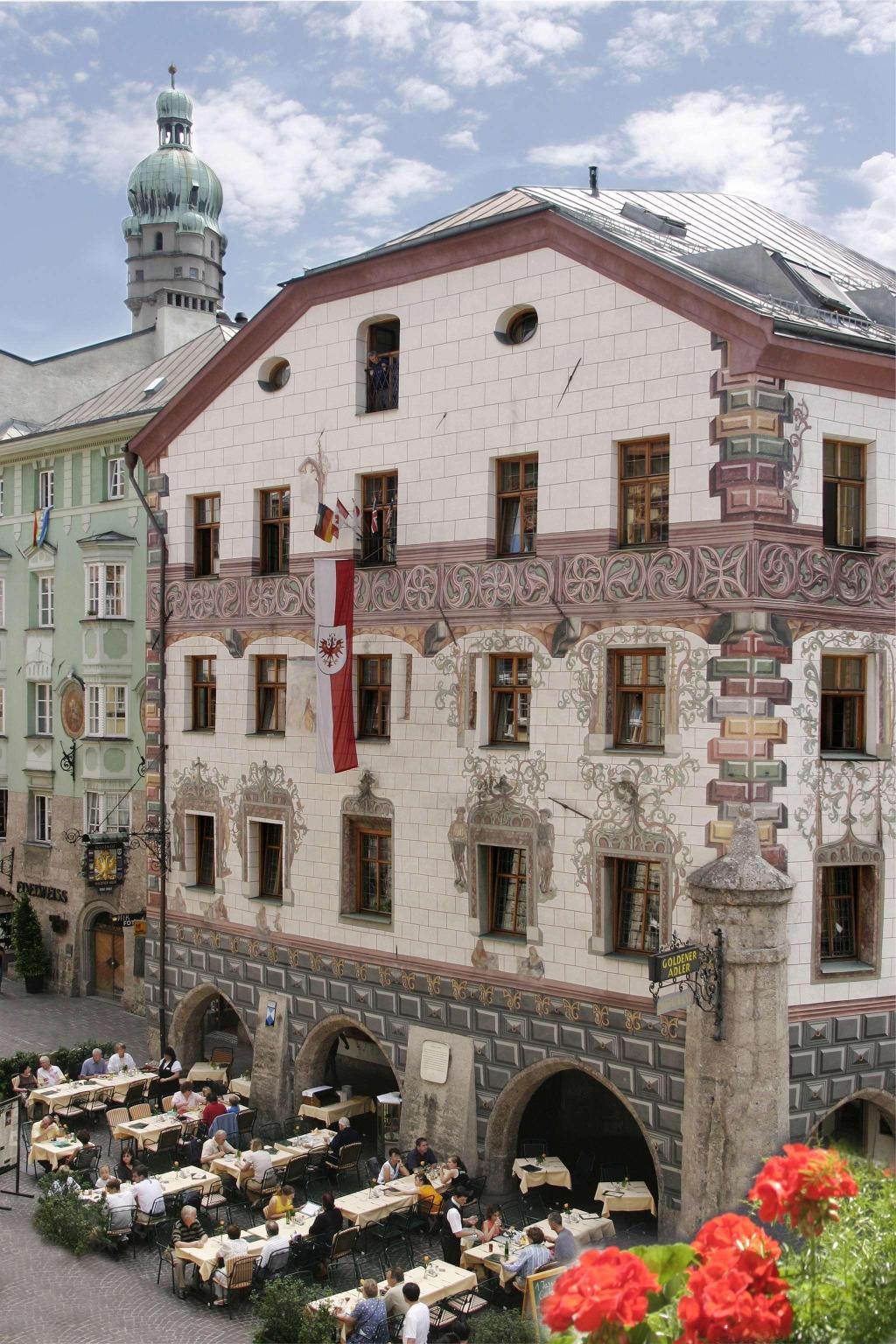
Few cities have a backdrop like this. Stand in the middle of Innsbruck's main street and a wall of grey limestone, snow-streaked for much of the year, rises straight up behind the baroque facades, close enough to feel like part of the architecture. The Habsburg emperors loved the place and left palaces, churches and a famous golden balcony. The mountains were here first and still steal every scene.
That is the particular joy of Innsbruck: you can spend the morning among imperial tombs and painted townhouses, be standing on a ridge above two thousand metres by lunchtime, and be back in the Old Town for strudel by four. It has hosted the Winter Olympics twice, and it remains a city where people carry skis onto the tram.
Don't miss
The Old Town
A tight knot of arcaded medieval lanes, a few minutes across.
The Golden Roof
Landmark

Photo: Wilfredor, CC0 Innsbruck's emblem is smaller than you expect and shinier than you can believe: an ornate late-Gothic balcony jutting from a house in the heart of the Old Town, roofed with more than two and a half thousand gilded copper tiles. Emperor Maximilian I had it built around 1500 as a royal box from which to watch tournaments in the square below.
The reliefs beneath show the emperor and a troupe of twisting dancers. A small museum inside tells his story.
Tip: For a photograph without the crowds, come before breakfast, when the morning light hits the tiles.
The City Tower
Landmark

Photo: Wilfredor, CC0 A few doors from the Golden Roof, the old town hall's watchtower has kept an eye on Innsbruck since the fifteenth century. Guards once looked out from here for fires and trouble. Now visitors climb its steps to a narrow open gallery that runs around the tower.
The view is the best orientation in the city: the Golden Roof almost directly below, a jumble of medieval rooftops, the green River Inn and mountains on every side. A good first stop.
The Hofburg
Landmark

Photo: Reinhold Möller Ermell, CC BY-SA 4.0 The Habsburgs' Imperial Palace in Innsbruck began as a medieval castle and was turned into a pale yellow rococo residence by Empress Maria Theresa in the eighteenth century. After Schönbrunn and the Hofburg in Vienna, it is among the most important palaces in Austria.
The highlight is the Giants' Hall, a long white and gold ballroom lined with full-length portraits of the empress's many children under a painted ceiling. The state apartments suit anyone with a taste for chandeliers and court gossip.
The Hofkirche
Landmark

Photo: Heinrich Stürzl, CC BY-SA 4.0 From outside, the Court Church looks plain. Inside is one of the most extraordinary sights in Austria. In the middle of the nave stands the vast marble tomb of Emperor Maximilian I, flanked by twenty-eight larger-than-life bronze figures of his ancestors and heroes, among them King Arthur. Locals call them the Black Men.
The odd thing is that the tomb is empty: Maximilian is buried elsewhere. The Tyrolean folk hero Andreas Hofer does lie here. Go slowly and look at the faces, armour and extravagant costumes.
Maria-Theresien-Strasse
Neighbourhood

Photo: Hiroki Ogawa, CC BY 3.0 The city's grand main street runs south from the Old Town, wide, largely traffic-free and lined with baroque town palaces in pastel colours. It frames the classic Innsbruck view: the slender St Anne's Column in the foreground and the Nordkette range filling the sky behind.
At the far end stands a Triumphal Arch put up by Maria Theresa. In between are shops, cafés with terraces and a modern shopping gallery with a rooftop bar. It is where the whole city comes to stroll.
Up the mountains
The peaks start where the tram lines end.
The Nordkette
Nature

Photo: Steffen Flor, CC BY-SA 4.0 No other city makes it this easy to get above the treeline. A funicular leaves from a station in the centre, a short walk from the Old Town, with swooping glass roofs designed by Zaha Hadid, and climbs to the hillside district of Hungerburg. From there, two cable cars continue to the Seegrube and on to the Hafelekar, at well over two thousand metres.
From the top station it is a short walk to the ridge. On one side the city lies far below; on the other is a wilderness of bare peaks.
Tip: It can be warm in town and icy at the top, with snow underfoot well into spring. Bring a jacket and proper shoes.
The Bergisel Ski Jump
Landmark

Photo: Michielverbeek, CC BY-SA 4.0 On a wooded hill at the southern edge of the city, a sleek tower of concrete and steel curls over the trees like a cobra about to strike. This is the Bergisel ski jump, rebuilt to a design by Zaha Hadid and one of the venues of the famous Four Hills Tournament each winter. It was an Olympic site in 1964 and 1976.
A lift takes you to a café and viewing terrace at the top, where you can stand at the start gate and consider what the jumpers see. It is not for the faint-hearted.
The Patscherkofel
Nature

Photo: Leonhard Lenz, CC0 The rounded mountain south of the city, topped with a transmitter mast, is Innsbruck's gentler peak. A gondola rises from the village of Igls, where the Olympic downhill was once raced, to a station just above the treeline.
In summer the draw is the Zirbenweg, a broad, almost level path through one of the oldest stone pine forests in the Alps, with huge views across the Inn valley all the way. In winter there is easy skiing. It suits families and unhurried walkers.
Castles and museums
Ambras Castle
Museum

Photo: Wilfredor, CC0 On a hill above the city stands a white Renaissance castle that Archduke Ferdinand II fitted out in the sixteenth century for his wife and for his collections. He was one of the great collectors of his age, and his galleries of armour and his chamber of art and curiosities, full of the strange and the marvellous, are still shown where he placed them.
The Spanish Hall, a long banqueting room with a coffered wooden ceiling and painted walls, is one of the finest Renaissance interiors north of the Alps. The park is lovely too.
The Tyrolean Folk Art Museum
Museum
Next door to the Hofkirche, in a former monastery, is one of the best museums of its kind in Europe. Whole wood-panelled parlours rescued from old farmhouses have been rebuilt inside, complete with tiled stoves and painted furniture, and you can step into them.
There are carnival masks, festival costumes and a marvellous collection of carved Christmas cribs. It is the place to understand how people actually lived in these valleys, and it is far more engaging than the name suggests.
Swarovski Crystal Worlds
Day trip

Photo: Zairon, CC BY-SA 3.0 In the small town of Wattens, a short way down the valley, the crystal maker Swarovski has built a thoroughly eccentric attraction. You enter through the mouth of a grass-covered giant's head with a waterfall pouring from it, into a series of underground chambers created by artists and designers.
Outside there is a garden with a cloud of crystals floating over a mirror pool, and a play tower for children. Part art installation, part showroom, it is a good wet-weather outing. Shuttle buses run from Innsbruck.
Eat and drink
Tiroler Gröstl
Food

Photo: Simon Legner (User:simon04), CC BY-SA 4.0 The definitive Tyrolean mountain lunch: sliced potatoes fried in a heavy pan with onions and pieces of beef or bacon until everything is crisp at the edges, then topped with a fried egg and served, pan and all, with a little cabbage salad on the side.
It began as a way of using up Sunday's leftovers and is now on the menu of every traditional inn in Innsbruck and every hut on the mountains. Ideal fuel for a day outdoors.
Kaiserschmarrn and strudel
Food

Photo: Ich, CC BY-SA 4.0 Austria takes pudding seriously, and Innsbruck's cafés are the proof. Kaiserschmarrn is a thick, fluffy pancake torn into pieces, caramelised, dusted with icing sugar and served with stewed plums or apple sauce. It is filling enough to be a meal.
Then there is strudel, thin pastry wrapped around apple, curd cheese or all sorts of other fillings. Find a coffee house in the Old Town arcades and settle in.
Day trips
Hall in Tirol
Day trip
Ten minutes down the valley by train, Hall was once richer and more important than Innsbruck, thanks to its salt mines and its mint. Its medieval old town is larger than its neighbour's and far quieter, a place of tall painted houses, sloping squares and church spires.
The landmark is the Mint Tower at Hasegg Castle, where some of Europe's first large silver coins were struck. It makes an easy, pretty half-day.
The Stubai Glacier
Day trip
At the head of the Stubai Valley, south-west of the city, lies Austria's largest glacier ski area, with skiing from autumn until late spring. Gondolas carry everyone, skier or not, up to a viewing platform above three thousand metres, with a panorama of peaks stretching to the Dolomites on a clear day.
The valley itself is classic Tyrol: onion-domed churches, waterfalls and flower-decked chalets. Buses run from Innsbruck, and a pretty narrow-gauge tram climbs as far as Fulpmes.
Where to stay in Innsbruck
Not sure which area suits you? Read our guide: Where to stay in Innsbruck →

★★★★
Hotel Goldener Adler, Bw Signature Collection
Innsbruck
43 rooms · Pets allowed · Parking
From £225 a night, taxes incl.2 adults · checked 14 Nov, 22:07

★★★★
The Penz
Innsbruck
Parking
From £208 a night, taxes incl.2 adults · checked 14 Nov, 22:07

★★★★
aDLERS Hotel Innsbruck
Innsbruck
Spa · Parking
From £240 a night, taxes incl.2 adults · checked 14 Nov, 22:07

★★★★
Hilton Garden Inn Innsbruck
Innsbruck
Parking
From £129 a night, taxes incl.2 adults · checked 14 Nov, 22:07

★★★★
Sporthotel Igls
Innsbruck
Spa · Pool · 74 rooms
From £155 a night, taxes incl.2 adults · checked 14 Nov, 22:07

★★★★
AC Hotel Innsbruck
Innsbruck
Spa · Parking
From £239 a night, taxes incl.2 adults · checked 14 Nov, 22:07

★★★★
Alpenhotel Karwendel
Leutasch
Pool
See prices and rooms →

★★★★
AlpenParks Chalet & Apartment Alpina Seefeld
Seefeld in Tirol
Spa · 43 rooms · Parking
From £219 a night, taxes incl.2 adults · checked 14 Nov, 22:07
Getting around
The Old Town and the centre are compact and walkable, and the Nordkette funicular starts from the edge of the centre. Trams and buses run to Ambras, Bergisel and Igls, and buses and local trains serve the surrounding valleys. You do not need a car for the city or the main mountain trips.
When to go
Innsbruck is a genuine year-round city. Winter means skiing on the surrounding mountains and Christmas markets in the Old Town. Summer and early autumn are for walking, with warm days in the valley. Mountain weather changes quickly in any season, so pack layers.
Questions about visiting Innsbruck
- What is Innsbruck best known for?
- The Golden Roof, its Habsburg palace and court church, winter sports (it has hosted the Winter Olympics twice) and its dramatic setting directly beneath the Nordkette mountains.
- Is Innsbruck worth visiting if you do not ski?
- Yes. The Old Town, the imperial sights and Ambras Castle fill a good two days, and cable cars take non-skiers up to mountain viewpoints and walking trails all year round.
- How many days do you need in Innsbruck?
- Two days covers the Old Town, the Nordkette and either Ambras Castle or Bergisel. Stay three or four if you want to walk, ski or take a trip to the Stubai Valley or Hall in Tirol.
- What is there to do in Innsbruck with kids?
- Ride the funicular and cable cars up the Nordkette, stand at the top of the Bergisel ski jump, explore the armour at Ambras Castle and visit Swarovski Crystal Worlds in Wattens.
- Do you need a car in Innsbruck?
- No. The city is walkable, public transport reaches the cable cars and the castle, and buses run into the nearby valleys.
More guides
- Where to stay in Innsbruck
- The best things to do in London
- The best things to do in Edinburgh
- The best things to do in Manchester
- The best things to do in York
- The best things to do in Amsterdam
- The best things to do in Birmingham
- The best things to do in Liverpool
- The best things to do in Bristol
- The best things to do in Barcelona
- The best things to do in Budapest
- The best things to do in Cambridge
- The best things to do in Dublin
- The best things to do in Krakow