
Jaipur does not ease you in. One minute you are in traffic behind a camel cart, the next you are staring up at a palace wall with 953 windows, painted the colour of a ripe peach. The capital of Rajasthan was laid out on a grid in the 18th century by an astronomer king, and it still feels like a city built to impress: forts on every ridge, palaces at every turn, bazaars that go on for miles.
Give it two or three days. Spend the mornings at the forts before the heat builds, the afternoons in the old city, and the evenings eating your way through Rajasthani cooking. Then, if you have time, head out to a stepwell, a holy lake or a tiger reserve.
Don't miss
The Pink City
The walled old town, where the big three sights sit within a short walk of each other.
Hawa Mahal
Landmark

Photo: Chainwit., CC BY-SA 4.0 The Palace of the Winds is Jaipur's signature: a five-storey screen of pink sandstone, honeycombed with small latticed windows so that the women of the royal household could watch the street below without being seen. It is barely a room deep in places, more stage set than palace.
The famous view is from the street outside, and it is best in the morning when the sun lights the facade. Go inside too, for the breezy upper galleries and the look back over the bazaar.
Tip: The rooftop cafés across the road give you the full facade without the traffic in the way.
City Palace
Landmark

Photo: Jakub Hałun, CC BY-SA 4.0 Still partly home to Jaipur's royal family, the City Palace is a run of courtyards, audience halls and gateways in the middle of the old town. The four painted doorways of the Pritam Niwas Chowk, one for each season, are the bit everyone photographs, and the peacock gate deserves the attention.
The museum rooms hold royal costumes, weapons and two enormous silver urns that a maharaja filled with Ganges water for a trip to England. It suits anyone who likes their history with a bit of swagger.
Jantar Mantar
Landmark

Photo: Jakub Hałun, CC BY-SA 4.0 Next door to the palace is a courtyard of what look like giant abstract sculptures. They are astronomical instruments, built in stone in the early 18th century by Maharaja Jai Singh II to track the sun, stars and planets, and the whole observatory is a UNESCO World Heritage Site.
The largest is a sundial as tall as a house, whose shadow you can watch creep along its scale. A guide earns their fee here: without one it is beautiful but baffling.
Albert Hall Museum
Museum

Photo: chetan, CC BY-SA 3.0 Just south of the walls, in the Ram Niwas Garden, this domed and arcaded building is Rajasthan's oldest museum and a fine piece of Indo-Saracenic showing off. Inside are miniature paintings, carpets, metalwork, pottery and, a little unexpectedly, an Egyptian mummy.
Come towards dusk. The building is lit up after dark, and the pigeons wheeling around the domes make it one of the city's easier photographs.
Forts and palaces on the hills
North of the city the Aravalli hills are lined with ramparts. Start early.
Amber Fort
Landmark

Photo: This photograph was taken by Rijin S and released under the license stated below, CC BY-SA 4.0 The great fort-palace at Amer, a short drive north of Jaipur, was the capital of the Kachhwaha rulers before the city existed. It climbs a hillside above Maota Lake in tiers of honey-coloured stone: public courtyards at the bottom, private apartments at the top.
The Sheesh Mahal is the room to find, its walls and ceiling set with thousands of tiny mirrors that catch a single flame and scatter it. Amber is one of the hill forts of Rajasthan on the UNESCO list, and it is the one sight in Jaipur nobody should skip.
Tip: Be at the gate when it opens. By late morning the courtyards are busy and the stone is hot.
Jaigarh Fort
Landmark

Photo: Jakub Hałun, CC BY-SA 4.0 On the ridge directly above Amber, and linked to it by fortified passages, Jaigarh is the plainer, tougher sibling: a military fort with thick walls, water tanks and long views over the hills. It is home to the Jaivana, a vast 18th-century cannon on wheels. Fewer people make it up here, which is half the appeal. Walk the ramparts for the best view down onto Amber's courtyards.
Nahargarh Fort
Landmark

Photo: Jakub Hałun, CC BY-SA 4.0 Nahargarh sits on the edge of the ridge right above the city, and the reason to come is the view: the whole of Jaipur laid out below, flat-roofed and hazy, with the old city's grid easy to pick out. Inside is a small palace of interconnected suites built for the maharaja's queens. It is the classic sunset spot. Bring a drink up to the terrace and watch the lights come on.
Tip: The road up is steep and winding. Arrange your ride back down before the sun sets.
Jal Mahal
Landmark

Photo: Arjuncm3, CC BY-SA 3.0 On the road to Amer, the Water Palace appears to float in the middle of Man Sagar Lake, with the hills behind it. You cannot go inside, so this is a pause rather than a visit, but it is a lovely one, especially in the soft light of early morning or evening.
Bazaars and temples
Johari Bazaar
Market
Jaipur is one of the world's great centres for cutting and setting gemstones, and Johari Bazaar is the jewellers' street: gold, silver, emeralds and the enamelled kundan and meenakari work the city is known for. Even if you buy nothing, the side lanes of workshops are worth a wander. Nearby Bapu Bazaar is the place for block-printed cotton, embroidered slippers and bangles. Bargain with good humour and expect to be offered tea.
Galta Ji
Landmark

Photo: Sharvarism, CC BY-SA 4.0 In a narrow gorge on the eastern edge of the city, a string of old temples and painted pavilions steps down between the cliffs, with natural spring water filling a series of bathing tanks. It is a working pilgrimage site, a world away from the palaces.
The walk over the hill from the city passes a small sun temple with a wide view back across Jaipur. Dress modestly and keep food packed away, as the resident monkeys are bold.
Eat and drink
Dal baati churma
Food

Photo: Nirmalbansal62, CC BY-SA 4.0 Rajasthan's signature meal is desert food at heart: hard wheat dumplings baked until crusty, cracked open and drowned in ghee, eaten with spiced lentils and a sweet crumble of the same dough. It is rich, filling and best ordered when you are properly hungry. A full Rajasthani thali will put it alongside gatte ki sabzi, ker sangri and fiery laal maas for meat eaters. Pace yourself.
Lassi and street snacks
Food
MI Road is where Jaipur comes for lassi, thick and sweet and served in rough clay cups that you hand back or smash when you are done. Follow it with a pyaaz kachori, a deep-fried pastry stuffed with spiced onion, which the city eats for breakfast. For something sweet, look for ghewar, a honeycomb disc soaked in syrup that fills the sweet shops around festival time.
Day trips
Chand Baori, Abhaneri
Day trip

Photo: Gerd Eichmann, CC BY-SA 4.0 East of Jaipur, in the village of Abhaneri, is one of the largest and deepest stepwells in India. Thousands of narrow steps zigzag down three sides in a perfect geometric pattern, with a pavilion on the fourth. It is over a thousand years old and looks like a drawing by Escher. It is a natural stop on the road between Jaipur and Agra, so it suits anyone travelling the Golden Triangle by car.
Pushkar and Ajmer
Day trip

Photo: Jakub Hałun, CC BY-SA 4.0 South-west of Jaipur, Pushkar is a small holy town wrapped around a lake, lined with bathing ghats and whitewashed temples, including a rare one dedicated to Brahma. It is calm, walkable and vegetarian, and a good change of pace after the city.
Neighbouring Ajmer has the shrine of the Sufi saint Moinuddin Chishti, one of the most important Muslim pilgrimage sites in India. The two together make a long but rewarding day.
Ranthambore National Park
Wildlife
A former royal hunting ground turned tiger reserve, Ranthambore is dry forest, lakes and a ruined fort on a crag. Safaris run in open vehicles at dawn and in the afternoon. Tigers are never guaranteed, but deer, crocodiles, monkeys and birdlife are, and the setting alone is worth it.
Tip: It is a long day from Jaipur. Staying a night near the park gives you two safaris and a far better chance of a sighting.
Where to stay in Jaipur
Not sure which area suits you? Read our guide: Where to stay in Jaipur →
★★★★
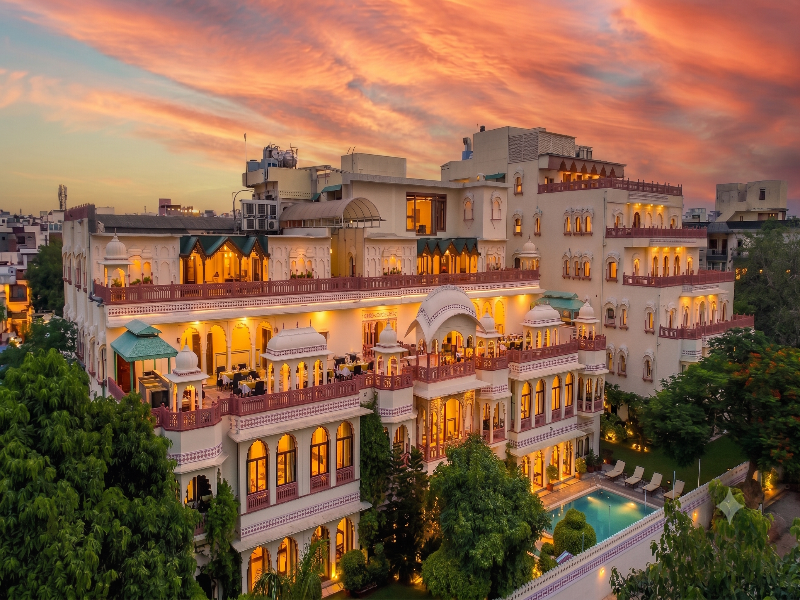
Shahpura House
Rajasthan-1. Jaipur
Spa · 65 rooms · Parking
See prices and rooms →

★★★★
Astroport Sariska Treetop By Eight Continents
Rajgarh
20 rooms · Pets allowed · Parking
See prices and rooms →

★★★★★
Dileep Kothi - Boutique Hotel
Jaipur
10 rooms
See prices and rooms →

★★★★
Clarion Bella Casa By Choice Hotels
Jaipur
Spa · Pool · Parking
See prices and rooms →

★★★★
Fairfield by Marriott Jaipur
Jaipur
76 rooms · Parking
See prices and rooms →

★★★★★
Rambagh Palace
Jaipur
Spa · Pool · 78 rooms
See prices and rooms →

★★★★
Four Points By Sheraton Jaipur, City Square
Jaipur
Spa · Pool · Parking
See prices and rooms →

★★★★★
Fairmont Jaipur
Jaipur
All-inclusive option · Spa · Pool
See prices and rooms →
Getting around
Taxis, app cabs and auto-rickshaws do most of the work, and hiring a car and driver for a day is the easy way to combine Amber, Jaigarh, Nahargarh and Jal Mahal. Inside the old city, walk: the Hawa Mahal, City Palace and Jantar Mantar are all close together.
When to go
The cooler, drier months from around October to March are the most comfortable for sightseeing. Late spring and early summer are very hot, and the monsoon brings rain in high summer. Whenever you come, see the forts first thing in the morning.
Questions about visiting Jaipur
- What is Jaipur best known for?
- The pink-painted old city, the Hawa Mahal, the City Palace, the Jantar Mantar observatory and Amber Fort in the hills just to the north. It is also famous for gemstones, jewellery and block-printed textiles.
- How many days do you need in Jaipur?
- Two full days covers the forts and the Pink City at a comfortable pace. Add a third if you want a day trip to the Abhaneri stepwell or Pushkar.
- Why is Jaipur called the Pink City?
- The buildings of the old walled city are painted a terracotta pink. The colour dates from the 19th century, when the city was painted to welcome a royal visitor, and it has been kept ever since.
- Is Amber Fort worth visiting?
- Yes. It is the highlight of most trips to Jaipur: a hilltop palace of courtyards, painted gateways and a mirrored hall. Go early in the day to avoid the heat and the crowds.
More guides
- Where to stay in Jaipur
- The best things to do in London
- The best things to do in Edinburgh
- The best things to do in Manchester
- The best things to do in York
- The best things to do in Amsterdam
- The best things to do in Birmingham
- The best things to do in Liverpool
- The best things to do in Bristol
- The best things to do in Barcelona
- The best things to do in Budapest
- The best things to do in Cambridge
- The best things to do in Dublin
- The best things to do in Krakow