
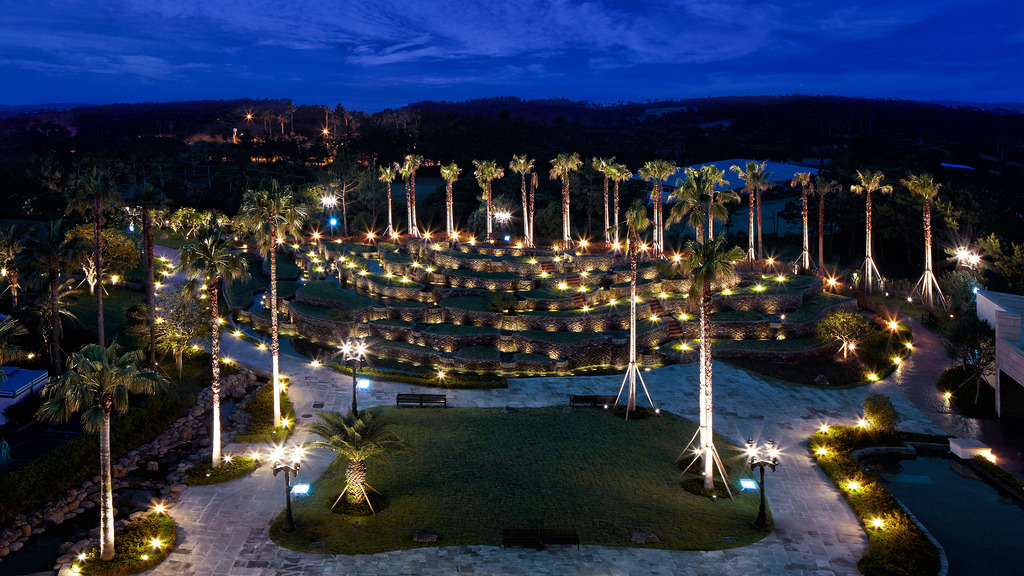
Jeju is what happens when a volcano builds an island and Korea turns it into its favourite holiday. Everything here is basalt: the black stone walls around the tangerine groves, the cliffs, the grandfather statues with their bulging eyes. In the middle sits Hallasan, the highest mountain in South Korea, and around the edge runs a coast of white-sand coves, waterfalls and craters.
It is bigger than it looks on the map, so plan by coast. The south around Seogwipo has the waterfalls and the lava cliffs. The east has Sunrise Peak and Udo. The north and west have the best beaches. A car, and three or four days, will show you most of it.
Don't miss
Volcanoes and lava
Jeju's volcanic landscape is a UNESCO World Heritage Site. These are the headline acts.
Hallasan
Nature

Photo: Yoo Chung, CC BY-SA 2.5 South Korea's highest mountain is a broad shield volcano that fills the centre of the island, with a crater lake at the summit. Several trails climb through forest and open moorland, and two of them go all the way to the top. Those are long, full-day walks that reward an early start.
Not a summit person? The shorter trails on the western side give you the high-altitude scenery without the slog. In spring the slopes turn pink with azaleas, and in winter the trees are furred with frost.
Tip: Summit trails have cut-off times and can require a reservation. Check before you go and carry warm layers.
Seongsan Ilchulbong
Nature

Photo: Bernard Gagnon, CC0 Sunrise Peak is a tuff cone that erupted out of the sea on Jeju's eastern tip, leaving a wide green crater ringed with jagged rock. A staircase climbs to the rim in around half an hour, and the view from the top takes in the crater, the coast and Udo offshore.
As the name suggests, people climb it in the dark to watch the sun come up. Any clear hour will do, though, and the base is a good place to see Jeju's haenyeo divers.
Manjanggul Lava Tube
Nature

Photo: AhmadElq, CC BY-SA 4.0 In the north-east, molten lava once flowed towards the sea and left behind a tunnel several kilometres long, big enough in places to drive a bus through. A section is laid out for visitors, with lava shelves, flow lines on the walls and a tall lava column at the end.
Tip: The cave has been closed for long periods for safety work. Check that it is open before you drive out.
Jusangjeolli Cliffs
Nature

Photo: Bernard Gagnon, CC0 On the south coast near Jungmun, lava cooled into tight ranks of hexagonal basalt columns, as neat as if they had been cut by machine. Waves crash against the base and throw spray up the black pillars. Boardwalks run along the clifftop, so it is an easy stop for anyone, pushchairs included.
Seopjikoji
Nature
A grassy headland just south of Seongsan, with a white lighthouse, red volcanic rock and a walking path along the cliffs. In spring the fields are yellow with canola flowers. It is a gentle hour's stroll with Sunrise Peak in the background, and a favourite Korean drama filming location.
Waterfalls and beaches
Jeongbang Waterfall
Nature

Photo: Abasaa, Public domain On the edge of Seogwipo, Jeongbang drops straight off a cliff onto the rocky shore, a few steps from the sea. It is a short walk down from the road, and you can clamber over the boulders to get close enough to feel the spray. Pair it with Cheonjiyeon, a few minutes away, where a path through subtropical forest leads to a waterfall and a deep green pool.
Hyeopjae Beach
Beach

Photo: Lcarrion88, CC BY-SA 4.0 The west coast's showpiece: pale sand, black lava rock and shallow water so clear and turquoise it looks tropical, with the little island of Biyangdo sitting offshore. It is safe for paddling and popular with families. Just inland, Hallim Park has gardens and a pair of lava caves if you need an hour out of the sun.
Hamdeok Beach
Beach

Photo: Hong Da Hyeon, CC0 A short drive east of Jeju City, Hamdeok is a wide curve of white sand with emerald shallows and a small hill, Seoubong, to climb at one end for the view. Cafés line the shore. It suits anyone staying in the north who wants a beach day without crossing the island.
Jungmun Saekdal Beach
Beach

Photo: Yoo Chung, CC BY-SA 3.0 Tucked below the cliffs of the Jungmun resort area on the south coast, this beach has sand in mixed shades of gold, grey and black, and proper waves. It is Jeju's best-known surfing beach, so expect boards, and stronger currents than on the north coast.
Islands and trails
Udo
Day trip

Photo: Abasaa, Public domain A short ferry ride from Seongsan, Udo is a small, low island of stone-walled fields, lighthouses and a white coral-sand beach. Most visitors loop it by electric bike or scooter, stopping for the island's famous peanut ice cream.
It is a half-day done briskly and a full day done properly. Combine it with a climb of Sunrise Peak and you have the east coast covered.
Jeju Olle Trail
Activity
A network of waymarked walking routes that circles the whole island, linking fishing villages, clifftops, forests and beaches. Each route is a day's walk and marked with blue and orange ribbons and little horse-shaped signs.
You do not need to commit to the lot. Pick one coastal section near where you are staying and you will see a slower Jeju than the one from the car window.
Culture and food
The haenyeo divers
Activity

Photo: by karendotcom127, CC BY 2.0 Jeju's haenyeo are women who free-dive for abalone, sea urchin and seaweed without breathing equipment, a tradition recognised by UNESCO. Many are in their sixties and seventies. You will spot their orange floats bobbing offshore all around the coast. The Haenyeo Museum on the east coast tells the story well, and seafood stalls run by the divers sell the morning's catch near Seongsan.
Black pork barbecue
Food
The island's proudest dish comes from a local breed of black pig. Thick slabs of belly and shoulder are grilled over charcoal at your table, snipped with scissors and eaten wrapped in leaves with a dab of salty fermented anchovy sauce.
Jeju City has a whole street of black pork restaurants near the old harbour. Go hungry, and order a bowl of cold noodles to finish.
Dongmun Market
Market

Photo: thddbwnd, CC BY 3.0 Jeju City's main traditional market is the place to graze: fresh hallabong and tangerines, glistening cutlassfish, tangerine chocolates and, after dark, a lively aisle of street-food stalls. Seogwipo has its own version in the Maeil Olle Market, just as good for a snacking supper.
Osulloc Tea Museum
Museum

Photo: Matt Kieffer, CC BY-SA 2.0 In the west of the island, rows of clipped green tea bushes run to the horizon around a sleek museum and tea house. The exhibits are brief. The real draw is a walk in the fields followed by green tea ice cream, which makes it an easy, popular stop with children.
Where to stay in Jeju
Not sure which area suits you? Read our guide: Where to stay in Jeju →

★★★★
Lotte City Hotel Jeju
Jeju Island
Pool
See prices and rooms →

★★★★
Astar Hotel Jeju
Jeju City
Spa · Parking
See prices and rooms →

★★★★★
Lotte Hotel Jeju
Seogwipo
Beach 50 m · Spa · Pool
See prices and rooms →

★★★★
Benikea Hotel Jeju
Jeju- do
Parking
See prices and rooms →

★★★★
Best Western Jeju Hotel
Jeju
Family-friendly · Parking
See prices and rooms →

★★★★★
Grand Josun Jeju
Seogwipo City
Beach 100 m
See prices and rooms →

★★★★
Boutique Villa De Aewol
Jeju-Si
Spa · Pool · 53 rooms
See prices and rooms →

★★★★★
Olle Resort and Spa
Jeju Island
53 rooms
See prices and rooms →
Getting around
A hire car is by far the easiest way to see Jeju, and the roads are quiet and well signed. Check in advance which driving permit you need. Without a car, buses link the main towns and sights but eat into your day, so taxis and organised day tours of the east, west and south are the practical alternative.
When to go
Spring brings cherry blossom and canola fields, and autumn has clear skies and good walking weather. Summer is hot, humid and the busiest time on the beaches, with some rain and the odd typhoon. Winter is cool and windy on the coast, with snow on Hallasan.
Questions about visiting Jeju
- What is Jeju best known for?
- Its volcanic scenery, including Hallasan, South Korea's highest mountain, and the crater of Seongsan Ilchulbong; its beaches and waterfalls; the haenyeo women divers; and local food such as black pork and tangerines.
- How many days do you need in Jeju?
- Three to four days is a good amount: one each for the east, the south and the west, plus a day for Hallasan if you want to hike.
- Do you need a car in Jeju?
- It is strongly recommended. The sights are spread around a large island and a car lets you link them easily. Buses, taxis and day tours work if you would rather not drive.
- What is there to do in Jeju with kids?
- The shallow beaches at Hyeopjae and Hamdeok, a bike ride around Udo, the boardwalk at the Jusangjeolli Cliffs and green tea ice cream at Osulloc are all easy wins with children.
More guides
- Where to stay in Jeju
- The best things to do in London
- The best things to do in Edinburgh
- The best things to do in Manchester
- The best things to do in York
- The best things to do in Amsterdam
- The best things to do in Birmingham
- The best things to do in Liverpool
- The best things to do in Bristol
- The best things to do in Barcelona
- The best things to do in Budapest
- The best things to do in Cambridge
- The best things to do in Dublin
- The best things to do in Krakow