
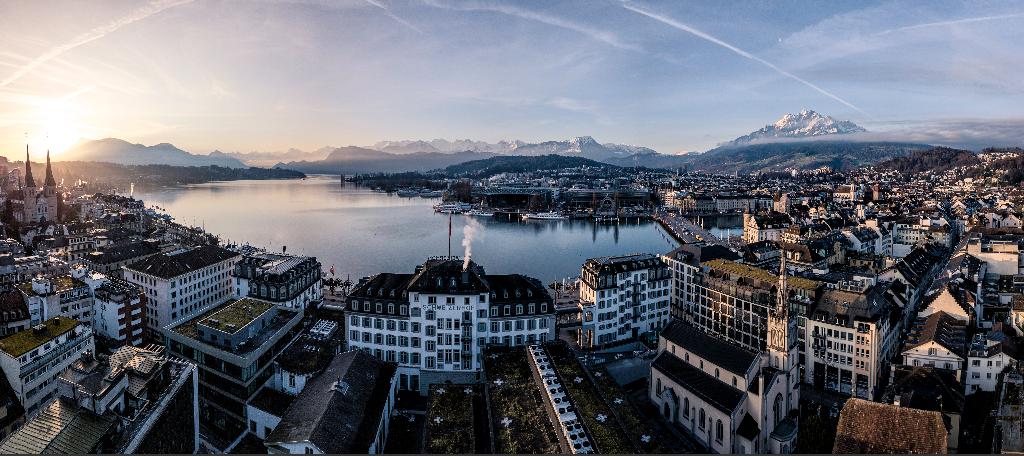
Lucerne is Switzerland with the volume turned up. A medieval wooden bridge crosses a river the colour of bottle glass, painted townhouses line the squares, white steamers slide out across the lake, and behind it all the Alps stand about looking expensive. You could walk the whole centre in an afternoon. You won't want to leave that quickly.
The trick is to split your time between the town and the heights. Give the bridges, the old walls and a museum or two a day, then go up: by cog railway, cable car or paddle steamer, to mountains that have been pulling in visitors since Queen Victoria rode up Pilatus on a pony.
Don't miss
The big sights
All within a short walk of each other, and of the station.
The Chapel Bridge
Landmark

Photo: Reinhold Möller Ermell, CC BY-SA 4.0 Lucerne's signature: a covered wooden footbridge that zigzags across the River Reuss beside a stout octagonal Water Tower. It dates from the fourteenth century, though much of it had to be rebuilt after a fire in 1993. Look up as you cross, at the triangular paintings under the roof that tell the city's story.
A few minutes downstream is its quieter sibling, the Spreuer Bridge, whose roof panels show a Dance of Death: skeletons cheerfully escorting everyone from kings to merchants. It is the better of the two for a moody photograph.
Tip: Cross first thing in the morning, when the bridge is empty and the flower boxes are catching the sun.
The Lion Monument
Landmark

Photo: Godot13, CC BY-SA 4.0 A dying lion, carved straight into a sandstone cliff above a still pond. It commemorates the Swiss Guards killed defending the French royal family during the Revolution in 1792, and it is far more affecting than a photograph suggests. Mark Twain called it the most mournful and moving piece of stone in the world. He had a point.
Tip: Coach parties arrive in waves through the middle of the day. Come early or late and you may get the lion to yourself.
The Musegg Wall
Landmark

Photo: JoachimKohler-HB, CC BY-SA 4.0 A long stretch of Lucerne's medieval ramparts still marches along the hill behind the Old Town, punctuated by nine towers. In the warmer months you can climb several of them and walk a section of the wall, with rooftops, lake and mountains spread out below.
The Zyt Tower holds the city's oldest clock, which by long tradition is allowed to strike the hour a minute before every other clock in town. A fine free outing for anyone with the legs for the steps.
The Old Town
Neighbourhood

Photo: Chaddy, CC BY-SA 3.0 Car-free, cobbled and almost suspiciously pretty. The lanes on the north bank open into a string of small squares, Weinmarkt, Hirschenplatz and Kornmarkt, where the house fronts are painted top to bottom with frescoes of feasts, knights and guild emblems. Fountains splash, church bells argue and the riverside terraces fill up at the first hint of sun.
Across the water, the Jesuit Church is worth a look for its onion domes outside and its white and pink baroque interior within.
Museums
The Swiss Museum of Transport
Museum
Do not be put off by the name. This lakeside museum is Switzerland's most visited, a vast collection of locomotives, aircraft, cars, cable cars and spacecraft, most of which you can climb into, poke or operate. There is a planetarium and a giant-screen cinema too.
It is the best wet-weather option in Lucerne by a distance, and children will need to be prised out at closing time. Allow at least half a day.
Tip: It is a pleasant walk along the lakeside promenade from the centre, or a short hop by boat, bus or train.
The Rosengart Collection
Museum
A former bank building near the station holds one of the most personal art collections in Switzerland. The Rosengart family were dealers and friends of the artists they bought from, and it shows: there are rooms of late Picasso and a superb run of small, strange, wonderful works by Paul Klee, alongside Monet, Matisse, Chagall and Miró.
It is compact, calm and rarely crowded. One for a slow hour rather than a route march.
The Glacier Garden
Museum

Photo: Roland zh, upload on 21. August 2009, CC BY-SA 3.0 Next door to the Lion Monument is a reminder of how Lucerne looked rather longer ago. Workmen digging here in the nineteenth century uncovered giant potholes ground into the rock by Ice Age meltwater, and a wonderfully old-fashioned attraction grew up around them.
Alongside the geology you get a path through the rock, a viewing tower and a nineteenth-century mirror maze that reliably reduces adults to giggling. Good with children, and easily combined with the lion.
Mountains and the lake
The reason Lucerne became famous in the first place.
Mount Pilatus
Nature

Photo: Reinhold Möller Ermell, CC BY-SA 4.0 Lucerne's house mountain, a jagged grey ridge that legend filled with dragons. From Alpnachstad, a little red train grinds up what is billed as the steepest cogwheel railway in the world; from Kriens, on the edge of the city, gondolas and a cable car swing up the other side. At the top are terraces, short ridge walks and, on a clear day, a horizon of snowy peaks.
The classic outing strings it all together: a boat across the lake, the cog railway up and the cable cars back down.
Tip: The cog railway closes for the winter months, though the cable cars from Kriens generally keep running. Check the summit webcam before you go: there is no point paying to stand in a cloud.
Mount Rigi
Nature

Photo: JoachimKohler-HB, CC BY-SA 4.0 The gentler of the two famous peaks, known as the Queen of the Mountains and surrounded by water on three sides. Europe's first mountain railway opened here in 1871, climbing from Vitznau on the lakeshore, and trains still run to the top from both Vitznau and Arth-Goldau. A cable car goes up from Weggis.
Rigi is all rounded meadows, cowbells and easy footpaths, so it suits walkers and families who want views without vertigo. In winter there are sledge runs and snowshoe trails.
Lake Lucerne by paddle steamer
Activity

Photo: Chme82, CC BY-SA 4.0 Lake Lucerne is a many-armed, fjord-like sprawl of deep water between steep green mountains, and the proper way to see it is from the deck of a paddle steamer. A fleet of Belle Époque boats, some more than a century old, still works the lake from the piers outside the station.
Stand by the open engine room and watch the pistons thump, then find a seat outside. Even a short hop to Weggis or Vitznau feels like an occasion; the full run to Flüelen at the far end is an unhurried half day.
Tip: Not every sailing is a steamer. The timetable marks which departures are, so it is worth a look before you turn up.
The Bürgenstock
Nature

Photo: Leiju, CC BY-SA 3.0 A wooded ridge rising sheer from the middle of the lake, reached by boat from Lucerne and a funicular from the landing stage. The resort on top has drawn film stars and statesmen for generations, but you don't need a room to enjoy the setting.
Follow the Felsenweg, a level path cut into the cliff face, to the Hammetschwand Lift: an outdoor elevator, the highest of its kind in Europe, that shoots up the rock to a viewpoint high above the water.
Mount Titlis
Day trip

Photo: CenturioST, CC BY-SA 4.0 For guaranteed snow, take the train to the monastery village of Engelberg and ride up Titlis, the highest of the mountains within easy reach of Lucerne. The final stage is in a cable car that slowly revolves as it climbs over the glacier.
At the top there is a cave carved into the ice, a suspension bridge strung across a very long drop, and snow to play in at any time of year. It suits anyone who wants a taste of the high Alps without skis or crampons.
Tip: It is properly cold up there even in August. Take a warm layer, sunglasses and sun cream.
Eat and drink
Chügelipastete
Food
Lucerne's own dish, and a hearty one: a large, domed puff-pastry case filled with little veal and sausage-meat balls in a creamy sauce, often with mushrooms. It has been served here for centuries and still appears on the menus of the old guild-house restaurants in the Old Town.
It is not light. Order it after a morning on a mountain, when you have earned it.
Fondue and rösti
Food
You are in central Switzerland, so cheese is going to happen. Fondue, a bubbling pot of melted cheese and white wine with cubes of bread for dunking, is the sociable choice on a cold evening; rösti, a golden cake of fried grated potato, turns up beside almost everything else.
Finish with something from one of the city's chocolate shops. Lucerne takes its chocolate as seriously as its clocks.
Where to stay in Lucerne
Not sure which area suits you? Read our guide: Where to stay in Lucerne →

★★★★
Romantik Hotel Wilden Mann Luzern
Lucerna
Parking
From £190 a night, taxes incl.2 adults · checked 14 Nov, 15:22

★★★★
Monopol Luzern
Lucerne
79 rooms · Parking
From £207 a night, taxes incl.2 adults · checked 14 Nov, 15:22

★★★★★
Hotel Schweizerhof Luzern
Lucerne
All-inclusive option · Spa · Family-friendly
From £500 a night, taxes incl.2 adults · checked 14 Nov, 15:22

★★★★
Romantik Hotel Beau Rivage
Weggis
Spa · Pool · 39 rooms
From £186 a night, taxes incl.2 adults · checked 14 Nov, 15:22

★★★★
Ameron Luzern Hotel Flora
Lucerne
Parking
From £190 a night, taxes incl.2 adults · checked 14 Nov, 15:22

★★★★★
Park Hotel Vitznau
Vitznau
Pool · 47 rooms · Parking
From £1,026 a night, taxes incl.2 adults · checked 14 Nov, 15:22

★★★★
Art Deco Hotel Montana
Luverne
Spa · Parking
See prices and rooms →

★★★★★
Burgenstock Hotel & Alpine Spa
Lake Lucerne | Obbürgen
Spa · Family-friendly · Pets allowed
From £724 a night, taxes incl.2 adults · checked 14 Nov, 15:22
Getting around
Central Lucerne is small and best covered on foot. The station sits on the lakefront with the boat piers right outside, and trains, steamers, cog railways and cable cars reach the lake villages and the mountains, so there is no need for a car.
When to go
Summer is the season for steamers, swimming and mountain walks, and the busiest time. Spring and early autumn are quieter and often clear. Winter brings Christmas markets and snow on the peaks, though some mountain railways and boat services run reduced timetables.
Questions about visiting Lucerne
- What is Lucerne best known for?
- The Chapel Bridge and its Water Tower, the Lion Monument, a beautifully preserved Old Town, and its setting on Lake Lucerne beneath Mount Pilatus and Mount Rigi.
- How many days do you need in Lucerne?
- Two days is a good minimum: one for the bridges, the Old Town and a museum, and one for a mountain and a boat trip. A third day lets you do both Pilatus and Rigi, or add Titlis.
- Pilatus or Rigi: which is better?
- Pilatus is the more dramatic, with a rocky summit and a very steep cog railway. Rigi is greener and gentler, with easy walking and wide lake views. If you have time for only one, choose Pilatus for thrills and Rigi for a relaxed day.
- What is there to do in Lucerne with kids?
- The Swiss Museum of Transport is the big hit, followed by the mirror maze at the Glacier Garden, a ride on a paddle steamer and a cable car up Pilatus or Rigi.
- Do you need a car in Lucerne?
- No. The centre is walkable, and boats, trains and mountain railways go everywhere a visitor is likely to want to go.
More guides
- Where to stay in Lucerne
- The best things to do in London
- The best things to do in Edinburgh
- The best things to do in Manchester
- The best things to do in York
- The best things to do in Amsterdam
- The best things to do in Birmingham
- The best things to do in Liverpool
- The best things to do in Bristol
- The best things to do in Barcelona
- The best things to do in Budapest
- The best things to do in Cambridge
- The best things to do in Dublin
- The best things to do in Krakow