
Melbourne doesn't have a harbour bridge or an opera house, and it has never cared. Its pleasures are smaller and closer to the ground: a perfect flat white down an alley you nearly walked past, a tram rattling by a Victorian arcade, a wall of street art that wasn't there last month. This is Australia's capital of coffee, food, sport and the arts, and it knows it.
The city centre is a tidy grid beside the Yarra River, easy to cover on foot and free to cross by tram. Beyond it lie the inner suburbs, each with its own tribe, and beyond those some of the best day trips in the country.
Don't miss
The big sights
Federation Square and Flinders Street Station
Landmark

Photo: Victoria State Transport Authority, restored by Adam Cuerden, Public domain Melbourne's meeting point is a study in contrasts. On one corner stands Flinders Street Station, a grand yellow Edwardian pile with a copper dome and a row of clocks that locals have been arranging to meet under for more than a century. Opposite is Federation Square, all jagged angles of zinc, glass and sandstone.
The square holds galleries, bars and a big screen that draws crowds for major sporting events. It is the natural place to start any walk around the centre.
The laneways and Hosier Lane
Neighbourhood

Photo: SuperJew, CC BY-SA 4.0 The grid of wide streets hides a second city of narrow lanes and covered arcades. Some, such as Degraves Street and Centre Place, are wall-to-wall cafés with tables wedged between the buildings. Others are open-air galleries: Hosier Lane is covered from cobbles to rooftop in street art that changes constantly.
Add the mosaic floors of the Block Arcade and the Royal Arcade and you have a morning's wandering. It suits anyone who likes to explore without a map.
Tip: Go early for photographs in Hosier Lane; by midday it is crowded.
Royal Botanic Gardens
Nature

Photo: Gary Houston, CC0 South of the river, these gardens spread across rolling lawns around an ornamental lake, with plants from across Australia and the world. They are a favourite with joggers, picnickers and anyone escaping the city for an hour.
Beside them stands the Shrine of Remembrance, Victoria's solemn war memorial, whose upper balcony gives a fine view back along the boulevard to the skyline.
Melbourne Cricket Ground
Landmark

Photo: DXR, CC BY-SA 4.0 The MCG, known simply as the G, is the spiritual home of Australian sport: one of the largest stadiums in the world, the main stadium of the 1956 Olympics, host of the Boxing Day Test and the home of Australian rules football.
Catching a footy match here in winter, surrounded by tens of thousands of roaring fans, is the most Melbourne thing you can do. Out of season there are tours of the ground and a sports museum on site.
Museums and galleries
National Gallery of Victoria
Museum
Australia's oldest and most visited art gallery is split across two sites. NGV International, on St Kilda Road, is entered past a wall of falling water and holds the international collection under a vast stained-glass ceiling. The Ian Potter Centre at Federation Square is devoted to Australian art, including a strong Indigenous collection.
Between them they could fill a day. The big touring exhibitions here are among the cultural events of the Australian year.
Melbourne Museum and the Royal Exhibition Building
Museum

Photo: DXR, CC BY-SA 4.0 In Carlton Gardens, just north of the centre, two very different buildings face each other. The Royal Exhibition Building is a domed Victorian showpiece from 1880 and a UNESCO World Heritage Site. The modern Melbourne Museum next door covers natural history, Victoria's story and the cultures of its First Peoples.
With a living forest gallery and plenty of hands-on displays, the museum is a reliable choice for families, whatever the weather.
Neighbourhoods and the bay
St Kilda
Beach

Photo: Donaldytong, CC BY-SA 3.0 Melbourne's seaside suburb is a tram ride from the centre. There's a broad beach, a long pier, palm trees along the promenade and Luna Park, a vintage amusement park you enter through a giant grinning mouth.
Acland Street is known for its old European cake shops, and the foreshore is at its best at sunset. It's a little rough around the edges and all the better for it.
Fitzroy
Neighbourhood

Photo: Mat Connolley (Matnkat), CC BY 2.5 Melbourne's first suburb is now its most bohemian. Brunswick Street and Gertrude Street are lined with vintage shops, record stores, independent designers, galleries and pubs with live music, all set among Victorian terraces with iron-lace balconies.
Come hungry and come late in the day: this is the part of town for a long dinner followed by a bar you find by accident. It suits night owls and the curious.
Brighton Bathing Boxes
Beach

Photo: Leonard Koh, CC BY-SA 4.0 On Brighton Beach, south of St Kilda, stands a long row of small wooden beach huts, each painted in its own bright colours and patterns. They date back to Victorian times and have become one of the city's best-known images, with the skyline rising across the bay behind them.
It is a quick trip by train, and the beach itself is calm and good for a paddle.
Eat and drink
Queen Victoria Market
Market

Photo: Dietmar Rabich, CC BY-SA 4.0 Trading since the 1870s on the northern edge of the centre, the Queen Vic is one of the largest open-air markets in the southern hemisphere. Its old halls are full of butchers, fishmongers, cheesemakers and delis, with sheds of fruit, vegetables, clothes and souvenirs stretching out behind.
Join the queue for a hot jam doughnut from the van that has been parked here for decades. It is the best place in town to put together a picnic.
Coffee culture
Food
Melbourne takes coffee more seriously than almost anywhere. Post-war Italian and Greek migrants brought the espresso machine, and the city has been refining the art ever since. The flat white is the house style and the standard is high even in the humblest café.
Brunch is practically a religion, too. Find a laneway café, order something involving avocado or ricotta hotcakes, and settle in.
Lygon Street
Food

Photo: Mat Connolley (Matnkat), CC BY 2.5 Carlton's main street is Melbourne's Little Italy, where the city's café culture began. Pavement tables run for blocks, with trattorias, pizzerias, gelato bars and old-school pasticcerias competing for your attention.
It is cheerful, a little touristy and still good fun on a warm evening. Chinatown, on Little Bourke Street in the centre, is the other classic eating strip and one of the oldest Chinatowns in the Western world.
Day trips
The Great Ocean Road
Day trip

Photo: Dietmar Rabich, CC BY-SA 4.0 One of the world's great coastal drives starts at Torquay, south-west of Melbourne, and winds past surf beaches, seaside towns and eucalyptus forest where koalas doze in the trees. Its climax is the Twelve Apostles, a line of limestone stacks rising from a wild sea.
It can be done as one very long day, by car or coach, but it is far better with a night on the coast.
Tip: If you drive it in a day, set off early and take the faster inland road back.
Phillip Island
Wildlife
South-east of the city, Phillip Island is famous for its little penguins, the smallest penguin species, which come ashore at dusk each evening and waddle up the beach to their burrows. Viewing is from stands and boardwalks.
The island also has rugged coastal walks, surf beaches and a seal colony offshore, and it hosts motorcycle grand prix racing.
Yarra Valley
Day trip

Photo: MusikAnimal, CC BY-SA 4.0 An hour or so east of Melbourne, the Yarra Valley is one of Australia's best-known cool-climate wine regions, celebrated for chardonnay, pinot noir and sparkling wine. Cellar doors sit among rolling vineyards with hills behind, and many have excellent restaurants.
Go with a tour so that nobody has to drive. Early risers can see the valley from a hot-air balloon at dawn.
Where to stay in Melbourne
Not sure which area suits you? Read our guide: Where to stay in Melbourne →

★★★★
Adina Apartment Hotel Melbourne
Melbourne
Pool · Parking
From £108 a night, taxes incl.2 adults · checked 14 Nov, 17:07

★★★★
Adina Apartment Hotel Melbourne on Flinders
Melbourne
Parking
From £112 a night, taxes incl.2 adults · checked 14 Nov, 17:07

★★★★★
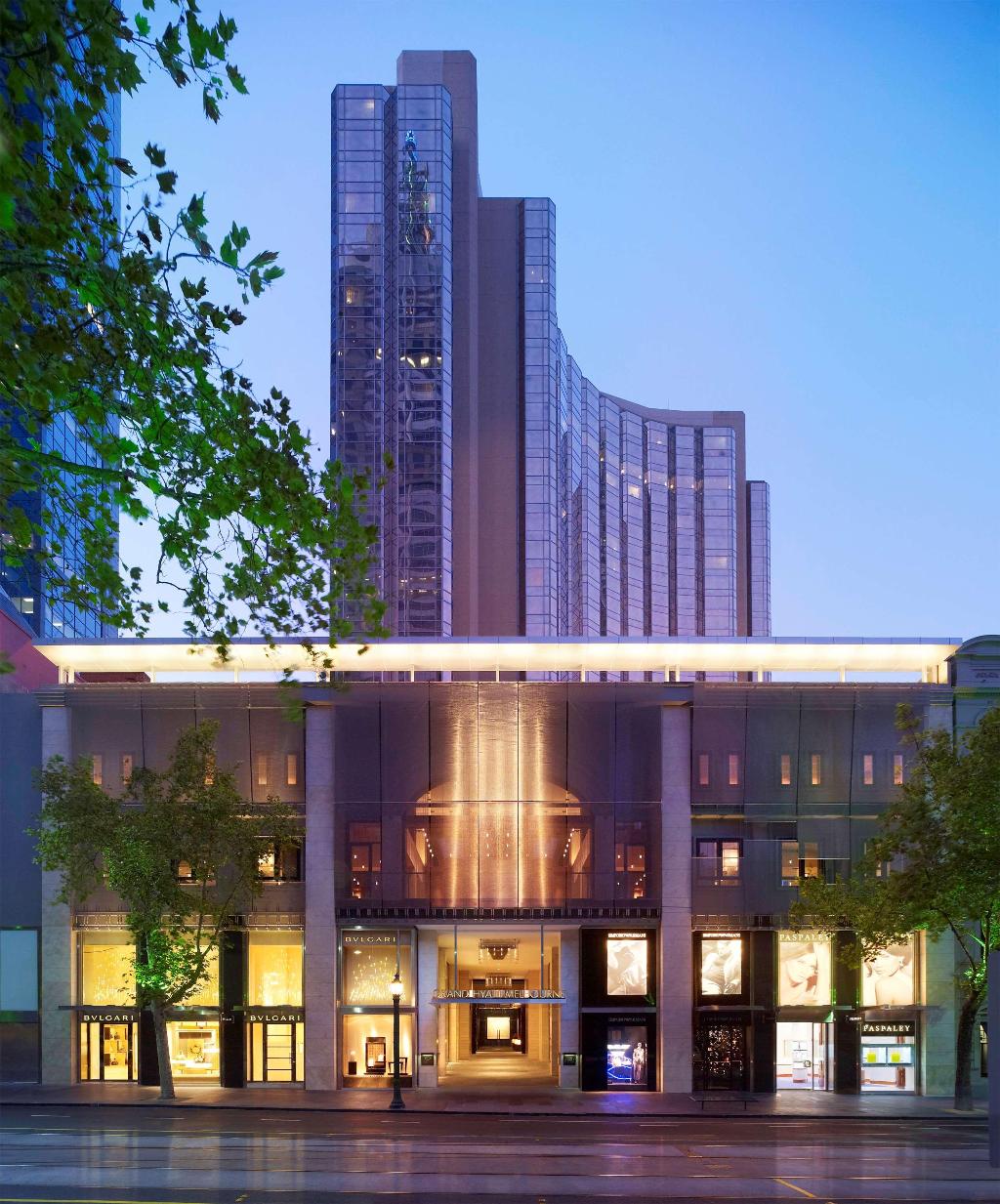
Grand Hyatt Melbourne
Melbourne
Spa · Pool · Parking
From £176 a night, taxes incl.2 adults · checked 14 Nov, 17:07

★★★★
Alto Hotel on Bourke
Melbourne
Spa · Pool · 50 rooms
From £92 a night, taxes incl.2 adults · checked 14 Nov, 17:07

★★★★
Amora Herencia Riverwalk Malbourne
Richmond
Parking
From £110 a night, taxes incl.2 adults · checked 14 Nov, 17:07

★★★★★
The Langham Hotel, Melbourne
Melbourne
Spa · Pool · Parking
From £200 a night, taxes incl.2 adults · checked 14 Nov, 17:07

★★★★
Batman's Hill on Collins
Melbourne
Parking
From £81 a night, taxes incl.2 adults · checked 14 Nov, 17:07

★★★★★
1 Hotel Melbourne
Docklands
Spa · Pool · Family-friendly
From £191 a night, taxes incl.2 adults · checked 14 Nov, 17:07
Getting around
Trams are the way to travel, and they are free within the city-centre zone. Beyond it you need a myki card, which also covers trains and buses. The centre is flat and walkable, and trams run straight to St Kilda, Fitzroy and Carlton.
When to go
Melbourne is famous for four seasons in one day, so pack layers whenever you come. Summer, from December to February, is warm to hot; autumn and spring are mild and pleasant. January brings the Australian Open tennis, and winter is football season.
Questions about visiting Melbourne
- What is Melbourne best known for?
- Coffee and food, laneways full of street art, trams, live sport at the MCG, the Australian Open, and its arts and music scene. It is also the gateway to the Great Ocean Road.
- How many days do you need in Melbourne?
- Three days covers the city centre, the markets, a gallery or two and St Kilda. Add one or two more for day trips to the Great Ocean Road, Phillip Island or the Yarra Valley.
- What is there to do in Melbourne with kids?
- Melbourne Museum, Luna Park and the beach at St Kilda, the Royal Botanic Gardens, a tram ride and the penguins on Phillip Island are all good with children.
- Do you need a car in Melbourne?
- Not in the city, where trams, trains and walking cover everything. A car or a coach tour is useful for the Great Ocean Road, Phillip Island and the Yarra Valley.
More guides
- Where to stay in Melbourne
- The best things to do in London
- The best things to do in Edinburgh
- The best things to do in Manchester
- The best things to do in York
- The best things to do in Amsterdam
- The best things to do in Birmingham
- The best things to do in Liverpool
- The best things to do in Bristol
- The best things to do in Barcelona
- The best things to do in Budapest
- The best things to do in Cambridge
- The best things to do in Dublin
- The best things to do in Krakow