
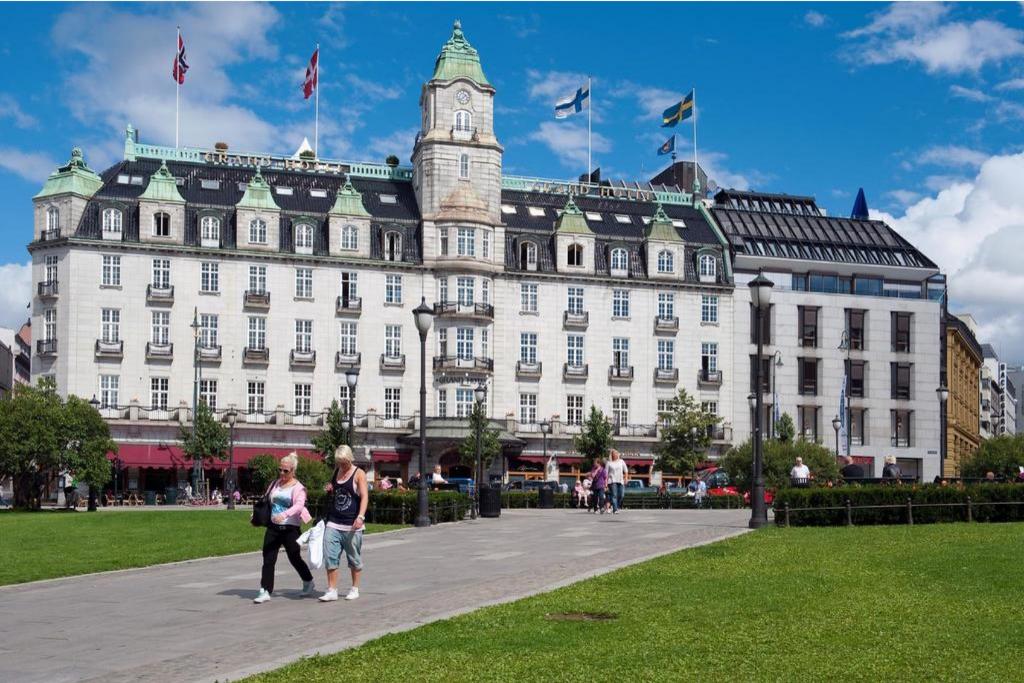
Oslo sits at the head of a fjord with forest at its back, and nature is never far from the conversation. People here swim in the harbour before work, ski after it, and think nothing of taking the metro to a lake. In between, they have quietly built one of the most exciting waterfronts in Europe.
A decade or two ago the Norwegian capital was a stopover on the way to the mountains. Now it has an opera house you can walk on, a tower block full of Munch and a national museum to match any on the continent. It is compact, calm and easy to like. Bring a swimming costume, whatever the season.
Don't miss
The big sights
A walk-on opera house, a park of granite figures and a fortress above the harbour.
Oslo Opera House
Landmark

Photo: kallerna, CC BY-SA 4.0 A building that looks like an iceberg sliding into the fjord. The white marble roof slopes right down to the water's edge, and the whole point is that you walk up it, all the way to the top, for views over the harbour and the new skyline of Bjørvika. Nobody minds if you have no intention of seeing an opera.
Inside, a wave of pale oak curves around the auditorium. On warm evenings the roof becomes the city's favourite place to sit and watch the light fade.
Tip: Wear shoes with grip: the marble can be slippery when wet or icy.
Vigeland Sculpture Park
Landmark

Photo: Christian David, CC BY-SA 4.0 Inside Frogner Park, in the west of the city, stand more than two hundred sculptures in bronze, granite and iron, all by one man, Gustav Vigeland. They show human life from cradle to grave: lovers, wrestling children, old couples, and one famously furious toddler stamping his foot. At the centre rises the Monolith, a column of intertwined bodies carved from a single block of stone.
It is strange, moving and occasionally funny, and it is open to all as a public park.
Akershus Fortress
Landmark

Photo: Pudelek (Marcin Szala), CC BY-SA 4.0 A medieval castle and fortress on a headland above the harbour, begun around 1300 to guard the city. Its ramparts are now a public park, patrolled by royal guardsmen and popular with strollers for the views over the fjord and Aker Brygge. Inside the walls are the old castle, a chapel and museums of Norway's wartime history.
Tip: Walk the ramparts in the evening, when cruise ships and ferries are sliding out down the fjord.
The Royal Palace and Karl Johans gate
Landmark

Photo: Beata May, CC BY-SA 4.0 Karl Johans gate is Oslo's main street, running in a straight line from the Central Station past the cathedral, the Parliament and the National Theatre, then uphill to the Royal Palace. The palace stands in an open park that anyone can wander through, and the royal guard changes daily in front of it. On Norway's national day in May, the whole street fills with children's parades.
Museums
Oslo's museums punch well above the city's size.
MUNCH
Museum

Photo: Asav, CC BY-SA 4.0 A tall, leaning tower on the Bjørvika waterfront, opened in 2021 and devoted to Edvard Munch, Norway's most famous artist. It holds the huge collection he left to the city, including versions of The Scream, alongside monumental canvases that needed a building this size to be shown at all. The upper floors have fine views over the fjord, and there is a bar on the roof.
The National Museum
Museum
Opened in 2022 by the harbour, this is the largest art museum in the Nordic countries, bringing art, design and architecture together in one sober stone building. The Munch room, with the best-known painted version of The Scream, draws the crowds, but there is a great deal more: Norwegian landscapes, royal gowns, furniture, glass and modern design. Give it half a day.
Fram Museum
Museum

Photo: Palickap, CC BY-SA 4.0 On the Bygdøy peninsula, this museum is built around the Fram, the wooden ship that carried Fridtjof Nansen and Roald Amundsen on their polar expeditions. You can climb aboard, walk the deck and go below to see the cabins where the crews spent years in the ice. It is a gripping story, well told, and it wins over people with no interest in boats.
Tip: In the warmer months a small ferry runs to Bygdøy from the quay by City Hall, which beats the bus.
Norsk Folkemuseum
Museum

Photo: Richard Mortel from Riyadh, Saudi Arabia, CC BY 2.0 Also on Bygdøy, Norway's open-air museum gathers historic buildings from every corner of the country: turf-roofed farmhouses, timber storehouses on stilts, and a whole old town quarter. The star is the Gol stave church, a dark wooden medieval church with dragon heads on its tiered roofs. In summer, costumed staff bake flatbread and demonstrate old crafts.
Neighbourhoods and food
Aker Brygge and Tjuvholmen
Neighbourhood

Photo: Geir Hval (www.MacWhale.eu), CC BY-SA 4.0 The old shipyard west of City Hall is now a waterfront of restaurants, bars and boardwalks, and the place Oslo heads on a sunny evening. Keep walking and you reach Tjuvholmen, a sleek modern district with a sculpture park, a tiny city beach and the Astrup Fearnley Museum of contemporary art, under a sail-like glass roof designed by Renzo Piano.
Grünerløkka
Neighbourhood

Photo: Helge Høifødt, CC BY-SA 3.0 Oslo's creative quarter, on the east bank of the Akerselva river. Former workers' housing and factories have filled up with coffee roasters, vintage shops, bars and small restaurants, and the squares are busy late into the evening. A footpath follows the river past waterfalls and old mill buildings, a surprisingly green walk right through the middle of town.
Mathallen
Market

Photo: Helge Høifødt, CC BY-SA 3.0 A food hall in an old brick industrial building at Vulkan, beside the river on the edge of Grünerløkka. Stalls and small restaurants sell Norwegian cheese, cured meats, seafood and baking, alongside food from around the world. It is a good place to try local specialities, from brown cheese to fresh shellfish, without committing to a formal dinner.
The fjord and the forest
The real luxury of Oslo: wild places at the end of a metro or ferry line.
The Oslofjord islands
Nature
A scatter of small islands lies just off the city, served by public ferries from the harbour near City Hall. Hovedøya, the closest, has the ruins of a medieval monastery, woodland paths and bathing spots. Others have brightly painted summer cabins and sheltered beaches. On a fine day, taking a picnic out to the islands is the most Norwegian thing you can do.
Fjord saunas
Activity

Photo: Frank Schulenburg, CC BY-SA 4.0 Floating saunas are moored along Oslo's harbour, and the routine is simple: heat up in a wood-fired cabin, then jump straight into the fjord. Repeat until glowing. Locals do it all year, and it is most memorable in winter, when steam rises off your shoulders and the water is seriously cold. The saunas near the Opera House have the best views.
Tip: Sessions are usually booked in advance, especially at weekends.
Holmenkollen
Landmark

Photo: Qwesy, CC BY 3.0 The great ski jump on the hill above the city is an Oslo landmark, a swoop of steel visible from all over town. A ski museum sits beneath it, and a lift takes you to the top of the tower for a vertiginous view down the jump and out across the fjord. The metro ride up, climbing through the forest suburbs, is part of the outing.
Nordmarka and Sognsvann
Nature
The forest that wraps around the north of Oslo is called Nordmarka, and it begins where the metro ends. Sognsvann, a lake at the terminus of one line, has an easy path around the shore, popular for walks, runs and summer swims. In winter the same trails become cross-country ski tracks, floodlit for the dark afternoons.
Where to stay in Oslo
Not sure which area suits you? Read our guide: Where to stay in Oslo →

★★★★
Amerikalinjen
Oslo
Parking
From £303 a night, taxes incl.2 adults · checked 14 Nov, 11:22

★★★★
Home Hotel Gabelshus
Oslo
Pets allowed · Parking
From £132 a night, taxes incl.2 adults · checked 14 Nov, 05:07

★★★★★
Grand Hotel Oslo by Scandic
Oslo
Spa · Parking
From £281 a night, taxes incl.2 adults · checked 14 Nov, 05:07

★★★★
Scandic Vulkan
Oslo
From £138 a night, taxes incl.2 adults · checked 14 Nov, 11:22

★★★★
Lysebu
Oslo
Pool · Pets allowed · Parking
From £167 a night, taxes incl.2 adults · checked 14 Nov, 05:07

★★★★★
Hotel Bristol
Oslo
Parking
From £232 a night, taxes incl.2 adults · checked 14 Nov, 11:22

★★★★
Clarion Hotel Oslo
Oslo
From £205 a night, taxes incl.2 adults · checked 14 Nov, 05:07

★★★★★
Hotel Continental Oslo
Oslo
Parking
From £365 a night, taxes incl.2 adults · checked 14 Nov, 11:22
Getting around
The centre is small enough to walk, and a harbour promenade links the Opera House, Akershus and Aker Brygge. Trams, buses, the metro and the island ferries all use the same tickets. The metro climbs right up to Holmenkollen and the forest lakes. Almost everywhere takes cards, and you do not need a car.
When to go
Summer brings long, light days, swimming in the fjord and life on the waterfront. Winter is cold and snowy, with short days, and turns the hills above the city into ski country. Spring and autumn are quieter. Whenever you come, pack layers: the weather changes quickly.
Questions about visiting Oslo
- What is Oslo best known for?
- The Opera House and its walk-on roof, the Vigeland sculptures, Edvard Munch and The Scream, polar exploration and the Nobel Peace Prize, all set between the Oslofjord and forested hills.
- How many days do you need in Oslo?
- Two days cover the waterfront, the Opera House, a couple of museums and Vigeland Park. A third lets you add the Bygdøy museums, Holmenkollen or a ferry out to the islands.
- What is there to do in Oslo with kids?
- Climbing the Opera House roof, exploring the ship at the Fram Museum, the open-air Norsk Folkemuseum, the sculptures in Vigeland Park and a ferry trip to the islands are all popular with families.
- Is Oslo worth visiting?
- Yes. It has striking modern architecture, excellent museums and a rare mix of city and nature, with swimming, saunas, islands and forest all within easy reach of the centre.
- Do you need a car in Oslo?
- No. The city is compact and public transport, including the ferries and the metro up to Holmenkollen, reaches everything in this guide.
More guides
- Where to stay in Oslo
- The best things to do in London
- The best things to do in Edinburgh
- The best things to do in Manchester
- The best things to do in York
- The best things to do in Amsterdam
- The best things to do in Birmingham
- The best things to do in Liverpool
- The best things to do in Bristol
- The best things to do in Barcelona
- The best things to do in Budapest
- The best things to do in Cambridge
- The best things to do in Dublin
- The best things to do in Krakow