
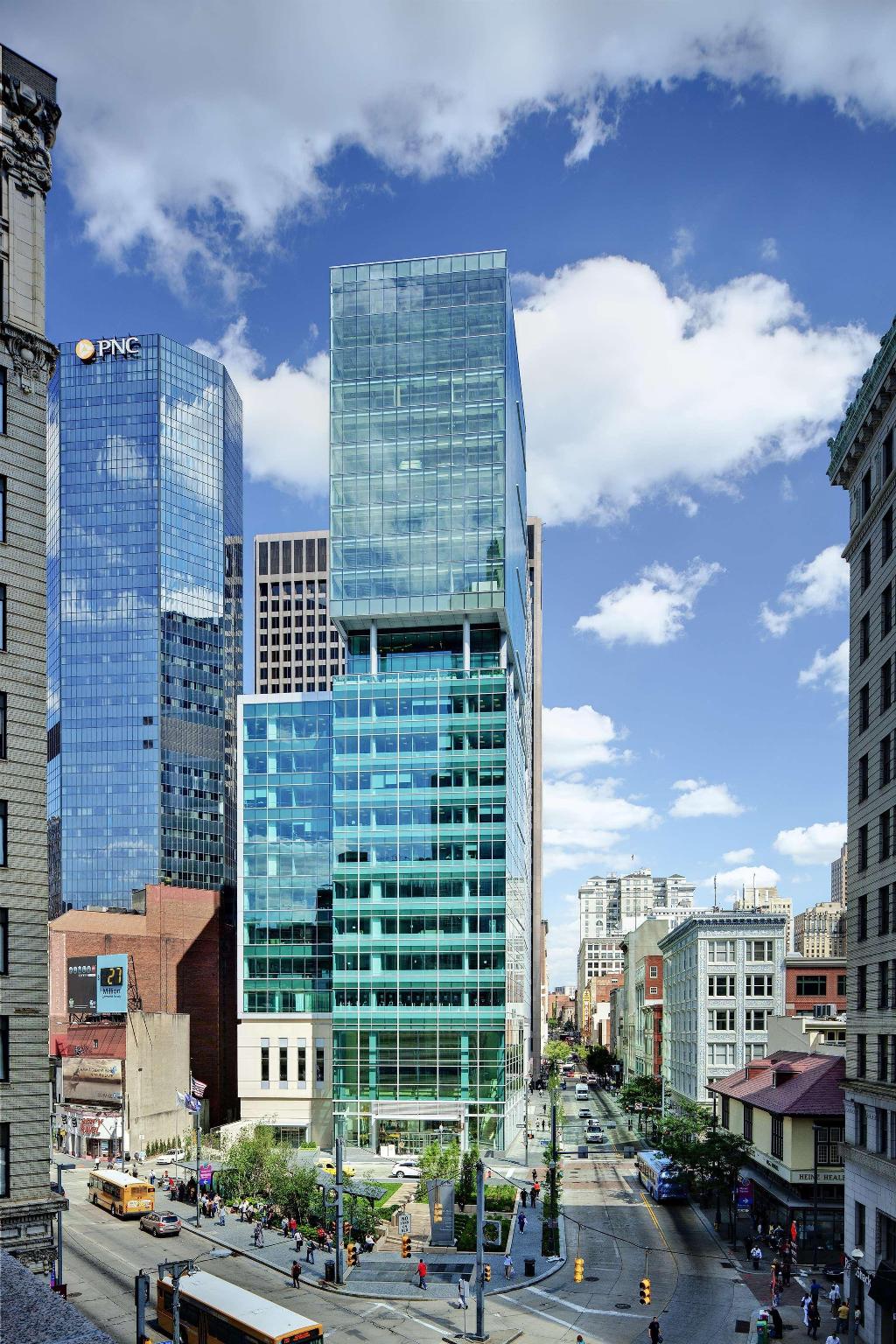
Pittsburgh is the best-looking surprise in the American north-east. Three rivers meet at a point of land crowded with towers, yellow bridges fan out in every direction, and wooded hills rise so steeply behind them that the city still runs cable railways up the slope. Arrive through the Fort Pitt Tunnel and the whole skyline appears at once, like a curtain going up.
The steel mills that built the place are gone, and the money they made has turned into museums, universities and a food scene with real swagger. It is a city of proud, distinct neighbourhoods, sports obsessives and sandwiches with the chips inside. Give it a long weekend and it will win you over.
Don't miss
The big sights
Start with the view, then work your way down to the water.
Duquesne Incline
Landmark

Photo: Dllu, CC BY-SA 4.0 Since the 1870s a pair of wooden cable cars has been hauling Pittsburghers up the face of Mount Washington, and riding one is still the best few minutes you can spend in the city. The cars creak, the hillside drops away, and the rivers and bridges spread out below.
At the top there is a viewing platform and a row of restaurants along Grandview Avenue, all facing the same astonishing panorama of the skyline. A second funicular, the Monongahela Incline, climbs the hill further along.
Tip: Go up before dusk and stay until the lights come on downtown.
Point State Park
Landmark

Photo: Roy Luck, CC BY 2.0 The very tip of downtown, where the Allegheny and Monongahela rivers join to form the Ohio, is a green wedge of lawns ending in a great fountain. This is where the city began, as a fort fought over by the French and the British, and a small museum and an eighteenth-century blockhouse tell that story.
Mostly, though, people come to sit by the water, watch the boats and look back at the towers. Riverside paths lead off in both directions for walkers and cyclists.
Cathedral of Learning
Landmark

Photo: Dllu, CC BY-SA 4.0 The University of Pittsburgh's centrepiece is a 42-storey Gothic skyscraper that looks like a cathedral stretched towards the clouds. Inside, the vaulted ground-floor hall is pure Hogwarts, full of students bent over laptops under stone arches.
Around it are the Nationality Rooms, working classrooms each designed in the style of a different country whose people settled in Pittsburgh, from a Polish Renaissance chamber to a Chinese hall. It is one of the oddest and most charming things in the city.
PNC Park
Landmark

Photo: David Brossard, CC BY-SA 2.0 Even people bored by baseball concede that the Pittsburgh Pirates play in one of the most beautiful ballparks in America. It sits on the North Shore of the Allegheny with the outfield open to the river, so the downtown skyline and the yellow Roberto Clemente Bridge become the backdrop to the game.
On match days the bridge closes to traffic and fans stroll across from downtown. Join them: an evening here, with a beer and a hot dog, is Pittsburgh at its most likeable.
Museums and gardens
The Andy Warhol Museum
Museum

Photo: Popscreenshot, CC BY-SA 4.0 Warhol was a Pittsburgh boy, the son of immigrants from eastern Europe, and his home town has given him seven floors on the North Shore, one of the largest museums in North America devoted to a single artist. You work down from the top, from childhood drawings to the soup cans, the celebrity portraits and the films.
It is more fun than most art museums, with a room of floating silver balloons to bat about and a booth where you can film your own screen test.
Carnegie Museums of Art and Natural History
Museum

Photo: Sage Ross, CC BY-SA 3.0 Andrew Carnegie made his steel fortune in Pittsburgh and gave the city two museums under one grand roof in Oakland. The natural history side is famous for its dinosaurs, a hall of real skeletons that includes some of the best-known specimens in the world.
Walk through a doorway and you are in the art museum, strong on Impressionists, American painting and architecture, with a huge hall of plaster casts of the great buildings of Europe.
Heinz History Center
Museum
A converted warehouse in the Strip District holds the story of western Pennsylvania, told with a light touch. There are floors on the steel industry, the city's sports teams and the Heinz company (ketchup is practically a civic religion here), along with the original set and puppets from the children's television programme Mister Rogers' Neighborhood, which was made in Pittsburgh.
Phipps Conservatory and Botanical Gardens
Nature

Photo: Dllu, CC BY-SA 4.0 A great Victorian glasshouse on the edge of Schenley Park, built in the 1890s and filled room after room with palms, orchids, ferns, desert plants and seasonal flower shows. It is warm, green and fragrant on even the greyest winter day, and glass sculptures are tucked among the leaves.
The park outside is good for a walk afterwards, with trails, a lake and views back to the Cathedral of Learning.
Neighbourhoods to wander
The Strip District
Market

Photo: Cbaile19, CC0 A narrow strip of old warehouses along the Allegheny, just north-east of downtown, is where Pittsburgh shops for food. Italian grocers, fishmongers, Polish delis, spice merchants, coffee roasters and street vendors selling team shirts crowd along Penn Avenue, and the pavements are jammed on Saturday mornings.
Come hungry and graze: biscotti here, pierogies there, a sandwich to finish. It is the most enjoyable breakfast walk in the city.
Tip: Saturday morning is the liveliest time. Arrive early if you want to park or move freely.
Lawrenceville
Neighbourhood

Photo: Pittsburghthreerivers, CC BY-SA 4.0 Follow the river a little further and you reach Lawrenceville, an old working-class district of brick terraces that has become the city's creative quarter. Butler Street, its long main road, is lined with independent shops, record stores, breweries, cocktail bars and some of the most talked-about restaurants in Pittsburgh.
It suits an afternoon of browsing that slides into dinner.
South Side
Nightlife
Across the Monongahela, East Carson Street runs for block after block of Victorian shopfronts, and almost every one of them seems to be a bar, a music venue or a late-night food counter. This is where students and football fans go out, loudly, at weekends.
By day it is calmer, with vintage shops and cafés, and the hillside steps behind climb to fine views over the river.
Eat and drink
The Pittsburgh sandwich
Food

Photo: Andre Charland, CC BY 2.0 The city's signature dish is a sandwich with the side orders inside it: grilled meat and melted cheese piled between thick slices of Italian bread with a fistful of chips and a scoop of vinegary coleslaw. It was made famous by Primanti Bros., which started out feeding lorry drivers in the Strip District and now has branches all over town.
It is messy, filling and oddly brilliant. Use both hands.
Pierogies
Food
Generations of Polish, Slovak and Ukrainian families came to work in the mills, and they brought their dumplings with them. Pierogies, stuffed with potato and cheese and fried in butter with onions, are now so much a part of Pittsburgh that people dressed as giant ones race around the field at Pirates games.
Look for them in church halls, delis in the Strip and on bar menus across the city.
Days out
Fallingwater
Day trip

Photo: Carol M. Highsmith, Public domain In the wooded Laurel Highlands, about seventy miles south-east of the city, Frank Lloyd Wright built a house directly over a waterfall. Its concrete terraces hang out above the stream as if they were part of the rock, and the sound of water follows you through every room.
It is among the most famous houses of the twentieth century and part of a UNESCO World Heritage listing of Wright's work. Guided tours take you inside; the classic view is from the path below.
Tip: Tours have limited places and must be booked ahead, especially in autumn.
Kennywood
Activity

Photo: Roller Coaster Philosophy, CC BY 2.0 A few miles up the Monongahela, Kennywood has been thrilling Pittsburgh families for well over a century and is a National Historic Landmark as a result. Its trio of vintage wooden roller coasters still rattle through the ravine, alongside modern steel monsters and old-fashioned rides you thought had disappeared.
It has more charm than most theme parks and plenty for younger children.
Where to stay in Pittsburgh
Not sure which area suits you? Read our guide: Where to stay in Pittsburgh →
★★★★
The Atterbury Hotel, Autograph Collection
Pittsburgh
Spa · Pets allowed · Parking
See prices and rooms →

★★★★
Autograph Collection The Oaklander Hotel
Pittsburgh
Parking
See prices and rooms →

★★★★★
Fairmont Pittsburgh
Pittsburgh
Spa · Pets allowed · Parking
See prices and rooms →

★★★★
The Inn On Negley
Pittsburgh
Adults only · 8 rooms · Parking
See prices and rooms →
★★★★
Pittsburgh Airport Marriott
Coraopolis
Pool · Parking
See prices and rooms →

★★★★
DoubleTree by Hilton Hotel Pittsburgh Airport
Moon Township
Spa · Pool · Parking
See prices and rooms →

★★★★
Doubletree By Hilton Pittsburgh - Cranberry
Mars
Pool · Pets allowed · Parking
See prices and rooms →

★★★★
DoubleTree by Hilton Pittsburgh-Green Tree
Pittsburgh
Pool · Parking
See prices and rooms →
Getting around
Downtown, the Strip District and the North Shore are close enough to walk between, with bridges for pedestrians across the rivers. A small light rail system, known as the T, links downtown with the North Shore and the southern suburbs, and buses run out to Oakland. Hire a car for Fallingwater.
When to go
Late spring to early autumn is the best time, warm enough for ball games, riverside walks and beer gardens. Autumn brings fine colour to the surrounding hills. Winters are cold, grey and often snowy, though the museums make that easy to bear.
Questions about visiting Pittsburgh
- What is Pittsburgh best known for?
- Steel, bridges and sport. The city grew rich on its steel mills, sits at the meeting of three rivers crossed by hundreds of bridges, and is devoted to its Steelers, Pirates and Penguins. It is also the birthplace of Andy Warhol.
- Is Pittsburgh worth visiting?
- Yes. It has a striking setting, excellent museums including the Andy Warhol Museum and the Carnegie Museums, lively neighbourhoods such as the Strip District and Lawrenceville, and Fallingwater within a day trip.
- What is there to do in Pittsburgh with kids?
- The dinosaurs at the Carnegie Museum of Natural History, a ride on the Duquesne Incline, Kennywood amusement park and the Mister Rogers' Neighborhood exhibits at the Heinz History Center are all good family choices.
- How many days do you need in Pittsburgh?
- Two to three days is enough for the main sights and a couple of neighbourhoods. Add a day if you want to visit Fallingwater.
- Do you need a car in Pittsburgh?
- Not in the centre: downtown, the North Shore and the Strip District are walkable, and buses and the light rail cover most other areas. A car is useful for Fallingwater and the countryside.
More guides
- Where to stay in Pittsburgh
- The best things to do in London
- The best things to do in Edinburgh
- The best things to do in Manchester
- The best things to do in York
- The best things to do in Amsterdam
- The best things to do in Birmingham
- The best things to do in Liverpool
- The best things to do in Bristol
- The best things to do in Barcelona
- The best things to do in Budapest
- The best things to do in Cambridge
- The best things to do in Dublin
- The best things to do in Krakow