
San Antonio is the most romantic city in Texas, and the oldest-feeling. It grew up around Spanish missions three centuries ago, and its Mexican heart beats loudly still, in the mariachi bands, the paper flags strung across the markets and the smell of fresh tortillas. Through the middle of it all winds a river, sunk a storey below the streets and lined with cypress trees, stone bridges and café tables.
Everyone knows one thing about the place: remember the Alamo. The little limestone church where Texan defenders fell in 1836 is the state's most visited landmark. But the pleasure of San Antonio is in what surrounds it, from four more missions strung along the river to a brewery turned food district. It is easy, walkable and tremendous fun.
Don't miss
The big sights
A shrine, a river and a chain of 18th-century missions.
The Alamo
Landmark

Photo: KelliMays, CC BY-SA 4.0 Smaller than you expect, and right in the middle of Downtown. The Alamo began as a Spanish mission in the 18th century, but its fame rests on thirteen days in 1836, when a small band of Texan defenders, Davy Crockett and Jim Bowie among them, held out against the Mexican army before being overwhelmed. Their defeat became the rallying cry of the Texas Revolution.
The weathered church facade is the icon. Step inside, then walk the gardens and exhibits to make sense of the siege.
Tip: Entry to the church is by timed reservation. Book a slot in advance, and come early in the day, before the heat and the crowds.
The River Walk
Landmark

Photo: 3steph14, CC BY-SA 4.0 The idea is simple and brilliant: a loop of the San Antonio River, a level below the traffic, turned into miles of stone paths shaded by towering cypress trees. Restaurants and bars set their tables at the water's edge under bright umbrellas, arched footbridges cross overhead and flat-bottomed tour boats drift past with guides telling stories.
The busy Downtown loop is the famous part. Walk north or south and it grows quieter, greener and more local, with public art under the bridges.
Tip: Come back after dark, when the lights are strung through the trees. Around Christmas the whole river glows.
San Antonio Missions National Historical Park
Landmark

Photo: Chris Light, CC BY-SA 4.0 The Alamo was one of five missions founded by Spanish friars along the river. The other four, Concepción, San José, San Juan and Espada, lie to the south and together with it form a UNESCO World Heritage Site. They are still parish churches, with thick stone walls, carved doorways and traces of old frescoes.
San José, the largest and most fully restored, is the one to see if time is short. Its fortified compound and ornate rose window show what mission life was like.
Tip: A riverside trail links the missions. Hiring a bike and riding between them is a lovely way to spend a morning.
San Fernando Cathedral
Landmark
Founded by settlers from the Canary Islands in the 1730s, this is one of the oldest cathedrals in the United States, and it still stands at the centre of the city on Main Plaza. The Gothic Revival front is a later addition; the older sanctuary lies behind it. On some evenings a sound-and-light projection tells the story of San Antonio across the facade.
Tower of the Americas
Landmark
The slender concrete tower that rises over Hemisfair park was built for the 1968 World's Fair and remains the tallest viewpoint in the city. A glass lift on the outside carries you up to an observation deck and a revolving restaurant, with the flat city spread below and the first folds of the Hill Country to the north-west. Sunset is the time to go.
Neighbourhoods and markets
The Pearl
Neighbourhood

Photo: Brownings, CC BY-SA 3.0 A 19th-century brewery on the northern stretch of the River Walk has been turned, with real care, into the most enjoyable district in the city. Around the towering old brewhouse are restaurants, a food hall, bakeries, bookshops and a campus of the Culinary Institute of America, all set around lawns and fountains. A farmers' market fills the squares at weekends.
Tip: Walk here from Downtown along the river, or take a river taxi. The stretch in between passes the San Antonio Museum of Art.
Historic Market Square
Market

Photo: Michael Barera, CC BY-SA 4.0 Three blocks of colour on the west side of Downtown, billed as the largest Mexican market in the United States. Stalls sell embroidered dresses, leather boots, painted pottery, piñatas and sweets, paper flags flutter overhead and mariachi bands stroll between the restaurant tables. It is touristy, cheerful and at its best during one of the frequent weekend festivals.
La Villita
Neighbourhood
On the south bank of the River Walk, this was one of San Antonio's first neighbourhoods. Its cluster of small adobe and limestone houses, some dating from the early 19th century, is now a village of artists' studios, craft shops and galleries set around quiet courtyards. It makes a calm, shady detour from the busy riverside below.
King William Historic District
Neighbourhood

Photo: Carol M. Highsmith, Public domain Just south of Downtown, wealthy German merchants built themselves grand houses along the river in the late 19th century, and their street of turrets, porches and deep gardens survives almost intact. Stroll it under the pecan trees, then carry on into Southtown, the neighbouring arts district, for galleries, coffee and some of the best restaurants in the city.
Museums and gardens
McNay Art Museum
Museum

Photo: Michael Barera, CC BY-SA 4.0 The first museum of modern art in Texas occupies a Spanish Colonial Revival mansion on a hill north of the centre, built around a tiled courtyard with a fountain and palms. The collection, begun by the artist and heiress Marion Koogler McNay, runs from Gauguin, Van Gogh and Picasso to contemporary work. The house and gardens are as much of a pleasure as the paintings.
San Antonio Museum of Art
Museum
Housed in the castle-like former Lone Star Brewery on the banks of the river, this museum has a broad sweep, with notably strong collections of Latin American art, from pre-Columbian to folk and modern, and of Asian and ancient Mediterranean works. The setting, with towers joined by a glass bridge, is half the appeal, and it sits handily on the riverside path to the Pearl.
Japanese Tea Garden
Nature

Photo: Corey Leopold, CC BY 2.0 In Brackenridge Park, an abandoned limestone quarry was transformed in the early 20th century into a sunken garden of lily ponds, stone bridges, winding paths and a tall waterfall, watched over by a thatched pavilion. Koi glide through the water below. It is a peaceful spot, and a short walk from the zoo and the Witte Museum.
Eat and drink
Tex-Mex and puffy tacos
Food

Photo: y6y6y6, CC BY 2.0 San Antonio is the home of Tex-Mex, and it shows on every menu. The local speciality is the puffy taco: a disc of fresh corn dough dropped into hot oil until it balloons into a crisp, airy shell, then filled with spiced beef or chicken, lettuce and tomato. Eat it fast, before it collapses. Mornings begin with breakfast tacos; evenings with enchiladas and a margarita by the river.
Days out
Natural Bridge Caverns
Nature

Photo: Larry D. Moore, CC BY 4.0 North of the city, beneath the rolling ranchland, lies the largest known cave system in Texas open to visitors. Guided tours descend into enormous chambers hung with stalactites and studded with columns and flowstone, all still slowly growing. The caverns stay at a steady, humid warmth year-round. Above ground there are zip lines and a maze for children.
Six Flags Fiesta Texas
Activity
A theme park built inside a disused limestone quarry on the north-west edge of the city, its rollercoasters swooping off the top of the cliff walls. There are big thrill rides for teenagers, gentler ones for small children and a water park for the hot months. The quarry setting makes it more dramatic than most.
Fredericksburg
Day trip

Photo: Michael Barera, CC BY-SA 4.0 German settlers founded this Hill Country town in the 1840s, and the wide main street still has beer gardens, bakeries and limestone houses among the boutiques and antique shops. The road in is lined with wineries and, in summer, stalls selling local peaches. The National Museum of the Pacific War is here too, in the home town of Admiral Nimitz.
Gruene and New Braunfels
Day trip

Photo: Michael Barera, CC BY-SA 4.0 Between San Antonio and Austin, the tiny riverside settlement of Gruene is home to Gruene Hall, the oldest dance hall in Texas, where country stars have played on a bare wooden stage since the 19th century. Next door, in New Braunfels, the summer ritual is tubing: floating down the cool, clear Comal or Guadalupe river on a rubber ring.
Where to stay in San Antonio
Not sure which area suits you? Read our guide: Where to stay in San Antonio →

★★★★
Mokara Hotel And Spa
San Antonio
Spa · Pool · Parking
From £301 a night, taxes incl.2 adults · checked 14 Nov, 19:52

★★★★
Albert Hotel
Fredericksburg
Spa · Parking
From £267 a night, taxes incl.2 adults · checked 14 Nov, 19:52

★★★★★
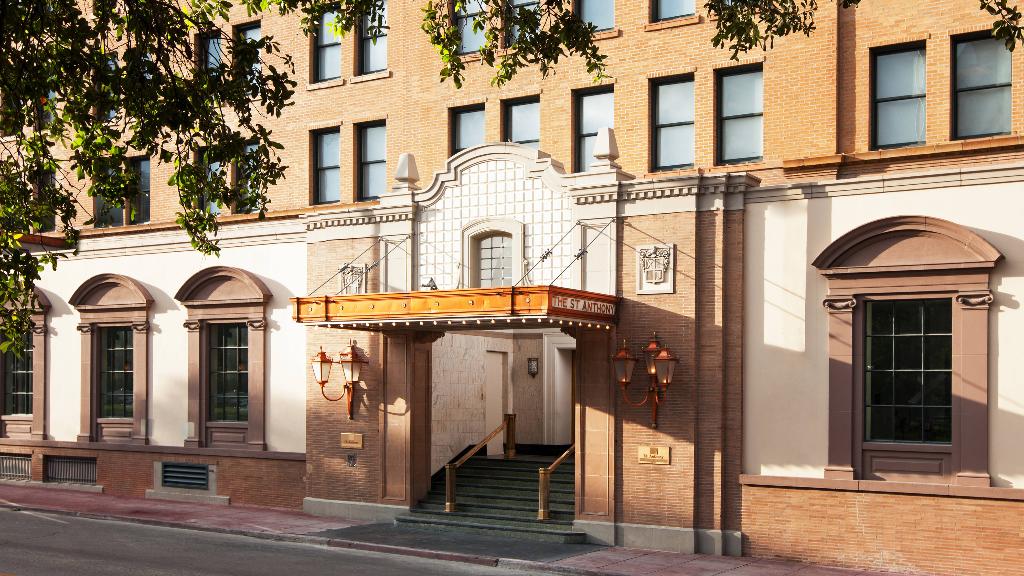
The St. Anthony,A Luxury Collection Hotel
San Antonio
Spa · Pool · Parking
From £182 a night, taxes incl.2 adults · checked 14 Nov, 19:52

★★★★
Canopy by Hilton San Antonio Riverwalk
San Antonio
Pets allowed · Parking
From £177 a night, taxes incl.2 adults · checked 14 Nov, 19:52

★★★★
Doubletree By Hilton San Antonio Airport
San Antonio
Pool · Parking
From £87 a night, taxes incl.2 adults · checked 14 Nov, 19:52

★★★★★
Grand Hyatt San Antonio
San Antonio
Pool · Parking
From £178 a night, taxes incl.2 adults · checked 14 Nov, 19:52

★★★★
DoubleTree by Hilton San Antonio Northwest
San Antonio
Pool · Parking
From £129 a night, taxes incl.2 adults · checked 14 Nov, 19:52

★★★★★
Hotel Emma
San Antonio
Pool · Parking
See prices and rooms →
Getting around
Downtown is compact, and the River Walk makes a pleasant traffic-free route between the Alamo, La Villita, Market Square and, further on, the Pearl. River taxis and buses fill the gaps. A hire car is useful for the outer missions if you don't fancy cycling, and essential for the caverns, the theme parks and the Hill Country.
When to go
Spring and autumn are the best times, warm and sunny. April brings Fiesta, a citywide party of parades and music. Summers are very hot, though the River Walk is shaded and the rivers nearby are made for cooling off. Winters are mild, and the river is hung with lights for Christmas.
Questions about visiting San Antonio
- What is San Antonio best known for?
- The Alamo and the 1836 battle fought there, the River Walk, its Spanish colonial missions (a UNESCO World Heritage Site), a strong Mexican-American culture and Tex-Mex food.
- Is San Antonio worth visiting?
- Yes. It is one of the most atmospheric and walkable cities in Texas, with real history, a beautiful riverside and excellent food. It suits couples and families equally.
- What is there to do in San Antonio with kids?
- A boat ride on the River Walk, the Alamo, the Tower of the Americas, Natural Bridge Caverns, Six Flags Fiesta Texas and tubing on the rivers at New Braunfels in summer.
- How many days do you need in San Antonio?
- Two to three days is enough for the Alamo, the River Walk, the missions and the Pearl. Add another for a Hill Country day trip to Fredericksburg or Gruene.
- Do you need a car in San Antonio?
- Not for Downtown, the River Walk or the Pearl. You will want one for the theme parks, the caverns and the Hill Country.
More guides
- Where to stay in San Antonio
- The best things to do in London
- The best things to do in Edinburgh
- The best things to do in Manchester
- The best things to do in York
- The best things to do in Amsterdam
- The best things to do in Birmingham
- The best things to do in Liverpool
- The best things to do in Bristol
- The best things to do in Barcelona
- The best things to do in Budapest
- The best things to do in Cambridge
- The best things to do in Dublin
- The best things to do in Krakow